Be Bop Wino Pages

Joan Selects - the complete Joan Selects Collection

Big Ten Inchers - 78rpm rips by El Enmascarado


Attention Mac Users!

Mac users have been experiencing problems in unpacking the WinRAR archives used on this blog. Two solutions have been suggested.

1. Use The Unarchiver - www.theunarchiver.com - see comments on Little Esther Bad Baad Girl post for details.

2. Use Keka - http://www.kekaosx.com/en/ - see comments on Johnny Otis Presents post.

Sunday, 29 May 2011

Sing Re-Bop – Doles Dickens Quartet


Scan courtesy El Enmascarado
Recorded in New York City, 1946. Herbie Scott (trumpet); Reuben Cole (piano); Dickie Thompson (guitar); Doles Dickens (bass).

Released in May 1947 with “Don’t Move A Vip Till I Say Vop” on the B-side.

Listen to “Sing Re-Bop” on streamed audio here:


Ripped by El Enmascarado from the original 78 rpm disc.

This jive novelty was reviewed in the May 10th 1947 issue of Billboard Magazine along with another platter by the group – “I Cried For You” / “Half Time Boogie” on Super Disc.

The Billboard review of “Sing Re-Bop”:

“For their efforts on this label, the Dole (sic) Dickens Quartet make it a swing thingy for both of these Harlemese jive ditties of their own origination. It’s the re-bop phrasings for the solo voice for “Sing Re-Bop” with the piano, trumpet and guitar also phrasing it that way. And for the mated “Vip” side, it’s the same vocal re-bop style, with all the boys joining in on the song. Harlem jump locations will lay in coins for this cutting.”

Scan courtesy El Enmascarado
New York based double bass player Doles Dickens had a long career in recording from the early 1940s into the 1960s. His recording debut was in December 1940 while he was with the Eddie South Orchestra. This was an eight piece jazz band fronted by violinist Eddie South and featuring Ginny Simms on vocals. Band members included Charlie Shavers on trumpet and Russell Procope on alto sax. From this session two singles were released on Okeh and a further session in March 1941 produced a single of “Oh Lady Be Good” / “Stompin’ At The Savoy,” released on Columbia.

Eddie South - "The Dark Angel Of The Violin"
In 1943 and 1944 Doles was a member of Steve Gibson’s 5 Red Caps who at that time were recording for the Joe Davis owned NYC indy label Beacon. He was also a member of the Red Caps “side project” The Red Caps Trio (Steve Gibson – guitar, Romaine Brown – piano, and Doles on bass) which also recorded for Joe Davis. In November 1944 Doles left the Red Caps to join the Phil Moore Four.

The 5 Red Caps in 1944 - Doles Dickens on double bass
Red Caps publicity shot clumsily doctored after departure of Doles
The Phil Moore Four were actually six – Phil Moore (piano, vocal); Remo Palmieri (electric guitar); Eddie Gibbs (guitar); Doles Dickens (bass); Wallace Bishop (drums) and Billy Daniels (vocals). They were contracted to RCA, recording their first session on November 24th, 1944 and they recorded for the label until the end of July 1945.

In 1946 Doles formed the Doles Dickens Quartet with the line up as listed at the top of this post. Their first recording session was for Continental sometime in 1946. The four sides recorded were released on two singles – “Hey Honey” / “Holiday For Slang” (Continental 6046) and “Sing Re-Bop” / “Don’t Move A Vip Till I Say Vop” (Continental 6047). The next recording session for the quartet was for Super Disc, probably in early 1947, which resulted in one single, “I Cried For You” / “Half Time Boogie.”

In January 1949 the Doles Dickens Quintet made its recording debut for Gotham, recording four sides released on two singles – “Cabaret” / “Sam’s Boogie” (Gotham 176) and “You’re The One” / “Arnold Fine” (Gotham 185). The latter disc was reviewed in Billboard on July 9th, 1949. “You’re The One” was categorized as “an easy little ballad tune” while “Arnold Fine” intriguingly received a rather barbed review: “from the import of the lyric, Mr Fine is a journalist for whom the Doles Dickens Quintet have the highest regard. This nice thought is framed in a jump boogie arrangement with a touch of bop. With a different lyric, or none, it would have been a pretty piece.”

The Doles Dickens Quintet which signed up with Decca was a completely different group from the Quartet which had recorded for Continental and Super Disc back in 1946 / 1947. The group’s first Decca session was on June 23rd, 1949, and the line up was: Louis Judge (tenor sax); Clarence Harmon (piano); Sam Hendricks (guitar); Doles Dickens (bass); Jimmy Crawford (drums); Joe Gregory (vocals).

Doles Dickens Quintet
And it is at this point that Doles Dickens enters rock and roll history, for one of the four sides the group recorded at that session was a cover of the Wild Bill Moore opus “Rock And Roll.” Wild Bill’s original version, released on Modern 674, was reviewed in Billboard on the 9th of June, 1949 as “another frenetic instalment in the pounding ‘good rocking’ serial. A potent platter of its kind.” In other words tenor sax honker Wild Bill’s “Rock And Roll” was seen as one of a number of rocking R&B records which followed in the wake of the 1948 hit version of “Good Rocking Tonight” by Wynonie Harris.

The Doles Dickens version is a slightly speeded up, slightly smoothed out adaptation of Wild Bill’s rough house waxing. Otherwise it sticks pretty closely to the arrangement of the original. It’s a damned fine dance record as you can see on this YouTube video.

From that first session for Decca in June 1949, two singles were released – “Hold Me Baby” / “Rock and Roll” (Decca 48110) and “Find ‘Em, Fool ‘Em And Forget ‘Em” / “Choo Choo Hop” (Decca 48115). Billboard’s comment on “Find ‘Em …” was “Thumping shuffle rhythm sets the pace for a rousing performance of an amusing novelty.” The reverse side of the platter was also praised as a sequel to Louis Jordan’s hit “Choo Choo Ch’boogie.”

The Quintet’s next Decca session wasn’t until January 1951. Meanwhile on July 8th, 1950, Billboard noted that “Doles Dickens and His Whispers” were about to take up a residency at the Ceders Inn, a new roadhouse near Atlantic City. A group called The Whispers had a record out on Apollo (1156) in March 1950 – “Your Ever Lovin’ Slick” / “Got No Time.” Was it the Doles Dickens band? We hope not, for according to Billboard, the A-Side featured “mediocre warbling, unexciting tenor and rhythm,” while the reverse side was dismissed as a “dull ballad opus.”

Another two Decca singles were cut from the January 1951 session: “All Alone” / “Blues In The Back Room” (Decca 48199), released in March, 1951, and “Blues In The Evening” / “I Only Have Eyes For You” (Decca 48242), released at the end of September, 1951. The latter disc, which was the Quintet’s final release on Decca, received a less than enthusiastic review in Billboard on October 6th, 1951, with the A side being summed up as a “slow blues … effect is on the cold side,” while “I Only Have Eyes …” was dismissed as a “routine entry.” The same edition of Billboard was rather more enthusiastic about “Because Of You” by Tab Smith (“stacks up as a money making proposition”) and “Riding In The Moonlight” by Howling Wolf (“ok for rural market”).

The Doles Dickens Quintet’s final session for Decca was held in New York on April 25th, 1951. The two resulting singles were: “Woogie” / “Can’t Let Your Lovin’ Go” (Decca 48124), released in June 1951, and “Gonna Rock This Morning” / “Won’tcha Tell Me Where She Went” (Decca 48229) which was released in August 1951.

“Gonna Rock This Morning” turned up many years later on the 1984 Ace LP “Jumpin’ The Blues Vol. 1” (CH94) which was where I first encountered Doles Dickens. Back in September 1951, Billboard summed up “Gonna Rock This Morning” as “… a standard rocking blues. It’s good but nothing special.” In this case the Billboard reviewer was probably erring on the side of kindness. The other side of the disc was summed up as “routine blues.”

“Woogie” also turned up on the Ace “Jumpin’ The Blues” three volume set of LPs of Decca and Coral sides. It featured on Volume 2 (CH135) along with such notable efforts as “Take Out Your False Teeth Daddy” by Margie Day, “Sit Back Down” by Little Esther and “Block Buster Boogie” by baritone sax man Cecil Payne. “Woogie is a nice little shuffler as you can hear on streamed audio below:


With the Decca contract not being renewed, this was the end of the Doles Dickens Quintet as a recording act. In July 1952 Doles signed a contract with deejay Ray Hudson to record six sides for his Lion label, but no recordings ever surfaced. The last session featuring Doles as the named artist appears to have been for Dot in 1958. In September of that year “Pia-Kuka-Ung-Cung” / “Our Melody” (Dot 15745) by “Doles Dickens and the De Costa Choir” was released.

The A side (I’m not gonna type it again) must have been something else according to Billboard – “This has the sound of hysteria with guitars, piano and soprano sax and big choral sounds contribute to the wild effects. Has the quality of a jungle war dance.” What about the other side? “A bit of offbeat cacophony that builds and builds.” Sounds like the kind of thing that would turn up on “Jungle Exotica” or “Las Vegas Grind.” It did have a UK release on the London label. I wonder if anyone actually bought the darned thing.

However, this was not the end of Doles Dickens’ recording career. Throughout the 1950s he was an in-demand session man on the New York R&B scene. In November 1952 and March 1953 he was on sessions by Piano Red for RCA. In 1954 he worked for Savoy on sessions for Doc Jones and Wilbert Harrison and the Roamers. In early 1955 he was on a Varetta Dillard session for Savoy. In August 1957 he was on another Piano Red session for RCA and in October of that year he was in the studio with Jimmy Witherspoon, again for RCA. In 1958 he was on a Mahalia Jackson session for Columbia. He popped into Atlantic for a Lavern Baker session in 1959, and in early 1962 along with Charlie Singleton, Buddy Lucas and Sam “The Man” Taylor he cut a series of Twist tracks for Camden. As the 1960s wore on Doles moved into music production and direction. Doles Dickens died in New Jersey on May 2nd, 1972.

And now it’s over to El Enmascarado’s record room to see that original Doles Dickens 78 rpm disc a-spinning on the vintage turntable. But hold! What do we have here? The record room is now doubling as a video editing suite and there are images culled from old films to accompany the crackly sounds. Be Bop Winos will recognize the source of the suitably hep re-bopper visuals on display here. It’s the famous nightclub sequence from the classic film noir D.O.A. Edmund O’Brien is confronted by the latest musical craze in a club called “The Fisherman.” I’m there – I’m the cat in the beret and goatee. Far out!


In his book “Nervous Man Nervous: Big Jay McNeely and the Rise of the Honking Tenor Sax!” Jim Dawson reveals just what is going on musically in the original sequence in D.O.A. On screen the showboating tenor sax man is James Von Streeter and the other musicians are Teddy Buckner (trumpet), Ray LaRue (piano), Shifty Henry (bass) and Al “Cake” Wichard (drums). However the soundtrack features a different set of musicians led by tenor sax man Maxwell Davis. Confusing? Yep.

Sources:

Billboard Magazine, available free to read on Google Books.

Marv Goldberg’s online article on The 5 Red Caps

Albert McCarthy – Big Band Jazz

Bruyninckx Discography

Bruce Bastin – sleevenotes to Krazy Kat LP KK779 “The Red Caps – Lenox Avenue Jump.”

Ray Topping – sleevenotes to Ace LP CH94 “Jumpin’ The Blues Vol.1”

Galen Gart – First Pressings – The History of Rhythm & Blues Volume 2:1952

Jim Dawson – Nervous Man Nervous: Big Jay McNeely and the Rise of the Honking Tenor Sax!

And most of all - thanks to El Enmascarado for "Sing Re-Bop" and its accompanying video.

Monday, 2 May 2011

Lloyd Glenn - After Hours


Side A
1. Chick-A-Boo
2. Tiddly-Winks
3. Sunrise
4. Still Waters
5. Nite Flite
6. Old Time Shuffle
7. Southbound Special

Side B
1. After Hours Part I
2. After Hours Part II
3. Rompin’ Rhumba
4. Strollin’
5. Blue Ivories
6. Love For Sale
7. Petite Fleur

Born in San Antonio, Texas, in 1909, pianist Lloyd Glenn started playing for South western territory bands in the late 1920s. From 1930 until 1932 he was pianist / arranger in the Oklahoma based Terrence Holder band which included Buddy Tate and Earl Bostic in its line up. In 1934 he joined the San Antonio based Don Albert Orchestra which billed itself as “Don Albert and his Music, America’s Greatest Swing Band.” Lloyd’s recording debut came in November 1936 when the Albert outfit laid down eight sides for Vocalion at a session in San Antonio.

The band toured extensively throughout the United States on a punishing schedule of one nighters and in 1937 even crossed into Canada and Mexico. Later that year the band broke up and Lloyd was not in the line up when it reformed in 1938 (although sax man Jimmy Forrest was). At this point Lloyd seems to have left the music business for a job in teaching.

In 1941 he relocated to California, settling in Los Angeles in 1945. He soon started building a reputation as a pianist and arranger in the burgeoning LA jump blues scene. In 1946 along with guitarist Gene Phillips, trumpeter Vernon “Jake” Porter, alto sax player Marshal Royal, bass player Arthur Edwards and drummer Bill Streets, Lloyd was in the group billed as Gene Phillips and his Rhythm Aces which recorded four sides for Modern. The band continued to record for Modern through to 1948.

Meanwhile in a series of sessions in December 1947 the same band recorded for Imperial as Lloyd Glenn and his Joymakers and also as King Porter and his Orchestra. These sessions may have been aimed at stockpiling recordings in the face of the impending AFM recording ban, but most of the tracks were subsequently released, although to little commercial success.

In mid 1947 Lloyd played on the T-Bone Walker session for Black and White Records at which “Call It Stormy Monday” was recorded. From 1949 until late 1952 Lloyd was with Swing Time Records, acting as A&R man, producing hits for Lowell Fulson, such as “Everyday I Have The Blues.” He formed a trio with bass player Billy Hadnott (who had played on many of T-Bone Walker’s Black and White sessions) and Bob Harvey on drums. With this trio Lloyd had the biggest hits of his career, “Old Time Shuffle Blues” and “Chica Boo,” both in 1951.

scans courtesy El Enmascarado

Lloyd moved to Aladdin Records in late 1953 or early 1954 where he stayed until 1960. And that brings us to this excellent 1983 Pathe Marconi selection of his Aladdin recordings.

The majority of these mid 1950s instrumentals were recorded by the trio which had been successful on Swing Time, with Billy Hadnott on bass and usually Bob Harvey on drums, although Harvey is replaced by Russell Lee on the 1955 session and by Johnny Kirkwood on “Petite Fleur” which was recorded in 1959. On “Still Waters” and “Nite Flite” the trio is augmented by guitarist Jesse Erwin. Tenor saxman Jack McVea provides restrained accompaniment on the October 1956 session which produced reworkings of Lloyd’s old hits “Old Time Shuffle” and “Chica Boo,” plus a great two part version of the old Avery Parrish / Erskine Hawkins piece “After Hours”.

courtesy Joan K

courtesy Joan K

courtesy Joan K

another from Joan!
This 1983 version of the “After Hours” LP is not a straight reissue of the LP of the same title which first appeared on Aladdin’s Score subsidiary in 1958 and was subsequently reissued on Imperial 1962. The Pathe Marconi issue mixes tracks from the original “After Hours” LP with tracks from Lloyd’s first LP “Chica Boo” which was issued on Aladdin in 1956 and reissued on Score in 1957 with the new title “Piano Stylings” and subsequently reissued again on Imperial in 1962 with its original title restored. The rather complicated story can be teased out from the wonderful Both Sides Now discographical website.

In the early 1960s Lloyd had a couple of recording sessions for Chess and Imperial. Although the era of classic R&B was over, Lloyd remained active in music, producing B.B. King’s LP “My Kind of Blues” and continuing to record and make live appearances into the 1980s. He died of a heart attack in May 1985 in Los Angeles.

Many thanks to Joan K for the 45rpm label shots. Thanks to El Enmascarado for the 78 rpm label shots.

Ripped from vinyl at 320 kbps.

Download from here:


1. Chicka-Boo
2. Tiddly-winks
3. Sunrise
4. Still Waters
5. Nite Flite
6. Old Time Shuffle
7. Southbound Special
8. After Hours part 1
9. After Hours part 2
10. Rompin’ Rhumba
11. Strollin’
12. Blue Ivories
13. Love for Sale
14. Petite Fleur

Recommended purchases:

There are two CDs in the Classics series available –


The Chronological Lloyd Glenn 1951 – 1952


The Chronological Lloyd Glenn 1954 – 1957 which has more of his Aladdin sides.


JSP has a 4 CD collection which I can personally recommend – “Rare West Coast Jump ‘n’ Jive 1945 – 1954.” It has 8 Imperial tracks by Lloyd Glen and his Joymakers, 10 Imperial tracks by King Porter and his Orchestra and 8 tracks from Modern by Gene Phillips and his Rhythm Aces. All of these tracks were recorded by what was substantially the same group of musicians in 1946 and 1947. Other artists on this 4 CD set are Jimmy Liggins, Joe Liggins, Roy Milton, Calvin Boze and, oh joy of joys, the much lesser known Charlie “Boogie Woogie” Davis, Poison Gardner, and Dick Lewis.

Saturday, 30 April 2011

Still Waters / Nite-Flite - Lloyd Glenn (Aladdin 3268)


It's the return of Be Bop Wino after a two week break and back we come with another 78 rpm disc from the collection of El Enmascarado - Texas born but West Coast based piano man Lloyd Glenn's instrumentals "Still Waters" and Nite-Flite." These sides were recorded for Aladdin in October 1954, at Lloyd's second session for that label.

The musicians on these sides include Billy Hadnott on bass and Bob Harvey on drums. Both of these musicians had accompanied Lloyd on his most commercially successful sides which were recorded for Swing Time between 1949 and 1952. On the sides in this post the trio is augmented by guitarist Jessie Erwin who turns in sterling performances, particularly on the bluesy "Still Waters." The rocking "Nite-Flite" ain't too bad either, with some nice interplay between Erwin and Glenn.

If you've been following the blog recently you'll have realised that many of these joint El Enmascarado / Be Bop Wino posts serve as tasters for an upcoming LP. If you've been following the blog for a few years you'll probably remember that an LP of Lloyd Glenn's Aladdin sides has already been posted. I'm working on a revamp of that post with new scans and more information, so stand by for a re-up of that Pathe Marconi LP "After Hours" in a few days.

Thanks to El Enmascarado for the label scans and rips from the 78 rpm disc of "Still Waters" / "Nite-Flite."

Saturday, 9 April 2011

Amos Milburn - Chicken Shack Boogie


Side A
1. My Baby's Boogying
2. Amos’ Boogie
3. Bye Bye Boogie
4. It Took A Long Long Time
5. Chicken Shack Boogie
6. Pot Luck Boogie
7. Jitterbug Fashion Parade

Side B
1. Roomin' House Boogie
2. Johnson Rag
3. Boogie Woogie
4. Sax Shack Boogie
5. Roll Mr Jelly
6. Grey Hound
7. House Party

This is the fifth of the Pathe Marconi Amos Milburn LPs to be posted on the blog and I believe that the set is now complete. I can say that I’ve saved the best till the last, for this collection of classic tracks rocks, rolls, pounds and boogies in a merciless onslaught of the finest rhythm and blues you’ll hear anywhere.

The only break is provided by the slower “It Took A Long Long Time” at track 4. From track 5, which is the original hit version of “Chicken Shack Boogie,” there is simply no letup as Amos shouts the blues and pounds that piano to the blasting tenor sax accompaniment of studio bands led by the great Maxwell Davis or else his road band, The Aladdin Chicken-Shackers.

This is a collection which spans Amos’ successful years with Aladdin, beginning with his first session for the label in September 1946 and ending in 1955, by which time the hits had dried up. He was born in Houston, Texas, in 1927, into a family of twelve children. After war service in the Pacific, he became the main breadwinner for the family and took up music professionally, forming a small combo which played the clubs around the Houston area. While playing at the Keyhole Club in San Antonio he was spotted by Lola Anne Cullum (the wife of a Houston doctor) who was something of a promoter on the local music scene. Taking the young Amos under her wing, Mrs Cullum soon had him relocated to Los Angeles and signed up with Aladdin Records.

From that first session under the supervision of Maxwell Davis, “My Baby’s Boogying” achieved good sales locally. In the next year or so Amos laid down a mix of boogies, salacious double entendre blues and the occasional ballad which sold well enough but it wasn’t until November 1948 that real success came along when “Chicken Shack Boogie,” which he’d recorded in late 1947 just prior to the AFM recording ban, stormed to the top of the R&B charts. This kicked off a remarkable series of hits for Amos which lasted from 1949 through to 1954 when “Good Good Whiskey,” the last in a series of drink related hits, (“Bad Bad Whiskey,” “One Scotch, One Bourbon, One Beer,” etc.) charted.

Like many of his contemporaries, Amos was left behind by changing fashions in R&B and the advent of rock and roll. In 1956 he recorded in New Orleans with top musicians such as Lee Allen and Earl Palmer in an attempt to reboot his flagging career. This session produced one of the greatest rock and roll records of all time – a searing remake of “Chicken Shack Boogie” but it didn’t sell. The Aladdin contract was not renewed in 1957.

Towards the end of the 1950s Amos hooked up with his old buddy Charles Brown for live appearances and a single on Ace, “I Wanna Go Home,” / “Educated Fool.” Sam Cooke’s “Bring It On Home To Me” was heavily based on “I Wanna Go Home,” but for Brown and Milburn there was to be not a hint of the success that Cooke would have with his version.

Amos recorded for King and Motown between 1960 and 1967, but nothing sold. As the 60s became the 70s, increasing ill health including two strokes and a leg amputation blighted the remaining years of his life which came to a close on January 3rd, 1980.

Ripped from vinyl at 320 kbps.

Download from here:

http://www10.zippyshare.com/v/XbNi61uX/file.html

Amos Milburn (piano and vocal) on all tracks.

Los Angeles, September 12th, 1946. Unknown g, b, dm. Maxwell Davis (ts) present at session:

1. My Baby's Boogying (Aladdin 160)
2. Amos’ Boogie (Aladdin 173)

Los Angeles, October 27th, 1947. Maxwell Davis (ts), possibly Gene Phillips (g), unknown b and dm:

3. Bye Bye Boogie (Aladdin 206)
6. Pot Luck Boogie (Aladdin 3026)

Los Angeles, November 19th, 1947. Maxwell Davis (ts), unknown g, b and dm:

5. Chicken Shack Boogie (Aladdin, 3014)

Los Angeles, December 18th, 1947. Maxwell Davis (ts), probably Frank Heywood (g), unknown b and dm:

4. It Took A Long Long Time (Aladdin 3014)

Los Angeles, February 28th, 1949. Maxwell Davis (ts), Gene Phillips (g), Ralph Hamilton (b), Jesse Sailes (dm):

7. Jitterbug Fashion Parade (Aladdin 3023)

Los Angeles, July 13th, 1949. Maxwell Davis (ts), Chuck Norris (g), Ralph Hamilton (b), Lee Young (dm):

8. Roomin' House Boogie (Aladdin 3032)

Los Angeles, December 19th, 1949. Amos Milburn and his Aladdin Chicken-Shackers – Don Wilkerson (ts), Billy Smith (ts), Willie Simpson (bs), Johnny Brown (g), Harper Cosby (b), Calvin Vaughan (dm):

9. Johnson Rag (Aladdin 3049)
10. Boogie Woogie (Aladdin 3105)

Los Angeles, January 4th, 1950. Amos Milburn and his Aladdin Chicken-Shackers – Don Wilkerson (ts), Billy Smith (ts), Willie Simpson (bs), Johnny Brown (g), Harper Cosby (b), Calvin Vaughan (dm):

11. Sax Shack Boogie (Aladdin 3064)

Los Angeles, January 30th, 1952. Willie Smith (ts), Bill Hill (ts), Leroy Robinson (as and bs), Wayne Bennett (g), Leonard Sonny Williams (b), Eldeen McIntosh (dm):

12. Roll Mr Jelly (Aladdin 3133)

Los Angeles, August 21st, 1952. Maxwell Davis (ts), unknown bs, g, b and dm:

13. Grey Hound (Aladdin 3150)

Los Angeles, July 25th, 1955. Amos Milburn and his Aladdin Chickenshackers – Arnett Sparrow (tb), Eddie Chamblee (ts), Joe Evans (bs), Irving Ashby (g), possibly Red Callender (b), possibly Rufus Jones (dm):

14. House Party (Aladdin 3306)

Mo’ Amos –

On the blog – the other 4 Amos Milburn Pathe Marconi LPs are shown below:


That gives you quite a helping of Amos but there is much more to explore. Try to hunt down and purchase the following CDs:

"Amos Milburn Rocks!" (Bear Family) is probably the current best single CD overview of his career:


The Revola CD "Let's Have A Party" is a compilation of 1950s sides recorded for Aladdin:


If you wish to explore the career of Amos Milburn in depth (and who wouldn't?), then the Chronological Classics series covers 1946 - 1953 in 5 CDs. The first CD, 1946 - 1947, may be hard to obtain. The succeeding four are available at Amazon.co.uk, some as mp3 downloads.


Now sadly out of print, but still one of my all time favourite R&B CDs, is the Capitol Blues Collection 3CD set ""Blues, Barrelhouse & Boogie Woogie." 66 tracks and superb liner notes by Mark Humphrey. Still available as a surprisingly cheap mp3 download from Amazon, but if you find a second hand copy at a reasonable price, buy it.

Monday, 4 April 2011

Let's Make Christmas Merry, Baby / Bow Wow! - Amos Milburn and his Aladdin Chicken-Shackers (Aladdin 3037)


There's good news for shellac fans: El Enmascarado has ripped more 78 rpm discs and among the latest offerings is this classic from Amos Milburn and his Aladdin Chicken-Shackers. Recorded in Los Angeles on the 1st of October, 1949, "Let's Make Christmas Merry, Baby" reached number 3 in the R&B chart in the weeks leading up to Christmas.


1949 was a peak year in the career of Amos Milburn. He had a string of big R&B hits and according to Billboard he was the top selling rhythm and blues artist of the year. He was also voted "Best Blues and Jazz Star of 1949" in Downbeat magazine. In the wake of his biggest hit "Chicken Shack Boogie," his road band was named the Aladdin Chicken-Shackers. Up until July 1949 Amos recorded with small studio groups led by Maxwell Davis. At the recording session of July 13th, a Davis-led studio combo was billed as the Aladdin Chicken-Shackers on "Roomin' House Boogie" and "Walkin' Blues."

At the next recording session on October 1st, 1949, Amos was backed by the real Chicken-Shackers, his road band, which featured a much heavier sax sound thanks to two tenor saxes and a baritone sax. Five sides were recorded: "Bow Wow," and "Let's Make Christmas Merry Baby," both released on Aladdin 3037, "Drifting Blues," and "Real Pretty Mama," both released on Aladdin 3038 and "Untitled Boogie," which remained unreleased until Capitol issued the 3 CD set "Blues, Barrelhouse and Boogie Woogie" in 1996.

The Aladdin Chicken-Shackers on this session were: Don Wilkerson and Willie Smith (tenor saxes), Willie Simpson, Jr. (baritone sax), Amos Milburn (piano, vocal), Johnny Brown (guitar), Harper Cosby (bass) and Calvin Vaughan (drums).

Amos recorded with this line-up until April 1951, occasionally alternating with Maxwell Davis led studio groups. "Let's Make Christmas Merry, Baby" is a fine piece of festive filth or seasonal sleaze which is rooted in "Merry Christmas Baby" - a 1947 hit for Charles Brown with Johnny Moore's Three Blazers. "Bow Wow" is a good instrumental workout, although one cannot help but feel that it is a bit of "filler" for the B Side of the intended Christmas hit.

Billboard ad
With thanks to El Enmascarado for his heroic efforts in creating a listenable rip from "Let's Make Christmas Merry, Baby" which was in very poor condition with scratches, a crack and a chewed up spindle hole.

Sources: liner notes by Mark Humphrey from the Capitol 3CD set "Blues, Barrelhouse and Boogie Woogie: The Best Of Amos Milburn, 1946-1955", and Billboard Magazine which is available free via Google Books.

Saturday, 26 March 2011

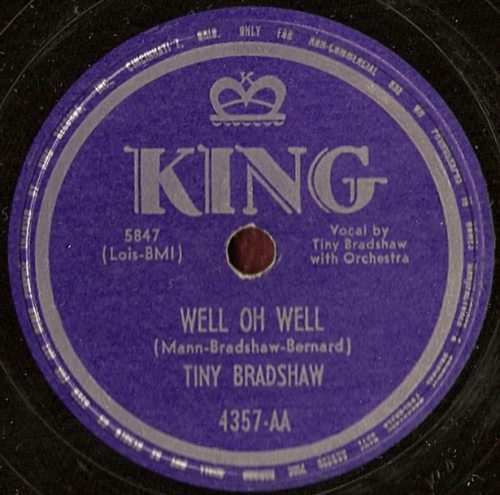
Well Oh Well / I Hate You - Tiny Bradshaw (King 4357)


"Well Oh Well" was recorded in Cincinnati on February 8th, 1950. "I Hate You" was recorded in Cincinnati on November 30th 1949. For personnel see below.


Call it synchronicity or coincidence or karma or fate or whatever, but there was your old Be Bop Wino wending his weary way home of a Friday afternoon after a hard week at the grindstone when a last minute decision to pop into one of Glasgow's few remaining second hand record shops resulted in the triumphant purchase of a used copy of the Proper 2CD Tiny Bradshaw set, "Breaking Up the House," for the very reasonable price of £4. OK, I already have most of the tracks on the second CD which deals with his first year or so at King Records, but I'm looking forward to listening to the first CD which goes way back to his first recordings for Decca in 1934.

And coincidentally I was already mulling over a post based around El Enmascarado's YouTube videos of "Well Oh Well" / "I Hate You" so it's time to pay another visit to that record room with its piles of 78 rpm shellac discs and its vintage Sparton radio / record player console.

So it's a big thank you to El Enmascarado for the label scans and rips from the original 78 rpm disc. The sound quality is surprisingly good and punchy considering that the record is well over 60 years old. As a bonus we have some scans of a 45 rpm EP supplied by Joan K. The downside is supplied by my interminable ramblings, so let's get to the point.

"Well Oh Well" was recorded in Cincinnnati on February 8th, 1950. Tiny Bradshaw had inked a pact with the King diskery in late 1949 and his hard blowing combo was ideally suited to the rise of rocking R&B which was elbowing aside the more subtle forms of jump blues at that time. Blaring sax histrionics were perpetrated by Rufus Gore and Orrington Hall, the dynamite rhythm section of Calvin "Eagle Eye" Shields (drums), Clarence Mack (bass), Leroy Harris (guitar) and Jimmy Robinson (piano) supplied the propulsive beat, the trumpet of Leslie Ayres is in there somewhere, and holding the whole thing together is a magnificent blues shouting vocal by the captain of the side, the leader of the pack, the great showman himself, Tiny Bradshaw.

"Well Oh Well" made it to number two in the R&B chart in May 1950 and has featured in just about every Bradshaw compilation since then. Let us pause to weep with pleasure over Joan's scans of a 1950s King EP which not only has "Well Oh Well," but presents other Bradshaw greats "Soft" (with Red Prysock), "Heavy Juice," (ditto) and future rock and roll classic "The Train Kept A-Rollin'" (more Red and a stonkingly good vocal from Tiny.)

All EP scans by Joan K

Thanks to El Enmascarado we can hear the B Side of "Well Oh Well" - "I Hate You" which hasn't been included in any Tiny Bradshaw compilation that I've come across. It's a nice little ballad which gives Tiny a chance to show a pleasant light singing voice which is very different form his usual blues bawling and squalling. "I Hate You" was recorded at Tiny's first session for King.

Mo' Tiny -

On the blog:

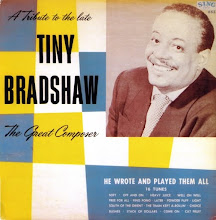
A Tribute To The Late Tiny Bradshaw, The Great Composer has a full account of his career.

Stomping Room Only is an excellent mix of blues shouting vocals and jazzy instros

Recommended purchases:

Breaking Up the House (Proper PVCD101) - the 2CD set charting his career from the big band days of the 1930s to the first year of his spell with King Records.

Heavy Juice - The King Recordings 1950-55 on Rev-Ola. Wild and wooly, jazzy and bluesy.

The EP Collection (See For Miles) is long out of print. If you see it going second hand, grab it. Twenty-nine King tracks from 1950 - 1955 in superlative sound quality.

Postscript: This post has been adapted from the original which featured videos from the now defunct Youtubeseventyeight channel. The 1930s Decca tracks on the Proper 2CD set turned out to be repetitive and not very good sub Cab Calloway stylings. The Savoy tracks were good, though. I just love "Take The Hands Off The Clock." It turned out that I already had a copy of that Proper set. Now I've got two. My memory ain't what it was.

Sunday, 20 March 2011

I Ain’t Mad At You

Gatemouth Moore - before he saw the light
Recently I came across the Jesse Price version of “I Ain’t Mad At You” and it immediately went straight into my all time top ten favourite R&B discs. Well, make that top thirty. It’s a beautifully relaxed and subtle performance of what I thought was the classic song by blues shouter Dwight “Gatemouth” Moore, a track which has been lurking in my collection for about two and a half decades.

After a search through the vinyl cupboard I retrieved Gatemouth’s track on my beat up copy of the double LP “The Shouters,” which was part of the “Roots of Rock ‘N’ Roll” series on Savoy Jazz. The Gatemouth Moore track which dates from 1945 is not the same song which became a modest hit for Jesse Price in 1947. The full title of the Gatemouth song is “I Ain’t Mad at You, Pretty Baby.” However there are similarities between the two, particularly around the shared refrain of “I ain’t mad at you!”

Price’s “I Ain’t Mad At You” was in its turn covered by Count Basie but that version is wildly different from the Price disc as you can now hear by clicking on the playlist. To round off our little wander along the back roads of early rhythm & blues, I’ve added an unreleased version by The Jones Boys which they recorded for Gotham at an unknown date. This frantic version is very different from anything else on the playlist, so despite the shared song title (well, almost) there are four very different performances.

Click on the playlist widget below for some Sunday afternoon rhythm’n’ bluesin’:


Track 1 – “I Ain’t Mad At You, Pretty Baby” (National 6001) by Dwight “Gatemouth” Moore with Dallas Bartley and his Small Town Boys. Recorded in Chicago on May 10th, 1945.

Kill 'em Gatemouth!
Gatemouth Moore is a performer whom we must investigate further here on Be Bop Wino. Like Jesse Price he had deep jazz roots in Memphis and Kansas City. While singing with Walter Barnes and his Royal Creoles he survived the appalling Natchez Rhythm Club inferno of April 23rd, 1940 which killed some 200 dance hall patrons as well as most of Gatemouth’s bandmates. In 1949 he had an onstage religious experience and immediately gave up screechin’ for preachin’.

Track 2 – “I Ain’t Mad at You” (Capitol 348) by Jesse Price. Recorded in Los Angeles on October 17th, 1946.

This is the track that got me searching through the vinyl vault. It's a nicely relaxed performance from a small studio jump group led by drummer and singer Jesse Price who is another performer whom we must revisit on Be Bop Wino. He was part of the booming Kansas City jazz scene of the 1930s – being drummer in the Benny Moten band and, after Moten’s death, in the Count Basie led version of that aggregation.

When Basie and the boys left KC for greater things, Price opted to stay on in the wide open city and ceded the drum chair to his friend Jo Jones. In 1939 the booming KC music scene came to an end with the arrest of mayor Pendergast and Price left with Harlan Leonard’s Rockets, one of the last bands to leave the now cleaned up, reformed and God fearing former Sodom of the plains. A brief spell as drummer in the Ella Fitzgerald led Chick Webb Orchestra (Chick having shuffled off this mortal coil) brought Jesse to Los Angeles, the Gomorrah of the Coast, where he settled down to take part in countless R&B and jazz sessions across the ensuing decades.

Track 3 – “I Ain’t Mad At You” (RCA Victor 20-2314) by Count Basie and his Orchestra. Vocal by Taps Miller. Recorded in New York on May 22nd, 1947.

This is an almost unrecognizable version of the Jesse Price disc. Taps Miller provides a scat vocal over the ensemble vocals and big band arrangement. The band includes Preston Love on alto sax, while the tenor saxes are wielded by Paul Gonsalves and Buddy Tate. A Google image search uncovers an unfortunate run in with the drugs squad for singer / dancer Taps Miller. But he was young and foolish back then. Try it for yourselves. The search, not the drugs.

Track 4 – “I Ain’t Mad At You” (Gotham, unreleased) by The Jones Boys. Unknown date – possibly around 1952 - 1953.

Who let 'em loose on this? It's a howling, blasting deconstruction of the Jesse Price opus, or maybe of the Gatemouth Moore song, it’s hard to tell. I don’t know anything about the Jones Boys. There was a vocal / jive group of the same name in the 1930s and early 1940s. There was also a loose mid 1950s jazz aggregation whose members shared the surname Jones. Quincy Jones, Eddie Jones and Jo Jones were in that group.

I have no idea if either of these groups is related in any way to the performers on this track. All I know is that whoever the Gotham Jones Boys may be, they carried out a similar assault on “Night Train.”