Be Bop Wino Pages

Joan Selects - the complete Joan Selects Collection

Big Ten Inchers - 78rpm rips by El Enmascarado


Attention Mac Users!

Mac users have been experiencing problems in unpacking the WinRAR archives used on this blog. Two solutions have been suggested.

1. Use The Unarchiver - www.theunarchiver.com - see comments on Little Esther Bad Baad Girl post for details.

2. Use Keka - http://www.kekaosx.com/en/ - see comments on Johnny Otis Presents post.

Sunday, 29 August 2010

Bostic LP Cover Quest - more info

I've received some more info plus a little sidelight on Earl Bostic. Our seeker after help lives not far from Cincinnati, yet can get little assistance there on the King back catalogue. So can the worldwide network of Be Bop Wino followers step up to the plate and assist our friend in her quest to trace the LP cover with a shot of her sister on the front?


My husband brought home the "C'mon and Dance" album thinking it was her, but the shot is only of her face.

As a kinda funny side note, the neighborhood Nosy Rosy spread the rumor that my sister was a hooker after seeing Mr. Bostic bring my sister home in his long black limo, as she and her husband did not own a car.

She said he was a very kind man.

I believe she was also on the cover of another Bostic album where she and 2 other models are sitting on a piano....possibly wearing flapper type dresses.

Earl Bostic LP Cover - Help Needed Urgently!!

Hi folks, this is a slightly unusual post and I'm hoping that there's an Earl Bostic fan out there who can help. An email arrived earlier today with a request for a Bostic LP cover from around 1957 - 1960. Here's the email (writer's name not included):


Ran across your site tonight and hope you can help me.

My sister was the model for the album cover of a Bostic LP recorded in Cincinnati between the years of 1957-1960 as best we can determine. Her signed album was stolen some years ago and I have yet to find it.

The front shows a white woman with dark hair but only a vertical half. She is doing a "Lauren Bacall" glance.

Believe it or not, Cincinnati has been of no help in this search.

She does not remember the name of the album.

My sister is getting kinda old and is in poor health, so any help would be appreciated.

Thanks!


I've already had a look through my Bostic albums and sites like ebay and so far I can't identify the LP. Can anyone help with identifying the correct album, or even better, send in a cover scan?

Tuesday, 24 August 2010

Lucky Millinder & His Orchestra - Apollo Jump


Side 1:
1. Apollo Jump
2. Ride, Red, Ride
3. That's All!
4. Shipyard Social Function
5. Hurry, Hurry!
6. Shout, Sister, Shout!
7. Mason Flyer
8. Slide, Mr Trombone
9. There's Good Blues Tonight

Side 2:
1. Let Me Off Uptown
2. Rock Me
3. Little John Special
4. Who Threw The Whiskey In The Well?
5. Trouble In Mind
6. Big Fat Mama
7. Rock Daniel
8. All The Time
9. I Want A Tall Skinny Papa

They say that the real swing that was generated in live performance by the Lucky Millinder Orchestra was never captured on their recordings and that you really had to be there in a packed ballroom to appreciate just how good they actually were. Well there are plenty of tracks throughout this superfine 1983 Affinity LP which get my toes a-tappin’ so this band must have really been something else live.

Lucky Millinder couldn’t play an instrument or even read a music sheet, if we are to believe some accounts. What made him a great bandleader was his ability to choose performers and arrangers who could bring his musical dreams to reality. A dazzling parade of future R&B and jazz stars came through the ranks of this band, especially during the years they recorded for Decca (1941 – 47), the period of the recordings on this selection.

Here’s a sample of the instrumental talent on these tracks: Bill Doggett, Panama Francis, Tab Smith, Bull Moose Jackson, Stafford Simon, Sir Charles Thompson, Dizzy Gillespie, Sam “The Man” Taylor, Eddie “Lockjaw” Davis, Clyde Hart and Preston Love.

Vocal numbers were an important feature in Millinder’s live set and his recordings. In 1941 the band had Trevor Bacon and the remarkable Sister Rosetta Tharpe at the mic. The good Sister was a gospel singer and guitarist who for a time was not averse to performing more worldly material. She left the band in 1942 to perform at Café Society before finally giving up the sinful blues in order to devote herself to The Lord’s music. All of her tracks on this LP are superb. A mixture of the sacred and the not exactly profane. Check her out on YouTube to see some incredible performances with Lucky Millinder in the 1940’s through to television broadcasts from the 1960’s.

Trevor Bacon was a guitarist with a pleasant, if limited singing voice who could handle blues and ballads. His biggest hits with the band, “When The Lights Go On Again (All Over The World)” and “Sweet Slumber” aren’t on this collection, but “Big Fat Mama” and “Let Me Off Uptown” are fine swinging showcases for his vocal ability. In 1944 he left the Millinder outfit to hook up with a “breakaway” group led by Tab Smith. See the Be Bop Wino post “I Don’t Want To Play In The Kitchen” for more of the Tab Smith / Trevor Bacon story.

After the departure of Bacon, Millinder picked up Wynonie Harris as a replacement, and it’s hard to think of a greater contrast in voices. Wynonie’s powerhouse blues shouting is a world away from Bacon’s light voiced singing. “Who Threw The Whiskey In The Well?” was a number one R&B hit in 1945, by which time Wynonie had already disappeared over the horizon in search of solo glory.

His replacement came from within the ranks of the band – tenor sax man Benjamin “Bull Moose” Jackson stepping forward to take up vocal duties. Unfortunately his singing doesn’t feature on this collection. He fronted a series of recordings on the Queen and King labels which were really Millinder band performances issued under a different name to get round the Decca contract. See the Be Bop Wino post “Big Fat Mamas Are Back In Style Again” for more Bull Moose.

Annisteen Allen recorded with the Millinder band between 1945 and 1951. Her only performance on this LP is “There’s Good Blues Tonight” which is a kind of precursor to “Good Rockin’ Tonight.” Other notable recordings by this fine singer include “Let It Roll” and “In The Middle Of The Night” but you’ll have to look elsewhere to find them, my swinging friends.

There’s a fair sprinkling of good instrumental numbers in this collection. “Mason Flyer” and “Little John Special” are most often cited by jazz critics as the best Millinder recordings. Both have solos by trumpeter Dizzy Gillespie, alto sax man Tab Smith and tenor sax player Stafford “Pazuzza” Simon. The propulsive “Apollo Jump” has a riff which Chuck Higgins fans will find oddly familiar.

Lucky Millinder himself was an occasional vocalist (“Shorty’s Got To Go”) with the one example here being “Ride Red Ride” which is a hangover from his days fronting the Mills Blue Rhythm Band back in the 1930’s. The Millinder Orchestra switched to RCA Victor in 1949 (“D Natural Blues”) and finally got to record officially for King between 1950 and 1952, including a reunion with Wynonie Harris for a great cover of Louis Prima’s “Oh Babe!” and a tremendous "Night Train." The break up came around that time, although Millinder did come out of musical semi retirement to front one last King session in 1955. See the Be Bop Wino post “Ram-Bunk-Shush” for Lucky Millinder’s 1950's King recordings.


Ripped from vinyl at 320 kbps. Password = greaseyspoon

Download from here:

http://www84.zippyshare.com/v/tPXqnNYV/file.html

1. Apollo Jump
2. Ride, Red, Ride (vocal – Lucky Millinder)
3. That's All! ((vocal – Sister Rosetta Tharpe + band)
4. Shipyard Social Function
5. Hurry, Hurry! (vocal – Wynonie Harris)
6. Shout, Sister, Shout! (vocal – Sister Rosetta Tharpe)
7. Mason Flyer
8. Slide, Mr Trombone (vocal – Trevor Bacon)
9. There's Good Blues Tonight (vocal – Anisteen Allen)
10. Let Me Off Uptown (vocal – Trevor Bacon)
11. Rock Me (vocal – Sister Rosetta Tharpe)
12. Little John Special
13. Who Threw The Whiskey Down The Well (vocal – Wynonie Harris)
14. Trouble In Mind (vocal – Sister Rosetta Tharpe)
15. Big Fat Mama (vocal – Trevor Bacon)
16. Rock Daniel (vocal – Sister Rosetta Tharpe + band)
17. All The Time (vocal – The Lucky Seven)
18. I Want A Tall Skinny Papa (vocal – Sister Rosetta Tharpe + band)

Recommended purchase:

“Jukebox Hits 1942-1951” on the Acrobat label (has it been revived?) is available both as a CD and mp3 collection on Amazon. It has 20 tracks including 2 under Bull Moose Jackson’s name. Recordings from Decca, RCA and King, including many not on the LP posted here. Go git it! The world needs to swing more.

Saturday, 14 August 2010

Jay McShann and his Orchestra - Hootie's K.C. Blues


Side 1:
1. Hootie Blues
2. Red River Blues
3. Confessin' The Blues
4. Vine Street Boogie
5. 'Fore Day Rider
6. Sepian Bounce
7. Hold 'Em Hootie
8. Swingmatism

Side 2:
1. The Jumpin' Blues
2. One Woman's Blues
3. Get Me On Your Mind
4. Dexter Blues
5. Hootie's Ignorant Oil
6. (New) Confessin' The Blues
7. Lonely Boy Blues
8. So You Won't Jump

In some of the upcoming posts I’ll be looking at the big band roots of R&B. Some of the LPs that were on the original Be Bop Wino blog will be re-posted and I’ll also be adding some new albums – and here’s the first of the new ones – the band that jumps the blues – The Jay McShann Orchestra out of Kansas City.

In the years 1926 to 1939, thanks to the corrupt rule of city boss Tom Pendergast, Kansas City remained relatively untroubled by technicalities like prohibition and city laws limiting bar opening hours. A multiplicity of clubs, bars, dance halls and bawdy houses provided just the right raucous environment for the growth of a flourishing jazz scene. Musicians from all over the Southwest and beyond were attracted to the bright lights and low down dives of this latter day Gomorrah (okay, I’m getting carried away here, but indulge me.)

There was Piney Brown’s Sunset Club where barman Big Joe Turner shouted the blues to the accompaniment of Pete Johnson’s boogie woogie piano. The Count Basie band squeezed itself on to the cramped stage of the Reno Club while a young Charlie Parker watched from the shadows as Basie and Walter Page and Walter’s half brother “Hot Lips” Page, and Herschel Evans and most of all Lester Young swung like crazy. And there were the jam sessions when visiting musicians with reputations to maintain would come up against locally based musicians all too determined to make their own mark. In 1934 Coleman Hawkins, then the acknowledged king of the tenor sax, took on the K.C. triumverate of Ben Webster, Herschel Evans and Lester Young in a mammoth session at the Cherry Blossom. Hawkins had to concede defeat with Young generally considered to be the winner.

Although a round-the-clock live music scene flourished in this Godless city of sin (carried away again, sorry), no parallel recording industry was established and artists who wished to record and become nationally known had to move North. In 1936 the record company talent scouts swooped and the exodus of talent began. From a scene which was dominated early on by Walter Pages’ Oklahoma Blue Devils and Bennie Moten’s Kansas City Orchestra, there issued forth Count Basie (whose band developed out of the Page and Moten outfits), Andy Kirk and His Twelve Clouds of Joy (with brilliant pianist and arranger Mary Lou Williams and sax giant Ben Webster), the duo of boogie pianist Pete Johnson and blues shouter Big Joe Turner, Hot Lips Page, Harlan Leonard’s Rockets (they picked up drummer Johnny Otis on their travels as they headed ever westwards after failing to make it in NYC) and one of the last to leave – the Jay McShann Orchestra.

Pianist Jay McShann was born in Muskogee, Oklahoma in 1909. The early part of his career was spent touring the Southwest and Midwest in various territory bands, but in 1937 he settled into the Kansas City scene, forming a small band which included Gene Ramey on bass and Gus Johnson on drums.

In 1939 the law finally caught up with Boss Pendergast and his cohorts who were carted off to prison on tax evasion and corruption charges, and as K.C. prepared to make the transformation from Godless to God fearing, the night time neon glare dimmed as many clubs and bars closed down, throwing a host of musicians out of work. Every cloud has a silver lining and Jay McShann, who had managed to raise the necessary financial backing, set about augmenting his septet and transforming it into a twelve piece big band. A rock steady Basie style rhythm section consisting of McShann (piano), Gus Johnson (drums), Gene Ramey (bass) and Lucky Enois (guitar) provided the basis for a powerful riff, boogie and blues based outfit.

Heading up the reeds section was young alto sax prodigy Charlie Parker. The band embarked on several gruelling tours of the South and Midwest and had its first recording session for Decca in Dallas in April 1941 (tracks 8, 1, 12, 4 and 3.)

The last addition to the band personnel before the session was blues shouter Walter Brown, for Decca producer Dave Kapp wanted the band to record the blues rather than show their jazz side. Indeed three of the sides (“Vine Street Boogie”, “Hold ‘Em Hootie” and “Confessin’ The Blues”) featured the rhythm section only, with a vocal contribution from Brown on “Hold ‘Em” and “Confessin’”. Parker was heard on “Swingmatism” and also on “Hootie Blues” which he co-wrote with McShann.

Of course it was “Confessin’ The Blues” which captured the record buying public’s imagination and it has become a blues standard, being subsequently revived by Chuck Berry, Little Walter and later by The Rolling Stones. The success of “Confessin’” led to Walter Brown’s vocals dominating the even more blues-drenched second session for Decca held in Chicago in November 1941 (tracks 2, 5, 10, 13, 14, 16.) Of the eight tracks recorded, all were Walter Brown vehicles with the exception of “So You Won’t Jump.”

The band was an extremely popular live act and proved itself to be a formidable opponent in band battles. In 1940 – 41 Earl Hines, Milt Larkin and Nat Towles were vanquished, but the McShann band had to give second best to Duke Ellington. When the band made its New York debut in early 1942 in a battle of the bands at The Savoy Ballroom against Lucky Millinder, the result was a resounding victory for Kansas City, possibly provoked by a pre-battle telegram sent by Millinder: “We’re gonna chase you hicks right back to the sticks.”


At the Savoy in early 1942.

During 1942 Jimmy Coe (baritone sax) was added to the personnel and on tenor sax Jimmy Forrest had a stint with the band, although he wasn’t on the July 1942 Decca recording session. That session did mark the recording debut of band ballad singer Al Hibbler on “Get Me On Your Mind” which turned out to be the only track he recorded with McShann. “Lonely Boy Blues” and “The Jumpin’ Blues” were Walter Brown vocal performances and “Sepian Bounce” was an all too rare opportunity for the whole band to show its jazz chops, with two solos from Charlie Parker. “The Jumpin’ Blues” is my favourite track on the album – a superb riffer with great piano intro from McShann, a solo from Parker and solid blues shouting from Brown.

After the recording session the band was scheduled to return to Kansas City, but Parker elected to remain in New York where he immersed himself in the jam session scene at Monroe’s Uptown House and Minton’s Playhouse. Towards the end of the year he joined the Earl Hines Orchestra along with two other refugees from the McShann band – John Jackson and Bernard Anderson. The time remaining to the Jay McShann Orchestra was marked by an increasingly high turnover in personnel, with many of the original KC musicians giving way to musicians from New York and Chicago.

The final Decca session took place in December 1943 with neither Gus Johnson nor Lucky Enois in the line up, although Paul Quinichette had been recruited on tenor sax. McShann was drafted in May 1944 and the band broke up. In early 1945 McShann briefly reformed the band but later in the year he moved to Los Angeles where he remained for the rest of the 1940s, achieving considerable success with small groups fronted by blues shouters Crown Prince Waterford and Jimmy Witherspoon.

Charlie Parker and Walter Brown represented the two opposing poles of the music that would develop from big band swing. One was the bebop genius who would become one of the greatest figures in twentieth century jazz, the other was the blues shouter who enjoyed early success which he never quite recaptured after the Jay McShann Orchestra split up. However, they shared a fondness for booze and heroin, an unfortunate enthusiasm which brought about their premature deaths – Parker in March 1955 and Brown in June 1956.


Ripped from vinyl at 320 kbps.

Download from here:


1. Hootie Blues (De 8559)*
2. Red River Blues (De 8595)
3. Confessin' The Blues (De 8559)*
4. Vine Street Boogie (De 8570)
5. 'Fore Day Rider (De 8635)*
6. Sepian Bounce (De 4387)
7. Hold 'Em Hootie (De 8583)
8. Swingmatism (De 8570)
9. The Jumpin' Blues (De 4418)*
10. One Woman's Blues (De 8607)*
11. Get Me On Your Mind (De 4418)**
12. Dexter Blues (De 8583)
13. Hootie's Ignorant Oil (De 8635)*
14. (New) Confessin' The Blues (De 8595)*
15. Lonely Boy Blues (De 4387)*
16. So You Won't Jump (De 8607)

* vocal = Walter Brown
** vocal = Al Hibbler

Recommended purchase:

From the Jazz Greats series – number 34 “Jazz City – Kansas City” magazine and CD now available as a download from Jazz Greats Online. 21 tracks including Walter Page’s Blue Devils, Benny Moten, Julia Lee, Big Joe Turner, Andy Kirk, Count Basie, Jay McShann, Harlan Leonard, Charlie Parker and others.


Recommended reading:

Bird Lives! by Ross Russell.
Big Band Jazz by Albert McCarthy

Tuesday, 3 August 2010

Summer Break and Confessin' The Blues

There's not been much activity around here for a few weeks. I'll try to get another post up soon, but hey, it's summer! This is no time to be spending hours hunched over a computer editing WAV files and scanning LP covers and tagging mp3s and all that stuff. So I'm sorry for keeping you cats and kittens on tenterhooks, although oddly enough I've noticed that the less I post, the more hits this blog attracts. That's just weird.

Some of you have been sending nice messages of appreciation for the work that goes into the blog, so I'd like to thank those very cool people (you know who you are) and I will reply to your emails soon.

I'm hoping to do some posts on the big band roots of R&B, so here's a taster of what's to come.

Let's all listen to the ORIGINAL "Confessin' The Blues" sung by Walter Brown accompanied by the rhythm section of the Jay McShann Orchestra way back in 1941:


Stay cool, you naughty kids! I'll be back soon with lots of riffin', boogyin' and bluesin'.

Saturday, 17 July 2010

Big Sound Tenors


Side A
1. Creamin' Boogie - Julian Dash
2. For Squares Only - Julian Dash
3. Devil's Lament - Julian Dash
4. Dance of the Mother Bird - Julian Dash
5. Long Long Ago - Al Sears
6. Searsy - Al Sears
7. Tweedle Dee - Al Sears
8. So Glad - Al Sears

Side B
1. Walkin' Home - Eddie Chamblee
2. Goin' Long - Eddie Chamblee
3. Back Up - Eddie Chamblee
4. Lazy Mood - Eddie Chamblee
5. Time Out For The Blues - Ben Webster
6. Cotton Tail - Ben Webster
7. Surf Board - Ben Webster
8. You Are Too Beautiful - Ben Webster


Thanks to Big Al (The Bloggers’ Pal) here’s a real gone treat for the folks who move their feet to the saxlicious sound of the big beat.

This is one tremendous LP of sides recorded mostly by jazz / swing veterans but aimed mostly at the R&B market. There aren’t any squealing histrionics in the Big Jay McNeely or Joe Houston style, but what we have here is the very stuff of the Be Bop Wino blog – that grey area where jazz, swing, R&B and even rock ‘n’ roll all meet together. The very first track “Creamin’ Boogie” absolutely nails it for me with the deep down and dirty tone of Julian Dash set against a chugging boogie woogie piano. Life doesn’t get any better than this.

Julian Dash was a veteran of the Erskine Hawkins Orchestra, all the way back to when the band was known as the ‘Bama State Collegians in the late 1930s. He is credited with co-composing the Hawkins signature tune (and smash hit for Glenn Miller) “Tuxedo Junction.” Dash remained in the Hawkins outfit until the mid 1950s, but coinciding with the band’s longstanding Victor contract coming to an end, he recorded under his own name with small groups for labels like Sittin’ In With, Mercury and Vee-Jay from 1950 – 1955.

The personnel of these groups was made up of fellow members of the Hawkins Orchestra (which was also doing some label hopping at the time), such as Haywood Henry, Bobby Smith, Lee Stanfield, Leroy Kirkland and Sonny Payne. A similar line up was simultaneously recording for Apollo under Bobby Smith’s name.


“For Squares Only” and “Creamin’ Boogie” were recorded in New York City in March 1951 and released on Sittin’ In With 614.

“Devil’s Lament” and “Dance of the Mother Bird” were recorded in New York City in July 1951 and released on Sittin’ In With 630.

Al Sears, or rather “Big” Al Sears, was a tenor sax player of remarkable longevity whose career spanned the early years of big band swing (he joined the Chick Webb band in 1928), the glory years of swing in the 1930s and 1940s, the rise of small group R&B, and even rock and roll. Among the bands he played for in the 1940s into the early 1950s were those of Andy Kirk, Lionel Hampton and Duke Ellington (replacing Ben Webster.) In 1951 he was a member of the Johnny Hodges band and composed and soloed on their big hit on Mercury “Castle Rock.”

During the 1950s he recorded numerous tenor sax instros in New York for a succession of labels including King, Vic, Coral, Groove, Herald, Jubilee and Baton. He became a member of Alan Freed’s Rock and Roll Orchestra, playing numerous concerts and recording for Coral. Perhaps Big Al’s best recording for Freed was the aggressive stomper “Right Now, Right Now” which was featured in the film “Rock, Rock, Rock.”


“Long, Long Ago” and “Searsy” were recorded in New York City in 1945 and were first released as International 351/352.

“Tweedle Dee” was recorded in New York City in 1954 and first released on Herald 448.

“So Glad” was recorded in New York City in 1957 and first released on Jubilee 5303.

Eddie Chamblee belonged to a younger generation of sax players than the other three on this compilation and consequently received his grounding in the developing R&B scene of the mid to late 1940s rather than the swing era of the 1930s. Although born in Atlanta, his family relocated to Chicago where he eventually studied law at the University of Chicago. After playing for army bands during the war, he formed his own small group and signed up with Chicago indie label Miracle.

In 1948 Eddie was on one of the biggest selling R&B records of all time, playing tenor sax on Sonny Thompson’s two part instrumental “Long Gone.” The record (Miracle 126) was the 3rd biggest R&B seller of the year and shifted enough units to make Miracle the 4th biggest selling R&B label that year. None of the tracks Eddie recorded under his own name were to achieve anything like the success of “Long Gone” and his last session for Miracle was in 1949 including “Lazy Mood” which is featured here. Eddie recorded tracks for Coral in 1952 and United in 1953 – 54 before joining the Lionel Hampton band, staying until 1956. See the post “Live In Paris” to hear Eddie on a Hampton European tour.

In 1957 he married Ruth Jones, whom he had known when they both attended the same high school, and who was now enjoying enormous success as Dinah Washington. He recorded for the same label as Dinah – Mercury – with “Goin’ Long” and “Back Up” featuring here. And yes, he was still trying to revive that “Long Gone” groove on “Goin’ Long.” The post “The Rockin’ and Walkin’ Rhythm of Eddie Chamblee” is a good overview of his career.


“Lazy Mood” was recorded in Chicago in 1949 and first released on Miracle 133 and later released on Federal 12014.

“Walkin’ Home” was recorded in Chicago 1953 and released on United 160.

“Goin’ Long” and “Back Up” were recorded in Chicago in 1957 and released on Mercury 71107.

Ben Webster was a true giant of jazz tenor saxophone. Born in Kansas City in 1909, in the 1930s he worked with, among others, Benny Moten, Andy Kirk, Cab Calloway and Duke Ellington. However it is his work with Ellington in the early 1940s that is considered his most important. After leaving Ellington he worked mostly with his own small groups and also as a backing musician. R&B fans of course know that he was with Johnny Otis on Mercury in the early 1950s and he also recorded with Dinah Washington on the same label. In 1964 he moved to Europe where he was in great demand both as a live act and as a recording artist. The sides featured on this LP were recorded by Ben with Benny Carter and His All Stars for Modern.


“Cotton Tail” and “Time Out For The Blues” were recorded by Benny Carter and His All Stars in Los Angeles in May 1949 and first released on Modern 858 with dubbed on applause. “Time Out For The Blues” was retitled “Ben’s Mood” for the LP “Jazz Masquerade” (Modern 1209, Crown 5009) in 1956. It is likely that tracks credited to the “Jimmy Jackson All Stars” on singles released by RPM in 1952 are from this session.

“Surf Board” and “You Are Too Beautiful” were recorded by Benny Carter and His All Stars in Los Angeles in May 1949 and released on Modern 865.

Thank you Big Al!

Tuesday, 6 July 2010

Lester Young And His Tenor Sax Volume 1 (Aladdin LP 801)

1. D.B. Blues
2. Lester Blows Again
3. These Foolish Things
4. Jumpin' At Mesner's
5. It's Only A Paper Moon
6. After You've Gone
7. Lover Come Back To Me
8. Jammin' With Lester
9. You're Driving Me Crazy
10. New Lester Leaps In
11. She's Funny That Way
12. Lester's Be Bop Boogie
13. S.M. Blues

Album released in October 1956. All tracks recorded in 1945/46 and originally released as 78 rpm singles in 1946/47.

A post for those who worship at the Altar of the Pork Pie Hat. As promised a mere 9 months ago here is the fourth tenor sax player in the Aladdin series of LPs “…And His Tenor Sax” – Lester Young. Back in October 2009 I posted versions of the other 3 LPs in this series by Lynn Hope, Illinois Jacquet and Maxwell Davis. I put out a plea for help in locating suitable artwork and received quite a few replies. So a special thank you goes out to R, Sleepy Cactus Slim, jaybird 69, bigtone, and also to Joan for an EP cover scan.

All tracks in this reconstitution of the 1956 LP “Lester Young and his Tenor Sax Volume 1” have been ripped from vinyl, so although I’ve managed to eliminate the louder clicks and pops, there is still some surface noise audible. “It’s Only a Paper Moon” was ripped from a particularly well worn slab of wax but thanks to the wonders of Magix Audio Cleaning Lab I’ve managed to eliminate the worst of the crackling and hissing.

Like the other albums in this series, this LP was issued and reissued in various forms over the years. It was first issued in 1954 as "Lester Young and his Tenor Sax" - a 10 inch LP (Aladdin LP-706) with only 8 tracks. See below for front and back covers and a label scan of this issue:

In October 1956 the album presented in this post was issued as a 12 inch LP with 13 tracks (Aladdin LP-801). Volume 2 (Aladdin LP-802) which also had 13 tracks was released at the same time. See below for cover scans:

Tracks from the above two LPs were also issued on 3 EPs – Aladdin EPs 502, 503 and 513. See below for Joan’s EP 503 scan:

In 1957 the two LPs were reissued with different titles and covers on Aladdin’s jazz/pop subsidiary Intro. Volume 1 became “Swinging Lester Young” (LP-602) and Volume 2 became “The Great Lester Young” (LP-603). In 1958 they were reissued on the Aladdin budget subsidiary Score (as SLP-4028 and SLP-4029) with the same covers and titles as the Intro issues. See below for Score cover scans:

Subsequent releases of Lester Young Aladdin material on Imperial in the early 1960s were on two LPs (as two volumes of “The Great Lester Young”) with different tracks and covers.


Back in the day with Basie

Ripped from crackly vinyl at 320 kbps. Password = greaseyspoon

Download from here:

http://rapidshare.com/files/405313666/Lester_Young_And_His_Tenor_Sax.rar.html

Or here:

http://www.megaupload.com/?d=YRXQNOZ4

Session Details

Los Angeles, December 1945 -
Lester Young and his Band : Vic Dickenson (tb-1, 2, 4) Lester Young (ts) Dodo Marmarosa (p) Red Callender (b) Henry Tucker (d):

1. D.B. Blues (Philo123)
2. Lester Blows Again (Philo123)
3. These Foolish Things (Philo124)
4. Jumpin' At Mesner's (Philo124)

Los Angeles, January 1946 –
Lester Young and his Band : Howard McGhee (tp- 5, 7, 8) Vic Dickenson (tb-5, 7, 8) Willie Smith (as) Lester Young (ts) Wesley Jones (p) Curtis Counce (b) Johnny Otis (d):

5. It's Only A Paper Moon (Aladdin 127)
6. After You've Gone (Aladdin 127)
7. Lover Come Back To Me (Aladdin 128)
8. Jammin' With Lester (Aladdin 128)

Los Angeles, August 1946 –
Lester Young and his Band : Lester Young (ts) Joe Albany (p) Irving Ashby (el-g) Red Callender (b) Chico Hamilton (d):

9. You're Driving Me Crazy (Aladdin 137)
10. New Lester Leaps In (Aladdin 137)
11. She's Funny That Way (Aladdin 138)
12. Lester's Be Bop Boogie (Aladdin 138)

Chicago, October 1946 –
Lester Young and his Band : Shorty McConnell (tp) Lester Young (ts) Argonne Thornton (p) Fred Lacey (g) Rodney Richardson (b) Lyndell Marshall (d):

13. S.M. Blues (Aladdin 162)

Recommended purchase:

Blue Note CDP 7243 8 32787 2 5:
The Complete Aladdin Recordings Of Lester Young -
A 2CD set with 40 tracks which include 4 sides recorded for Van with Nat “King” Cole and Red Callender in 1942 and a 6 track December 1945 session with Helen Humes. Liner notes by Leonard Feather.

Available as a 2 CD set at mid-price or as an Amazon mp3 download at a very low price. I would go for the CD!


Listen to "It's Only A Paper Moon" -

Saturday, 3 July 2010

The Ray-O-Vacs - Besame Mucho (Official LP 6047)


Side 1
1. Besame Mucho
2. Take Me Back To My Boots And Saddle
3. If You Ever Should Leave Me
4. My Baby's Gone
5. Let's
6. What's Mine Is Mine
7. I Still Love You
8. She's a Real Lovin' Baby

Side 2
1. Start Lovin' Me
2. Outside Of Paradise
3. I Still Love You
4. All About Daddy
5. I'm The Baby Now
6. Party Time
7. Crying All Alone
8. Wine-O

I remember feeling disappointed by this LP when I bought it twenty years ago in some long vanished record shop. Having never actually heard the Ray-O-Vacs, I was expecting some rockin’ R&B vocal group action, maybe similar to the Dominoes, the Clovers, the “5” Royales, and other early 1950s groups. Instead I found myself listening to something rather different and I didn’t quite know what to make of it. So I stuck the album on the shelf and rarely listened to it again. Hell, I never even wondered about where they got the group name from, only discovering recently that they were named after a make of battery.

Now that I’ve reacquainted myself with the album as I plough my way through the conversion of the Boogie Woody vinyl vault to a digital format, I find myself appreciating the sheer genius of the music contained in the unjustly neglected grooves. The Ray-O-Vacs’ sound is rooted in that of the jive groups of the late 1930s and the 1940s and is similar to that of other self contained vocal / instrumental outfits like The Red Caps or The Four Blazes.

These sides are dominated by the smoky lead vocals of Lester Harris and Herb Milliner, with brilliantly sparse backing arrangements featuring tasty tenor sax and piano fills weaving in an out of the vocals. They are a lesson in the art of being effortlessly cool. Even such apparently unpromising material as the hokey “western” song “Take Me Back To My Boots And Saddle” is transformed into a broadcast from the Planet Hep.

Information about the Ray-O-Vacs can be hard to come by. They were from New York and kicked off their recording career with Coleman Records who released 5 singles by the group in 1949. Their first side, “I’ll Always Be In Love With You,” gained some modest chart success and was re-released some years later on Sharp. Two further Coleman sides, “Happy Am I” and “Hot Dog” were re-released on the Savoy subsidiary Regent in 1951. The only Coleman side on this collection is “I’m The Baby Now” which is a slightly rawer version of the sly slinky sound which characterised their sides for Decca for whom they recorded through 1950 and 1951.

Of the Decca releases, only “Besame Mucho” (covered some years later by The Coasters and then by The Beatles) achieved noteworthy sales. The Ray-O-Vacs’ sound was rapidly becoming old fashioned as rockin' gospel-influenced vocal groups began to dominate the R&B market. The Dominoes and The “5” Royales especially were a world away from the comparatively staid Ray-O-Vacs who seemed to belong more to the world of The Charioteers or The Delta Rhythm Boys.

The Decca contract was not renewed and in 1952 The Ray-O-Vacs started recording for Jerry Blaine’s Jubilee label. Lead singer Lester Harris had already gone solo and signed a contract with RCA. He died at the tragically young age of 33 in early 1953. Herb Milliner took over lead vocal duties but the Jubilee releases of 1952 failed to bring commercial success. In 1954 the group transferred to Josie, a sister label of Jubilee. Their first release on the label, the instrumental “Riding High” backed with “Darling” stiffed and the following year the label tried a different approach, with the group backing songthrush Babe Hutton on “All About Daddy” while the B side featured a Herb Milliner vocal on “I Still Love You.”

This single was credited to Flap McQueen & His Ray-O-Vacs. Jackson “Flap” McQueen was the former bass player in the Pancho Diggs Orchestra, a big band who were the kings of swing in Newark, NJ in the 1930s and early 40s. Back in the day they could draw thousands of Lindy Hoppers to the Skateland Ballroom on Montgomery Street, Newark. They would generously let a local lass join them on stage for a few vocal numbers. Someone called Sarah Vaughn. In the early 40s with a beefed-up line up which included Count Hastings and Ike Quebec, they made it to the world famous Savoy in Harlem. The war brought about the end of the band.

See below for mid 1930s photos of the Pancho Diggs Orchestra with Flap McQueen on bass. Photos and information on Flap McQueen and Pancho Diggs are from the book "Swing City: Newark Nightlife 1925-50" by Barbara J. Kukla, Rutgers University Press, 2002.

Now I have to confess that I have no idea when Flap joined the Ray-O-Vacs or how long he stayed with them. Perhaps someone out there can fill in the blanks?

In 1956 the group released “Party Time” / “Crying All Alone” on the small Kaiser label. The single was picked up and re-released by Atlantic subsidiary Atco. “Party Time” was a radical change in sound for the Ray-O-Vacs, being a raw R&B stomper with a shouted vocal by Bill Walker. There was one further release on Kaiser, “Hong Kong” / “Wine-O.” The B side was a ringer for any number of Amos Milburn booze anthems from the early 50s. A good record, though, and the last one released by the group.

Joan K has supplied a couple of label scans from Kaiser plus an issue on Sharp of “I’ll Always Be In Love With You”, which was the first Ray-O-Vacs’ recording to be issued, originally as a 78 rpm disc on Coleman in 1949. And as a final little treat from Joan there’s two m4a rips (plus mp3 conversions) from 78 rpm discs of “What’s Mine Is Mine” / “I Still Love You Baby”, originally released on Decca in 1950.
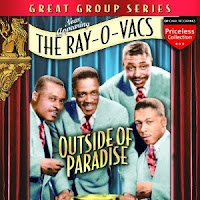
See this Doowop Nation article for some more Ray-O-Vacs information.

Ripped from vinyl at 320 kbps. Password = greaseyspoon

Download from here:

http://rapidshare.com/files/404140247/Besame_Mucho.rar.html

Or here:

http://www.megaupload.com/?d=LERU7HG8

1. Besame Mucho (Decca 48162), 1950
2. Take Me Back To My Boots And Saddle (Decca 48197), 1950
3. If You Ever Should Leave Me (Decca, unissued?), 1950
4. My Baby's Gone (Decca 48211), 1951
5. Let's (Decca 48211), 1951
6. What's Mine Is Mine (Decca 48234), 1950
7. I Still Love You (Decca 48234), 1950
8. She's a Real Lovin' Baby (Decca 48274), 1951
9. Start Lovin' Me (Jubilee 5098), 1952
10. Outside Of Paradise (Jubilee 5124), 1952
11. I Still Love You (Josie 781), 1955
12. All About Daddy (Josie 781), 1955 vocal – Babe Hutton
13. I'm The Baby Now (Coleman 112), 1949
14. Party Time (Kaiser 384, Atco 6085), 1956
15. Crying All Alone (Kaiser 384, Atco 6085), 1956
16. Wine-O (Kaiser 389), 1957

Recommended purchases:

In the UK a CD on the Collectables label, “Outside of Paradise,” with a modest 10 tracks from Jubilee, is available via Amazon.

In the US two 22 track CDs were released on the Coleman label – “Besame Mucho” (Coleman 100) and “It’s Party Time with the Ray-O-Vacs” (Coleman 105). They’re probably just about impossible to find now.

A jive group who managed to get a hit in 1952 were The Four Blazes, with “Mary Jo” on the United label. Their sound was similar to that of The Ray-O-Vacs, with tasteful sax fills supplied by Eddie Chamblee. A 24 track Delmark CD, “Mary Jo” (DE-704) is highly recommended by your boogster pal. Oh, and by the way, I haven’t a clue who is playing sax on The Ray-O-Vacs’ sides. Can anyone help?

Wednesday, 16 June 2010

Rockin' in Munich

It's time for Be Bop Wino to take a short break from bringing you the best of boppin' and bluesin' for movin' and groovin'. I'm off for a little trip to Munich. Should any Bavarian hipsters happen to notice a cool cat in a retro Scotland football shirt flitting through the streets, beer gardens and pubs of your wonderful city this weekend, that'll be me.

I'll be back with more rhythm delights sometime next week. In the meantime here's a little T-Bone Walker to tide you over - "T-Bone Jumps Again" on Black and White Records. Ripped from vinyl, as ever.


Sunday, 13 June 2010

Plas Johnson - Rockin' With The Plas


Side 1
1. Hoppin' Mad
2. Blow your Blues away
3. Popcorn
4. Downstairs
5. The Loop
6. Swanee River Rock
7. The Big Twist

Side 2
1. Little Rockin' Deacon
2. You Send Me
3. Robin's Nest Cha Cha
4. Plas Jazz
5. Come Rain or Come Shine
6. Dinah
7. Everyone Knows

Now listen up you be bop winos! Big Al (The Bloggers’ Pal) has sent in another tenor sax vinyl gem – a 1980s French Pathe Marconi comp of Plas Johnson’s Capitol singles.

Maybe you haven’t heard of him, but you certainly have heard him. How about these: Shuffle In the Gravel by Young Jessie; Stranded In The Jungle by The Cadets; Girl Of My Dreams by Jesse Belvin; Searchin’ by The Coasters; Rockin’ Robin by Bobby Day; Bony Moronie by Larry Williams; Teenage Heaven by Eddie Cochran; Say Mama by Gene Vincent; and a myriad of tracks by Duane Eddy, Ernie Fields, The Piltdown Men, Sandy Nelson, The Ernie Freeman Combo, Johnny Otis, The Marketts, The Routers, The Olympics, and Don & Dewey. And that’s just scraping the surface of the output of Plas Johnson, LA session man extraordinaire.

And if you ain’t no fan of rock and roll or R&B, you’ve STILL heard him on The Pink Panther Theme or The Odd Couple Theme. Plas Johnson’s sax stylings have been ubiquitous on countless pop, rock and roll, rhythm and blues, soul, jazz and film soundtrack recordings emanating from the recording studios of Los Angeles, especially those of Capitol, Imperial and Liberty.

Plas was born in 1931 in Donaldsonville, Louisiana. In the late 1940s, along with his pianist brother Ray, he formed a band called the Johnson Brothers Combo which played around New Orleans and recorded a single for DeLuxe in 1949, “Our Boogie” b / w “Mellow Mama.” Plas went on the road with the Charles Brown Band, and then had a spell in the armed forces.

After completing his service he moved to Los Angeles along with his brother Ray, and around 1955 -56 the brothers were recording with drummer George Jenkins (once of the Buddy Johnson Orchestra back in the day) for the Tampa label. Some of these recordings were issued on an LP credited to Jenkins, “Drum Magic,” while others appeared on an LP credited to Plas, “Bop Me Daddy.”

Big Al also sent in “Bop Me Daddy” but a quick check showed that, unbelievably, this obscure 8 track LP is available as an Amazon mp3 download. One track from the album, “Dungaree Hop” is on the blog post “Original Rhythm ‘N Blues.” If you want to hear the rest of the tracks though, I’m afraid you’ll have to get yourselves over to Amazon. It’s a good LP of gutsy, swingin’ small combo R&B instrumentals. The moody “Last Call,” a Plas composition, is a stand out track. Striptease jazz at its finest. Below you’ll find Big Al’s front and back cover scans of “Bop Me Daddy,” which I’ve included in the download


In 1957 Plas took a break from recording on other people’s discs and laid down a bunch of sides for Capitol, all of which were released as singles and which didn’t make it to LP until Pathe Marconi issued this set. The musicians on these sides were mainly those with whom Plas was recording as a session man – Earl Palmer and Ray Martinez on drums, Irving Ashby, Rene Hall and Bill Pitman on guitar, Ernie Freeman and Ray Johnson on piano and Red Callender on bass. The sound is rather different from the R&B of “Bop Me Daddy.” It’s a mix of what we nowadays call space age pop, lounge, jazz noir, striptease jazz, anything but rock and roll or rhythm and blues. We’re talking mainly background music to that sophisticated cocktail party in your space age bachelor pad.

But do not despair, there’s some great stuff here. Striptease jazz gets covered in the bump ‘n’ grind of “The Big Twist” (swing those tassles, baby!); “Downstairs” is a tremendously tense piece just begging to be played over the opening credits of a late 50s / early 60s TV crime series; its B-Side “The Loop” is a good wailin’ stomper; “Blow Your Blues Away” is another little gem with Plas wailing through a girlie vocal chorus. Now let’s be honest, there is a pop sensibility to a lot of the stuff here, with catchy little hooks and vocal choruses. It’s of its time, but the instrumentalists do get to show off tremendous technique, and all in all it’s an enjoyable listening experience.

In 1958, Plas played flute on an LP for Score, simply titled “Plas Johnson.” In 1959 and 1960, Capitol released two LPs by Plas – “That Must Be The Plas!” and “Mood For The Blues.” In 1963 Charter released two LPs featuring Plas under the pseudonym Johnny Beecher and in 1964 came the Capitol single of The Pink Panther Theme. Through all this and up to the present day Plas continued his session work, including backing Marvin Gaye and Rod Stewart. The website at plasjohnson.com brings you up to date on this fine and still very much active musician. Of course such modernity is beyond the scope of this blog because on Be Bop Wino the 1960s haven’t happened yet.

Ripped from vinyl at 320 kbps. Password = greaseyspoon

Download from here:

http://www16.zippyshare.com/v/RgUThBP6/file.html


Tracklist:

1. Hoppin' Mad
2. Blow your Blues away
3. Popcorn
4. Downstairs
5. The Loop
6. Swanee River Rock
7. The Big Twist
8. Little Rockin' Deacon
9. You Send Me
10. Robin's Nest Cha Cha
11. Plas Jazz
12. Come Rain or Come Shine
13. Dinah
14. Everyone Knows

Recommended purchases:

On Amazon download the mp3 album “Bop Me Daddy.” Rousing stuff.


I had a look through my CDs and found that I had three which feature loads of Plas and here they are:


Sandy Nelson – Rock’N’Roll Drumbeat, Ace CDCHD 586 – tenor sax duties split with Jackie Kelso, once of Roy Milton’s Solid Senders.


Ernie Freeman Combo – Raunchy, Ace CDCHD 659 – good R&B instros


The Piltdown Men Ride Again, Ace CDCHD 681 – includes tracks by Ernie Fields, Billy May and Earl Palmer (Drum Village).

Thank you, Big Al!

Listen to Plas (Downstairs):