Be Bop Wino Pages

Joan Selects - the complete Joan Selects Collection

Big Ten Inchers - 78rpm rips by El Enmascarado


Attention Mac Users!

Mac users have been experiencing problems in unpacking the WinRAR archives used on this blog. Two solutions have been suggested.

1. Use The Unarchiver - www.theunarchiver.com - see comments on Little Esther Bad Baad Girl post for details.

2. Use Keka - http://www.kekaosx.com/en/ - see comments on Johnny Otis Presents post.

Showing posts with label Paul Williams. Show all posts

Monday, 3 April 2017

Paul Williams - House Rocker


Side 1:
01. The Twister
02. Boogie Mr Williams
03. Turtle Rock
04. Canadian Ace

Side 2:
01. Rompin'
02. Jelly Roll Boogie
03. House Rockin' (aka House Rocker)
04. Back Bender

Download from:

http://www49.zippyshare.com/v/okErVdfW/file.html

These eight sides are from the Savoy 2LP set "Honkers and Screamers."

Facts on the sax tracks, Jack:

"The Twister" and "Boogie Mr Williams" were recorded in Detroit on December 20th, 1947. Personnel: Phil Guilbeau (trumpet); Wild Bill Moore (tenor sax); Paul Williams (baritone, alto sax); T.J. Fowler (piano); Herman Hopkins (bass); Reetham Mallett (drums).

Both tracks unreleased on singles. Another take of "The Twister" recorded on March 2nd, 1948 was released as a two parter on Savoy 665 in April 1948.

"Turtle Rock" and "Canadian Ace" were recorded in Detroit on March 4th, 1948. Personnel: Phil Guilbeau (trumpet); Wild Bill Moore (tenor sax); Paul Williams (baritone sax); Floyd Taylor (piano); Herman Hopkins (bass); Reetham Mallett (drums).

"Canadian Ace" was a title given to a previously untitled, unissued track on Savoy 2LP SJL2234 "Honkers and Screamers."

"Turtle Rock" was released on Savoy 773 b/w "Blues At Daybreak" in December 1950.

"Rompin'" "Jelly Roll Boogie," "House Rockin' "(aka "House Rocker"), and "Back Bender" were recorded in Detroit on January 13th 1949. Personnel: James Poe (King Porter) (trumpet); Louis Barrett, Billy Mitchell (tenor saxes); Paul Williams (baritone sax); Floyd Taylor (piano); John Holiday (bass); Bill Benjamin (drums).

"Rompin'," "Jelly Roll Boogie," and "Back Bender" were not released as singles. "House Rocker" b/w "He Knows How To Hucklebuck" was released as Savoy 702 in July 1949.

Label scan from 45worlds.com

The Cash Box July 2nd 1949
It's no coincidence that two of my favourite sax players from the 1940s and 1950s are Paul Williams and Leo Parker. Both were exponents of the big, bad, low down and dirty baritone sax, although one, Leo Parker, in the jazz field (although usually with a blues sensibility) and the other, Paul "Mr Hucklebuck" Williams in the rhythm 'n' blues field.

Paul Williams was born in Lewisburg, Tennessee, on July 13th, 1915, spent part of his childhood in Bowling Green, Kentucky, before moving to Detroit with his family when he was thirteen years old. He started playing saxophone in school where he met trumpet player Lloyd Henderson. On leaving school the pair formed a small group, the Kings of Rhythm, which found a gig at a Detroit club (The Morris Cafe) which lasted five years. The group played popular hits of the day for the white patrons of the club.

The Second World War brought about the breakup of the little band and as the war wound down Paul Williams joined the Clarence Dorsey band which played for black audiences at the Sensation Club. Paul next played for the King Porter band at a club called "Sportree" and it was here that he was scouted by Savoy Records man Teddy Reig after head honcho Herman Lubinsky had received a tip from local record shop owner Joe Battle.

The King Porter outfit didn't impress Reig too much but Paul Williams did, so Paul split from the Porter band and used the T.J. Fowler band as backing at his first two Savoy sessions on September 5th and October 6th 1947. The October session yielded the big hit "Thirty-Five Thirty" (named after the address of Joe Battle's record shop) which made the top ten in the national R&B chart.

Towards the end of 1947 Paul formed his own band which included musicians from the King Porter outfit as well as tenor sax man Wild Bill Moore. The same group of musicians also produced recordings on Savoy for release under Wild Bill's name. 

Good sellers for the Williams band through 1948 included two disc jockey tributes, "Bouncing With Benson" and "Waxie Maxie," and the hard blowing two-parter "The Twister." The latter two tracks featured Wild Bill's muscular tenor sax with Williams playing hot 'n' heavy baritone. Savoy A&R man Teddy Reig is usually credited with persuading Paul to make the decisive shift to baritone sax, a development which gave the band a big sound which could send audiences wild, particularly on honk heavy numbers like "The Twister."

By the time the band recorded "The Hucklebuck" in December 1948 Wild Bill had left, thus missing out on THE R&B phenomenon of 1949. Not only was it the top selling R&B disc of the year, it inspired big selling cover versions in both the pop and R&B fields. It's a disc which deserves it's own post and one is in preparation.

The huge sales of "The Hucklebuck" brought Paul Williams very little financial reward. He was not the composer (and thereby hangs a tale ...) and performers' royalties had a way of ending up elsewhere in the Savoy organisation. He continued to record for Savoy until the end of 1951 but no other release came anywhere near the success of "The Hucklebuck." A follow up, "He Knows How to Hucklebuck" / "House Rocker" had modest success in the second half of 1949. "What's Happening" and "Rockin' Chair Blues" from 1950 and 1951 made even less noise.

Paul Williams first post-Savoy session for Jubilee / Josie in mid-1952 failed to engender any releases but a session for Mercury later in the year produced two singles. In 1953 Paul had two singles on Jax with Noble Watts now joining the band on tenor sax. In 1954 - 1956 there was a spell of label-hopping as the Williams band had releases on Groove, Capitol, Rama, Josie and Vee-Jay. A couple more releases followed in 1961-62 on Warwick / 7 Arts and Ascot. 

Throughout his recording career and beyond, Paul's band was in demand as a backing band for live appearances by R&B and rock and roll artists. He was on the bill of Alan Freed's infamous March 1952 "Moondog Coronation Ball" at the Cleveland Arena and indeed was the only act to actually perform before the police shut the event down due to overcrowding.


You can see Paul backing various well known R&B performers in those old 1950s "Showtime At The Apollo" films which crop up in various guises on TV and DVD (and YouTube). He was also a studio backing musician for Ruth Brown and a band director for Lloyd Price and James Brown.

With Amos Milburn on Showtime At The Apollo
In 1964 Paul Williams retired from playing, took up sales jobs, did well, and then founded his own booking agency in 1968. He passed away in September 2002 at the age of 87.

Sources - Peter Grendysa and Atilla Oess interviews with Paul Williams in 1980 and 1985 for the Saxophonograph LPs "The Hucklebuck" and "Spider Sent Me."

Bob Porter - Soul Jazz (Jazz In The Black Community, 1945-1975), XLibris, 2016.

Saturday, 25 March 2017

Wild Bill Moore - Swingin' For Pappy


Side 1:
01. Swingin' For Pappy
02. Bubbles
03. Harlem On Parade
04. We're Gonna Rock

Side 2:
01. Bongo Bounce
02. South Parkway Hop
03. Top And Bottom
04. Rocking With Leroy

Download from:

http://www47.zippyshare.com/v/3X0xjjIG/file.html

Notes on the tracks:

"Swingin' For Pappy," "Bubbles," and "Harlem On Parade" were recorded in Detroit on the 21st November 1947. Personnel: Phil Guilbeau (trumpet); Wild Bill Moore (tenor sax); Paul Williams (baritone, alto sax); Floyd Taylor (piano); Herman Hopkins (bass); Reetham Mallett (drums).

"We're Gonna Rock," "Bongo Bounce," "South Parkway Hop," "Top And Bottom," and "Rocking With Leroy" were recorded in Detroit on the 18th December 1947. Personnel: Phil Guilbeau (trumpet); Wild Bill Moore (tenor sax); Paul Williams (baritone, alto sax); T.J. Fowler (piano); Herman Hopkins (bass); Reetham Mallett (drums).

These 8 sides were originally issued as follows:

Swingin' For Pappy / Bubbles, released on Savoy 662 in January 1948. "Bill Moore And His Band."

We're Gonna Rock / Harlem On Parade released on Savoy 666 in July 1948. "Bill Moore featuring Paul Williams."

South Parkway Hop / Bongo Bounce released on Savoy 690 in March 1949. "Wild Bill Moore Sextette."

Top And Bottom / Rocking With Leroy released on Savoy 717 in November 1949. "Wild Bill Moore."

Wild Bill Moore goes into the annals of rock and roll for his 1947 Savoy recording of "We're Gonna Rock," featuring honkin' and squealin' sax from the man himself, accompanied by a moronic band chant of "we're gonna rock, we're gonna roll," all underpinned by boogie piano from T.J. Fowler and mo' riffin' sax from Paul Williams.

Released in July 1948 this proto-rocker made it into the Billboard top twenty race records chart briefly, thereby constituting Wild Bill's only entry into the national charts, although his previous single "Bubbles" had good sales in certain locations, e.g. number two in The Cash Box's New Orleans chart in March / April 1948 and number one in Chicago. Savoy also had Paul Williams' "35-30" riding high in the Cash Box New Orleans and Chicago charts at the same time.

The Cash Box July 17th 1948


This homemade compilation has all of Wild Bill's single releases on Savoy, which amounted to only four discs, recorded at two sessions. The Bill Moore story is rather sketchy in places. Wikipedia claims he was born in Detroit but every other source I've looked at gives his place of birth as Houston, Texas, on June 13, 1918. He did spend prolonged periods working in the Detroit area as well as in Los Angeles. His first recording date was in New York in 1944 as a backing musician on a Christine Chatman session for Decca.

In 1945, 1946 and most of 1947 he was involved in a series of recording sessions in Los Angeles. In August 1945 he was part of the Bill Doggett Octet which backed Helen Humes on Philo / Aladdin, a session which produced the smash hit "Be-Baba-Leba." In September he was on a Slim Gaillard session for Queen and in December 1945 he played on an Apollo recording session for blues shouter Duke Henderson. Three and a half years later two sides from this session were released in March 1949 under Wild Bill's name - "Homecoming Blues" (a Duke Henderson vocal) and the instrumental "Boulevard Boogie." The vocal was dated - referring to a return from World War Two - and the instrumental sounded like an arrangement from 1945 rather than 1949.

Wild Bill continued to record in LA through 1946, starting with a Joe Turner session for National on January 23rd in which the backing group was billed as "Bill Moore's Lucky Seven Band." A week later Bill was once more backing Joe Turner for National as part of a group billed as "Joe Turner's All Stars" which also included Russell Jacquet and Camille Howard. In February he was part of a Jack McVea led group at a session for Black & White and later in the same year he backed Helen Humes in a session for the same label.

On July 6th 1947 Wild Bill Moore took part in the "Hollywood Jazz Concert" at the Elks Auditorium on South Central Avenue. This event was organised by promoter Jack Williams as a concert / dance featuring top beboppers Dexter Gordon, Wardell Gray, Sonny Criss and Howard McGhee. Also on the bill was a band featuring Bill Moore and fellow tenor sax man Gene Montgomery. The entire concert was recorded by Ralph Bass with a view to persuading Herman Lubinsky to release extracts on 78 rpm discs on the Savoy label. Bass was particularly impressed by the tenor sax battles between Gordon and Gray and having failed to secure releases on Savoy, released extracts of what were in fact extended jam sessions on his own Bop label.

Along with the Dexter Gordon / Wardell Gray sides, he released extracts from the Wild Bill Moore / Gene Montgomery "Perdido" jam as "Wild Bill Parts 1 & 2" on Bop 103, a disc which was the first to be released under Bill's name. Savoy eventually acquired the Bass masters and released the Wardell Gray / Dexter Gordon tracks in various formats, culminating in the 2LP set "The Hunt." The Wild Bill Moore / Gene Montgomery jam on "What Is This Thing Called Love" eventually emerged on another Savoy 2LP set, "Black California Vol. 2."

Finally Savoy Jazz released a 3CD set in 2004, "Bopland" which featured the complete Elks Auditorium concert including the full 20 minutes of Wild Bill Moore and Gene Montgomery's "Perdido."


Towards the end of 1947 Wild Bill was in Detroit where he recorded the tracks on our featured compilation for Savoy on November 21st and December 18th. At around the same time (November 20th and December 20th) he was recording tracks with Paul Williams which were released as Paul Williams Sextet records. On December 19th he took part in a King Porter (James A. Pope) recording session for the King label.

Bill was involved in further Paul Williams Savoy sessions in Detroit during March 1948, playing on "Waxie Maxie," "The Twister," and "Spider Sent Me." The next Paul Williams session (at which "The Hucklebuck" was recorded) was in December 1948, by which time Bill had left the band.

Things get a bit vague now regarding Bill's session dates for much  of 1948-49. We have already referred to the March 1949 release of two Apollo sides recorded by Bill in 1945 with Duke Henderson. We know that Bill recorded four sides for Modern in LA, possibly some time in 1948. One of the sides "Rock And Roll" was released in June 1949 (Modern 674) and a follow up, "Dubble Bubble" (Modern 687) was released in July 1949.

A Wild Bill disc "Football Boogie" / "Blue Journey" was released on Sensation in November 1949. Discographies usually list this as being recorded sometime around 1954, but obviously with the disc being reviewed in the 19th November 1949 issue of Billboard, this is impossible. The recording session may have been sometime in 1949 and possibly in Detroit.


An interesting point in the review is that "Football Boogie" is described as having "suspiciously loud crowd noises" - obviously inferring that crowd noise had been dubbed in to give the impression that it was recorded live. The version of "Football Boogie" on the Blue Moon CD "Wild Bill Moore The Complete Recordings Volume 2 1948-1955" does not feature any crowd noises. It does have lots of crackling and hissing.

Bill took part in another King Porter session for King on June 7th 1949 in Cincinnati, with "Come On In" / "Battle Axe" being released in January 1950.

Another release during this period was "Steam Heat" / "Wanda Lee Blues" credited to Wild Bill Moore And His Wild Cats on the obscure Alben label. These sides are thought to have been recorded in Detroit in 1948 or 1949.

Bill's recording career becomes easier to trace from late 1949 onwards with a session for Regal in New York on October 26th of that year. On March 3rd 1950 he recorded four sides for King in New York, the resultant two discs being released in May and August 1950 - "Rock Bottom" / "Neck Bones And Collard Greens" and "Hey-Spo-Dee-O-Dee" / "Balancing With Bill." These are four tremendous sides which I first came across on the old Westside CD "Groove Station" - a comp of King and Federal sax instros including Al Sears, Preston Love and Jesse Powell as well as Wild Bill.


There was one more session for King in Detroit in August 1950 which was followed by a hiatus of around 5 years when Bill recorded two sides for Old Town - "Slow Drag" and "Big Bubble" probably around 1955-56.
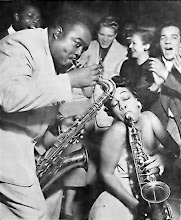
Like many of his R&B / jazz sax contemporaries, Bill recorded some soul jazz LPs in the early 1960s - "Wild Bill's Beat" and "Bottom Groove" for Jazzland in 1961. In 2009 Concord Music combined both LPs on one CD called "Bottom Groove." It seems to be out of print but you can hear the music on Spotify or YouTube. I was so impressed that I've ordered a second hand copy of the CD.


Bill remained active in music and featured on Marvin Gaye's "Mercy Mercy Me (The Ecology)" in 1971. He moved back to California where he died in 1983. By some strange coincidence while I was writing this blog post the latest issue of Blues and Rhythm magazine arrived. It contains a hitherto unpublished 1974 interview with guitarist Pee Wee Crayton and there, on the final page of the article is a photo of Wild Bill Moore on stage with Pee Wee Crayton and Percy Mayfield at a blues festival in 1982. It looks like Wild Bill was still rockin' almost to the very end.

Further listening - Bill's complete 1940s and 1950s recordings were compiled on two Blue Moon CDs in 2004. They are sadly hard to find nowadays, especially Volume 1. If you find copies, grab 'em!


Monday, 20 March 2017

Paul Williams And His Hucklebuckers (Savoy MG-15046)


Side A:
01. Jockey Jump
02. Rye Boogie
03. Jeep's Blues
04. Paul's Boogie

Side B:
01. Weasel Swing
02. Juice Bug
03. Camp Meetin' Bounce
04. Blowing The Boogie

Download from here:


10 inch vinyl LP released in 1954. All the above scans from www.45worlds.com.

The LP has been "reconstructed" using rips from various sources.

Recording and original release details of the tracks:

"Jockey Jump" was recorded on March 2nd, 1948 in Detroit. Personnel: Phil Guilbeau (trumpet); Wild Bill Moore (tenor sax); Paul Williams (baritone sax); Floyd Taylor (piano); Herman Hopkins (bass); Reetham Mallett (drums).

"Jockey Jump" was originally released as "Waxie Maxie" (b/w "Spider Sent Me") on Savoy 670, August 1948. Reached number 11 in Billboard's best selling race records chart, late September 1948.

"Juice Bug" was recorded on November 2nd, 1949 in New York City. Personnel: Phil Guilbeau (trumpet); Fred Jackson, Cranford Wright (tenor saxes); Paul Williams (baritone, alto sax); Lee Anderson (piano); Pete Glover (bass); Bill Benjamin (drums).

Originally released as "Juice Bug Boogie" on Savoy 721 (B-Side of "Cranberries") in January 1950.

Label shot: Discogs.com
"Paul's Boogie" and "Camp Meetin' Bounce" were recorded on December 1st, 1949, in Detroit. Personnel: Phil Guilbeau (trumpet); Fred Jackson, Cranford Wright (tenor saxes) Paul Williams (baritone, alto sax); Lee Anderson (piano); John Murphy (bass); William Benjamin (drums).

"Camp Meeting Bounce" was originally released on Savoy 734 (B-Side of "What's Happening") in March 1950.

"Paul's Boogie" was originally released on Savoy 758 (B-Side of "Jeep's Blues") in September 1950.

"Jeep's Blues," "Rye Boogie" and "Weasel Swing" were recorded on May 18th, 1950 in New York City. Personnel: Phil Guilbeau (trumpet); Joe Alexander, Miller Sam (tenor saxes); Paul Williams (baritone sax); Lee Anderson (piano); John Murphy (bass); William Benjamin (drums).

"Weasel Swing" and "Rye Boogie" were originally released on Savoy 751 in June 1950.


"Jeep's Blues" was originally released on Savoy 758 (b/w "Paul's Boogie") in September 1950.

"Blowing The Boogie" was recorded on 17th December, 1951, in New York City. Personnel: Blue Mitchell (trumpet); Lee Pope (tenor sax); Ted Butler (baritone sax); Paul Williams (baritone, alto sax); Lee Anderson (piano); Sam Jones (bass); Joe Booker (drums).

"Blowin' The Boogie" was originally released on Savoy 831 (b/w "It's All Over Now") in January 1952.


Our look at releases on the Savoy label continues with this 1954 LP of Paul Williams tracks which were recorded between 1948 and 1951. In the late 1940s Savoy had a series of big R&B hits with saxophone instrumentals such as "Bubbles" by Wild Bill Moore, "The Hucklebuck" and "Thirty-Five Thirty" by Paul Williams, "Corn Bread" by Hal Singer and "Deacon's Hop" by Big Jay McNeely.

See the post "Rhythm and Blues Volume 1" for these hits. We'll be looking at some of these sax players again in upcoming posts, including another look at Paul Williams.

Be Bop Wino - your saxsational R&B blog!

Saturday, 4 March 2017

Rhythm and Blues Volume 1 (Savoy LP MG 15008)


Side A:
01. The Hucklebuck - Paul Williams
02. The Deacon's Hop - Big Jay McNeeley
03. 35-30 - Paul Williams

Side B:
01. Bubbles - Bill Moore
02. Corn Bread - Hal Singer
03. Lights Out - Milton Buckner

Download from here:

http://www48.zippyshare.com/v/UiU25ocr/file.html

Here's a bit of fun for the weekend! This is a "reconstruction" of the Savoy 10 inch LP MG 15008, issued in 1952, although some sources give 1951 as the year of issue. I've been unable to find any reference to this LP in Billboard or The Cash Box, so the exact year remains in doubt.

The front cover was "borrowed" from Discogs.com, and the label shots are from ebay. According to various websites the back cover of this LP was blank. I have the first five tracks of the compilation on a slightly scratched copy of the classic Savoy 2LP set from the 1970's, "The Roots Of Rock'N Roll," so this download contains that authentic crackly vinyl experience. The Milt Buckner track is from a Chronological Classics download from Uncle Gil.

Track details:

1. The Hucklebuck - Paul Williams. Personnel: Phil Guilbeau (trumpet); Miller Sam (tenor sax); Paul Williams (baritone, alto sax); Floyd Taylor (piano); Herman Hopkins (bass); Reetham Mallett (drums). Recorded in Detroit, 15th December, 1948.

Released on Savoy 683 (b/w ""Hoppin' John"), January 1949. "The Huckle-Buck by Paul Williams and his Hucklebuckers."

2. The Deacon's Hop - Big Jay McNeeley. Personnel (possibly - opinion varies!): John Anderson (trumpet); John "Streamline" Ewing (trombone); Big Jay McNeely (tenor sax); Bob McNeely (baritone sax); pbly Jimmy O'Brien (piano); Ted Shirley (bass); Leonard "Tight" Hardiman (drums). Recorded in Los Angeles, December 15th, 1948.

Released on Savoy 685 (b/w "Artie's Jump"), January 1949. "The Deacon's Hop by Deacon McNeeley's Blue Jays."

3. 35-30 - Paul Williams. Personnel: John Lawton (trumpet); Walter Cox (tenor, alto sax); Paul Williams (baritone sax); T.J. Fowler (piano); Hank Ivory (bass); Clarence Stamps (drums). Recorded in Detroit, 6th October, 1947.

Released on Savoy 661 (b/w "Come With Me Baby"), December 1947. "Thirty-Five Thirty by Paul Williams Sextette."

4. Bubbles - Bill Moore. Personnel: Phil Guilbeau (trumpet); Wild Bill Moore (tenor sax); Paul Williams (baritone, alto sax); Floyd Taylor (piano); Herman Hopkins (bass); Reetham Mallett (drums). Recorded in Detroit, 21st November, 1947.

Released on Savoy 662 (B Side of "Swingin' For Pappy"), January 1948. "Bubbles by Bill Moore And His Band."

5. Corn Bread - Hal Singer. Personnel: Milt Larkin (trombone); Hal Singer (tenor sax); Wynton Kelly (piano); Franklin Skeete (bass); Heywood Jackson (drums). Recorded in NYC, circa June 1948.

Released on Savoy 671 (b/w "Plug For Cliff"), August 1948. "Corn Bread by Hal Singer Sextette."

6. Lights Out - Milton Buckner. Personnel: Pazzuza Simon (tenor sax); Milt Buckner (piano); Curly Russell (bass); Arthur Herbert (drums). Recorded in NYC, 28th October, 1946.

Released on Savoy 653 (b/w "Raising The Roof"), July 1947. Credited to "The Beale St. Boys" with no mention of any of the performers on the label. The composer credit "A.M. Brunner" was a pseudonym for Savoy owner Herman Lubinsky. "Lights Out" was subsequently reissued on a 45 rpm disc, Savoy 45-797, still credited to The Beale St. Boys. The reverse side of this release was "Corn Bread" by Hal Singer.

"Lights Out" was first credited to Milt Buckner on this LP, and is a terrific late night slow blues instrumental which is similar to Sonny Thompson's "Long Gone." This track was also released as a single on Savoy 1136 in September 1954 under the title "Blue Nights" (b/w "Blue Dreams"), credited to "The Hot Shots." This time round the composer credit was given to "L. Herman," another pseudonym for Herman Lubinsky.

Label shot from Discogs .com
All of the tracks on this LP also appeared spread across two Savoy EPs confusingly titled "Rhythm and Blues Volume 1" and "Rhythm and Blues Volume 2" with the exact same front cover artwork as the LP. The front cover of the  Volume 1 EP was coloured red and that of the Volume 2 EP was coloured blue (see below).

Sleeve shot from Discogs.com
The Volume 1 EP (XP 8049) had the Paul Williams tracks "The Hucklebuck" and "35-30" plus "Bubbles" by Bill Moore and "Corn Bread" by Hal Singer. Volume 2 (XP 8050) had "The Deacon's Hop" by Big Jay McNeely (note that his surname was now spelled without the extra "E") and "Lights Out" by Milton Buckner. The two additional tracks were "Back Biter" by T.J. Fowler and "Cooking With Cookie" by Sir Charles Thompson with Hal Singer on tenor sax.

We may well be digging out more gems from the 1940s Savoy vaults in upcoming posts. Have a groovy weekend!

Thursday, 21 July 2016

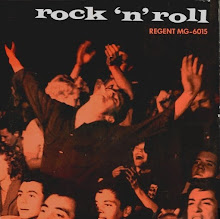
Rock 'n' Roll (Regent MG-6015) - Re-up!


Side 1:
01. Rockin' Boy - Chuz Alfred Combo
02. Hot Rod - Hal Singer
03. Blues For Everybody - Bobby Banks Orch.
04. Playboy Hop - Rockin' Bros. Orch.
05. The Grinder - Rockin' Bros. Orch.

Side 2:
01. You Gotta Rock And Roll - Bob Oakes Orch.
02. Backbiter - T.J. Fowler
03. Wine Cooler - T.J. Fowler
04. Rooster Boogie - Paul Williams Orch.
05. Frog Hop - Hal Singer Orch.

Download from:


Original Post (1st May, 2010) is here:


In response to a re-up request, here's a genuine 1950s LP which was sent in to the blog by an anonymous donor back in 2010.

A theme which has occasionally reared its head on this blog is "exploitation" and this is as fine an example of cashing in on the rock 'n' roll phenomenon as you could hope to see. The LP was issued on Regent in 1956 (probably in the second half of the year) and it consists of tracks recorded in 1954-56 as rock 'n' roll tracks, plus R&B tracks from 1951-52.

The repackaging of early 1950s and even late 1940s R&B as "rock n' roll" was a common practice of record labels as they tried to achieve sales among the burgeoning teen market of the second half of the 1950s. There have been several examples posted on this blog, including some LPs on Atlantic, and the whole "Hen Gates" saga on various budget labels. Of course the Twist craze of the late 1950s and early 1960s provided another opportunity for record companies to pitch old material at a new market. We had a fine example on this blog - A Crown LP of old Jimmy McCracklin tracks presented as "Twist" tracks. Ludicrous, but nevertheless a fine blues album!

Regent was a subsidiary label of Savoy, so they had access to a strong R&B back catalogue. Here's the deal on the contents of this LP:

01. Rockin' Boy - Chuz Alfred Combo - originally released on Savoy 1175 b/w "Rock Along." Recorded in Cincinnati, March 30th, 1955. Personnel: Ola Hansson (trombone); Chuz Alfred (tenor sax); Chuck Lee (piano, drums). Here are the Chuz Alfred Combo, the wild men of rock 'n' roll:


02. Hot Rod - Hal Singer - originally released on Savoy 1179 b/w "Rock And Roll." Recorded in NYC, October 27th, 1955. Personnel: Buddy Lucas, Hal Singer (tenor saxes); Kelly Owens (piano); Mickey Baker (guitar); Leonard Gaskin (bass); Panama Francis (drums). Hal Singer was a genuine rock 'n' roll wild man. His 1948 recording of "Corn Bread" (Savoy 671) contains every rock 'n' roll riff known to humankind.

03. Blues For Everybody - Bobby Banks Orch. - originally released by The Bobby Banks Trio on Savoy 1186 in 1956. B side of "Shangri La." Recorded in NYC, December 29th, 1955. Personnel: Henry Durant (tenor sax); Bobby Banks (organ); Jimmy Schenck (bass); Rodney "Red" Alcott (drums).

04. Playboy Hop and 05. The Grinder - Rockin' Bros. Orch. - originally released on Savoy 1144, credited to The Rocking Brothers. Recorded in October or November 1954. Location and personnel unknown. "Playboy Hop" features excellent baritone sax while "The Grinder" is a fine example of striptease sleaze. A very good disc.

06. You Gotta Rock And Roll - Bob Oakes Orch. - originally released on Regent 7502, credited to Bob Oakes and his Sultans. B side of "Church Bells May Ring." Recorded NYC, April 13th 1956. Bob Oakes (vocals) with unknown personnel. Standard "rock and roll" vocal from Bob Oakes, but the band really cooks. Great wailin' tenor sax backing.

07. Backbiter and 08. Wine Cooler - T.J. Fowler - originally released on Savoy 857. Recorded in Detroit, Michigan, July 25th, 1952. Personnel: Elliott Escoe (trumpet); Lee Gross (alto sax); Walter Cox (tenor sax); T.J. Fowler (piano); Calvin Frazier (guitar); James Murphy (bass); Clarence stamps (drums). The real deal - good early 1950s R&B instrumentals. Also on the blog - "Early Detroit R&B" by T.J. Fowler

09. Rooster Boogie - Paul Williams Orch. - unissued Savoy track. Recorded February 26th, 1951. Location unknown. Paul Williams (baritone sax) with unknown personnel.

10. Frog Hop - Hal Singer Orch. - originally released on Savoy 861 in September 1952 as B side of "Indian Love Call." Recorded in NYC, August 21st 1952. Personnel: Hal Singer and Sam "The Man" Taylor (tenor saxes); Dave McRae (alto and baritone sax); Kelly Owens (piano); Mickey Baker (guitar) plus unknown trumpet, bass and drums. A rousing end to this compilation!


The original post ended with a plea for anyone who could send in a copy of the companion LP to this compilation. In 1957 Regent issued an LP "Rock and Roll Party" (MG-6042) with tracks by Nappy Brown, Little Esther, Big Jay McNeely, T.J. Fowler, Paul Williams, The Hot Shots, Hal Singer, and Heywood Henry. Can anyone out there help? Millions of rock 'n' roll fans would be eternally grateful (as would I).


Sunday, 22 June 2014

"Hot Jazz" and "Race" Records

 
I originally meant to make this post solely about a Leo Parker December 1947 single release on Savoy - "Wild Leo" / "El Sino" but while browsing online through the Billboard issues of the period (available free via Google Books) I found myself reading up on the reviews of other releases. That's how this post "growed and growed" as I found myself wandering down the highways and byways of  late 1940s jazz and R&B.
 
So let's start with "Wild Leo" / "El Sino" (Savoy 912):


Recorded in Detroit, October 4th, 1947. Personnel: Howard McGhee (trumpet); Gene Ammons (tenor sax); Leo Parker (baritone sax); Junior Mance (piano); Gene Wright (bass); Chuck Williams (drums).

The disc was reviewed in the Billboard issue of December 13th, 1947. Of "Wild Leo" Billboard said: "Showcase for the bary horn of Leo Parker with boppish backgrounds." As for "El Sino": "Medium tempoed be-bop riffer with top notch Parker bary, Navarro trumpet solos." The trumpet player was in fact Howard McGhee, but Fats Navarro performs on a track further down this post.


The Leo Parker platter was reviewed in the "Hot Jazz" section. On the same page were reviews under the heading "Race" which was the term used by Billboard at the time for what would later (from June 1949 onwards) be called "Rhythm and Blues" in the trade journal. The platter in this section which caught my eye was the Bull Moose Jackson release on King 4181, "I Love You, Yes I Do" / "Sneaky Pete":


Recorded in New York City, August 1947. Personnel, largely unknown, except Bull Moose Jackson (vocals, tenor sax). This disc went on to become the fourth largest rhythm seller of 1948, behind "Tomorrow Night" by Lonnie Johnson, "King Size Papa" by Julia Lee and "Long Gone, parts 1 and 2" by Sonny Thompson. Bull Moose was the top selling rhythm artist of 1948, easily outselling Louis Jordan thanks to big hits like "I Love You, Yes I Do", "All My Love Belongs To You", "I Can't Go On Without You" and "Love Me Tonight".

Many Bull Moose discs featured a ballad on one side and a jump tune on the other side. Collections of his material which were released from the 1980s onwards tended to feature the latter, often featuring "lee-rics" such as "Big Ten Inch" and "I Want A Bow Legged Woman." His ballads were generally consigned to the dustbin of musical history. However, I managed to resurrect "I Love You, Yes I Do" from a 1979 "Old King Gold" LP, hence the dodgy sound quality despite some TLC on my conversion software.

Continuing my Billboard search on Leo Parker, I came across this Savoy advert in the issue of 20th November, 1948:

 
What Billboard rather condescendingly labelled "race" records are advertised by Savoy under "Tops in Pops" and "Tops in Bop" is used for jazz releases, which is preferable to the rather archaic sounding "hot jazz." In the late 1940s, Savoy was a big backer of both be-bop and sax-driven r&b. The biggest seller of the discs advertised above was Hal Singer's storming "Corn Bread" which was the 9th biggest selling rhythm platter of 1948 and the second biggest selling  rhythm instrumental on the charts, behind Sonny Thompson's "Long Gone" (Miracle 126) which featured Eddie Chamblee on tenor sax.


Baritone sax man Paul Williams' "Waxie Maxie" was also a good seller, although his "Thirty-Five Thirty" was an even bigger success. Other sax instros on Savoy that year included "September Song" by Don Byas and two from Wild Bill Moore: "Bubbles" and "We're Gonna Rock." Other labels were in on the sax action too - King / Gotham with "Temptation" by Earl Bostic, and Atlantic with "Blue Harlem" and "Midnight Special" by the Tiny Grimes band featuring Red Prysock.

Enough from me, it's time to rock and bop to four of the tracks from the above advert: "Waxie Maxie" by Paul Williams; "Spinal" by Eddie "Lockjaw" Davis and his Be-Boppers (with Fats Navarro); "Cornbread" by Hal Singer; and "Barbados" by Charlie Parker.