Be Bop Wino Pages

Joan Selects - the complete Joan Selects Collection

Big Ten Inchers - 78rpm rips by El Enmascarado


Attention Mac Users!

Mac users have been experiencing problems in unpacking the WinRAR archives used on this blog. Two solutions have been suggested.

1. Use The Unarchiver - www.theunarchiver.com - see comments on Little Esther Bad Baad Girl post for details.

2. Use Keka - http://www.kekaosx.com/en/ - see comments on Johnny Otis Presents post.

Monday, 18 July 2011

Rock The Joint!

Jimmy Preston - Wild Man of Rock 'n' Roll 
It’s time for another Be Bop Wino playlist post. The tracks listed below are for your listening pleasure only. Downloading is not available. As you can see from the length of the post below the playlist widget, I kind of got carried away by the exuberance of my own verbosity ….


It was a wild and raucous jump blues recorded in May 1949 by Jimmy Preston and his Prestonians. It was covered by Bill Haley and the Saddlemen in 1952, and thus became a milestone in the development of rock and roll. That’s what most fans of R&B and early rock and roll know about “Rock The Joint.” But there’s much more to the story of this record than that short summary.

Our playlist starts with three records which influenced “Rock The Joint.” They were recorded within a few days of each other at three widely separate locations. There’s also the first cover version by a white band, which preceded the Bill Haley version, and that brings us to a whole music and dance scene which was a conduit for white kids picking up on R&B but which is rarely mentioned in histories of rock and roll, at least not the ones I’ve read.

Let us go back to December 1947, a year and a half before Jimmy Preston recorded “Rock The Joint.” With the second American Federation of Musicians recording ban due to start on the first of January 1948, the final weeks of 1947 saw frantic recording activity by diskeries all across the U.S. of A. On December 18th, in Detroit, the Wild Bill Moore Sextette laid down the primitive honker “We’re Gonna Rock” for Savoy Records. Underpinned by the boogie piano of T.J. Fowler, beefy baritone sax blasts from Paul Williams, and a band chant of “We’re gonna rock, we’re gonna roll,” Wild Bill’s down in the alley tenor sax growled and squealed high, wide and handsome over the whole glorious shootin’ match.

On December 23rd, in Los Angeles, the little known Nelson Alexander Trio recorded “Rock That Voot” for Specialty Records. They were a standard piano, guitar and bass group of the kind which became popular in the wake of the success of the King Cole Trio. This driving little number is structurally close to “Rock the Joint,” although in spirit it remains closer to the jive groups of the late 1930s and early 1940s with its unison vocal chorus of “I wanna rock that voot, baby all night long!” The lyrics are racy, to say the least, as it’s pretty clear that the singer’s intense desire to “rock that voot” can mean only one thing, and it doesn’t involve listening to a Slim Gaillard record. The Trio’s members were Edgar Rice (guitar), William Regan (bass) and Nelson Alexander (piano).

Dig those ties! The Nelson Alexander Trio
The King Record label’s new signing Wynonie Harris was busy recording in December 1947. On the 13th and 16th of the month he was in a studio in New York and on 23rd December he was recording in King’s home city of Cincinnati, backed by a group of top notch musicians led by Oran “Hot Lips” Page. On the 28th December he was back in the Cincinnati studio with much the same set of musicians for a session which would yield two big R&B hits – “Lollipop Mama” and “Good Rockin’ Tonight.” It is of course the latter recording which concerns us in our eternal quest for the true origins of rock and roll.

Wynonie’s “Good Rockin’ Tonight” was a cover of the more sedate original version by the composer of the song, Roy Brown. The Harris version had a squawking sax solo by Hal Singer and a heavier beat reinforced by gospel style handclapping, a feature which would also be used by Jimmy Preston on “Rock The Joint.” The lyrics included mention of the more temporal interests of Deacon Jones and Elder Brown whose boozy misadventures had been the subject of Wynonie’s first hit “Who Threw The Whiskey In The Well,” a few years back.

Of those three “rockers” recorded in the dying days of 1947, it was “Good Rockin’ Tonight” which was released first, in February 1948. It was easily the most successful of the three records, reaching number one in the R&B chart. “Rock That Voot” was the next to be released, in April 1948, but the record buying public remained indifferent to its charms. Wild Bill Moore’s “We’re Gonna Rock” was released in June 1948 (on Savoy 666 – proof that the Devil was at work), climbing to number 14 in the R&B charts.

Billboard, June 1948

From the same edition of Billboard - Nelson Alexander not getting much of a push from his label

Still June, 1948 - Mr Blues rules race retail sales chart
Of the three discs, it is “Good Rockin’ Tonight” which remains the best known, being generally credited with starting the “rocking R&B” trend which gradually transformed jump blues into something rather different from its small group jazz origins. Of course the Elvis Presley cover version has ensured that the song is still widely known today, although how many latter day rockabilly fans are aware that Link Davis covered it on Goldband years before Elvis walked into the Sun studio?

We now find ourselves in a recording studio in Philadelphia in May 1949, where jump band leader, alto sax man, and vocalist Jimmy Preston is about to record “Rock The Joint” for Gotham Records. Preston was born in Chester, Pennsylvania, and grew up in Philadelphia. His band, the Prestonians, had started recording for Gotham in 1948.

At their second session for the label in early 1949, the band had recorded “Hucklebuck Daddy,” a fast and rowdy jump blues with shouted band vocals, moronically honking sax and a subtle chorus of “She said: ride, Jimmy, ride!” In this opus “Hucklebuck” was very plainly not a dance, but something much more intimate and energetic. By the end of April the record had reached number 6 in the Billboard Race Record chart but by early May it had already fallen back to number 13.

A follow up in the same vein was obviously called for and Gotham A&R man Doc Bagby brought along “Rock The Joint,” a song he had co-written with his band assistant Wendell Keane and his band singer Harry Crafton. He also brought along instrumental reinforcement in the shape of tenor sax player Danny Turner.

The resulting performance was even more frantic than “Hucklebuck Daddy,” but without the single entendre lyrics. “Rock the Joint” was a clarion call to have a whale of a time with its pounding beat, squealing saxophones and drunken yelling. It sounded like a small riot (not many injured) was taking place in the studio. The disc achieved the same success as "Hucklebuck Daddy,” peaking at number 6 in Billboard’s renamed Rhythm and Blues chart.

On September 22nd, 1949, Columbia Records recorded a cover version by another Philadelphia jump band, Chris Powell and the Five Blue Flames. “Combo pitches a mad ball in the “Good Rockin’ school. Gangbuster tenor, handclapping, unison chanting and a live beat add to a solid side,” noted Billboard in its issue on the 12th November, 1949. Danny Turner was on this version too, blowing alto sax with the Blue Flames, but perhaps the outstanding feature of this version is the superb playing of Eddie Lambert on electric guitar.

On September 29th, 1949, way down in Dallas, Texas, the original good rockin’ man, Roy Brown, was in the studio with his Mighty-Mighty Men recording the wildly blasting “Boogie At Midnight” which was very much in the “Rock The Joint” mould. “Well, you wanna get drunk, you got a good point, let’s get together, gonna rock this joint,” howled Roy over the unholy sax shrieks of that mightiest of the Mighty-Mighty Men, the great Johnny Fontennette. Released in November 1949 on the DeLuxe label, this apocalyptic rocker, along with “Hard Luck Blues” and “Love Don’t Love Nobody” helped Roy to become the fourth top selling R&B artist of 1950.

Good Rockin' Roy Brown
And that appeared to be that, until 1952, when a country singer called Bill Haley, who happened to live and work in Jimmy Preston’s hometown of Chester, covered “Rock The Joint” and more or less invented rock and roll, or so the story used to go. But Bill Haley and the Saddlemen weren’t the first white musicians to cover the Jimmy Preston record. The previous year a version appeared on the tiny BSD label out of Auburn, New York, performed by Jimmy Cavallo and his band.

Unlike the Bill Haley version, this was a straight rhythm and blues performance with no trace of country or pop. Jimmy Cavallo had been singing and playing R&B tenor sax since 1946, at which time Bill Haley was recording with The Downhomers, prior to recording with The Four Aces of Western Swing and (in 1950) forming The Saddlemen.

Born in Syracuse, New York, Jimmy started playing alto sax in his school band but soon shifted to tenor sax. He started listening to what were then called “race” records by Louis Jordan and other jump bands. In 1946 naval service took him to Fayetteville, North Carolina, where he not only furthered his jump blues education by hanging around black clubs, he also formed his own R&B band. Meanwhile on the Carolina coast white kids were turning on to R&B in a big way as juke box owners in the white patronised resorts started to stock their machines with jump blues 78s.

This was the kind of music that was ideal for shagging to. For the benefit of UK readers, “shag” in this context refers to a form of swing dancing which had been developing in the Carolinas since the late 1920s. I hope that clears up any unfortunate misunderstandings. Soon artists such as Paul Williams, Paul Gayten and Earl Bostic were playing the resorts. Jimmy Cavallo’s band spent the summers of ’47, ’48 and ’49 playing their brand of R&B to an ever increasing following at resorts such as Carolina Beach, Ocean Drive and Myrtle Beach.

At the end of the 1949 summer season Jimmy disbanded his group, returned to his hometown of Syracuse, recruited a new band and started playing dates at his uncle’s club where he gradually weaned the audience over to R&B. In 1950 the band took their rockin’ music to the nearby lakeside resort of Sylvan Beach where once more they built up a big following. In 1951 they recorded a session for the small BSD label of Auburn, New York. Owned by Angelo Pergolito, the recording studio was the basement of his house and the distribution was strictly local.

Scan courtey Joan K
Scan courtesy Joan K
At the recording session, the precise date of which remains uncertain, Diz Utley, the tenor sax player from Jimmy’s Carolina band was brought in to beef up the sound. Two singles were released – “Ha Ha Ha Blues” / “I Got Eyes For You” and “Rock The Joint” / “Leave Married Women Alone.” As you can hear from the playlist above, this version of “Rock The Joint” packs quite a wallop. It starts with Jimmy declaiming: “Well, rock-a-bye baby in the tree top, don’t need no wind for Mr. Blues to rock!” Of course he borrowed that from the intro to “Rock Mr. Blues” by Wynonie Harris. There’s nothing like nailing your colours to the mast right from the off. Then we’re into a suitably rockin’ rendition of the Jimmy Preston hit.

And now we enter the realms of “what if.” For instance, “what if a bigger label had picked up on the disc and given it national distribution?” Or alternatively “what if Jimmy had recorded more discs like this and that elusive bigger label had picked up on them?” Would Jimmy Cavallo have gone down in history as the founder of rock and roll instead of Bill Haley or Elvis Presley? Would rock and roll have broken big in 1952 instead of 1955?

It wasn’t to be. Jimmy didn’t record again until 1956 by which time rock and roll was already well on its way to becoming a world wide phenomenon. At least he had a few years in the sun. By this time he was fronting sax player Joe Morelli’s band, but they were billed as Jimmy Cavallo and the House Rockers. They auditioned for Alan Freed who was impressed enough to take them under his wing.

Jimmy "Cavello" in "Rock, Rock, Rock."
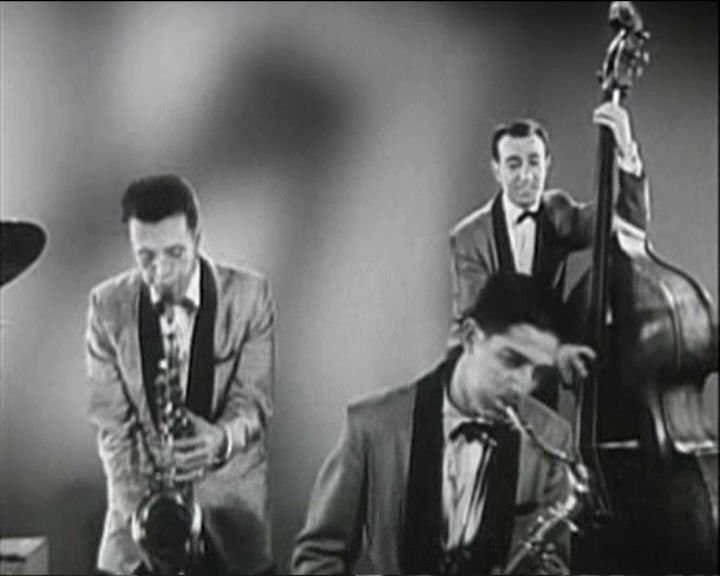
Twin sax threat - Jimmy with Joe Morelli in "Rock, Rock, Rock."
The association with Freed brought a recording contract with Coral, appearances in two Freed produced films – “Rock, Rock, Rock!” and “Go, Johnny, Go,” regular spots in Freed’s live rock and roll stage shows and a footnote in history as the first white rock and roll band to play the famed Apollo Theater. Unfortunately Freed got Jimmy’s surname wrong and they were now Jimmy Cavello and the House Rockers. Such is the price of stardom.

But let us roll back the years to the spring of 1952 and once more we find ourselves in the vicinity of Philadelphia: Chester, Pennsylvania, Jimmy Preston’s home town. There in the studio of radio station WPWA we find station musical director and would-be country and western star Bill Haley who leads a small band with a suitably cowboyish name – The Saddlemen. They’re recording a cover of “Rock the Joint” for release on small local label Essex.

Although steeped in country music, Bill was open to other musical influences. “Rock The Joint” was in fact the third R&B cover recorded by The Saddlemen. In 1950 they covered Ruth Brown’s “Teardrops From My Eyes” for Atlantic but it remained unissued. In the spring of 1951 they covered Jackie Brenston’s “Rocket 88” for Holiday, the predecessor of Essex. Both of these recordings were heavily countrified versions of the R&B originals. It was a common practise of the time for record labels to issue country versions of R&B songs and vice versa, and what Bill Haley and the Saddlemen were recording wasn’t particularly innovative.

Scan courtesy Joan K
Their version of “Rock the Joint” was another example of an R&B original being countrified. Billy Williamson’s steel guitar plays throughout and there’s solo space for him too. The lyrics had been bowdlerised, with booze references dropped and the Jelly Roll, the Hucklebuck and the Jitterbug being replaced by country dances like the Sugarfoot Rag, the Paul Jones and the Virginia Reel. But what this version does have is a brilliant guitar solo by Danny Cedrone which he reproduced note for note two years later on “Rock Around The Clock.”

“Rock The Joint” sold pretty well, at least well enough to convince Bill and the boys that R&B could be a fruitful direction for the band to take. Before the year was out they were no longer Bill Haley and the Saddlemen, but instead they were now Bill Haley and Haley’s Comets. Their music moved towards rhythm and blues with the addition of a drummer and later a sax player. In an upcoming post we’ll be taking a closer look at Bill’s musical transformation from country to rock and roll.

In July 1952 R&B band the Jackson Brothers Orchestra recorded five tracks for RCA Victor. Two of them were real belters– “There’s No Other Way” (Vic 20-5446) and “We’re Gonna Rock This Joint” (Vic 20-5004). The latter was reviewed in the November 1st, 1952 edition of Billboard: “One of the best sides from the label recently. It’s a joint-busting item that really rolls. Billy Henderson, showing a lot of presence, adds a screaming vocal. Should pull a lot of coin into boxes.”

“We’re Gonna Rock This Joint” although obviously influenced by Jimmy Preston’s “Rock The Joint” was a sufficiently different song to allow composer credits to be given to Wilfred Jackson. It resembles a sort of hybrid between “Good Rockin’ Tonight” and “Rock The Joint.” It was the powerhouse vocals of Billy Henderson which really lifted both “There’s No Other Way” and “We’re Gonna Rock the Joint” above the rest of the rockin’ R&B sides which were coming out at this time. Unfortunately for the Jackson Brothers Orchestra it all came to an untimely end when Billy Henderson was arrested in a show stopping onstage drugs bust. You can’t get more rock and roll than that.

And what of the rest of our rock and roll pioneers? Wild Bill Moore’s solo recording career was somewhat sporadic. His biggest hit was “Bubbles” on Savoy in 1948. He recorded good R&B sides for Regal and King in the 1950s and a couple of jazz LPs for Prestige in the early 1960s. He then went on to become a successful session musician with Motown. Of Nelson Alexander I know nothing of whence he came and whither he went. Doubtless the trio are still bashing out their jive novelties in the celestial cocktail lounge.

Wynonie Harris was a blues superstar in the early 1950s with a series of R&B hits on King. By the mid 50s it was all over, the hits dried up, the money vanished and he was all but forgotten when he died in Los Angeles in 1969. Drummer / vocalist Chris Powell continued to record for Columbia and its subsidiary Okeh until 1952. He then recorded for Philadelphia label Grand and thereafter for Groove until 1956. And then he was gone.

Bill Haley became a global superstar. His “Rock Around The Clock” is the top selling rock and roll disc of all time. But fame and money and reputation are transitory and wilder and more youthful rock and roll acts pushed him aside. Although the hits soon petered out (his last Billboard Top Twenty placing was in 1956) he remained a big name, especially in the UK. He was served poorly by many rock and roll histories but on this side of the pond anyone dissing Bill ran the risk of being stomped on by a six foot tall razor scarred former Teddy Boy. When he died in 1981 it was in the saddest of circumstances, wracked by the effects of a brain tumour and alcoholism. He deserved much better.

Jimmy Cavallo got it right. Today he enjoys a reputation as a founder of rock and roll thanks to his 1951 recordings. He enjoyed a few years in the big time in the second half of the 1950s and thereafter remained none too bothered by what might have been. He’s still rocking, having been “rediscovered” by new generations of R&B and R&R fans.

Jimmy Preston? His biggest hit was a 1950 cover on the Derby label of Louis Prima’s “Oh Babe.” In a Joe Lutcher style moment of clarity or madness, depending upon your point of view, he gave up music in 1952, having decided to go about the Lord’s work. He died in Philadelphia in 1984.

Digging deeper:

Listening Pleasures:


Wild Bill Moore: The Complete Recordings Volume 1 1945-1948 (Blue Moon BMCD 6042)


Specialty Legends of Boogie-Woogie (Ace CDCHD 422) – this Billy Vera comp has The Nelson Alexander Trio’s “Rock That Voot.”


The Black and White Roots of Rock ‘n’ Roll (Indigo IGODCD 2549) – a 2CD compilation by Dave Penny which looks at the interaction between mostly country and R&B in the years leading up to rock and roll. It includes the Jimmy Preston and Bill Haley versions of “Rock The Joint” as well as more Haley-esque originals and covers (it worked both ways) of “Rocket 88,” “Crazy Man Crazy,” and “Thirteen Women and One Man.” There's a host of other hepcats and hillbillies on board including Wynonie Harris, Hawkshaw Hawkins, Hank Williams, Ruth Brown, The Clovers, Moon Mullican, etc.


Rare Rock’N’Roll Rampage (Properbox 146) is a 4CD collection of the music that the late Charlie Gillett labelled “Northern Band Rock and Roll.” It has 3 of Jimmy Cavallo’s early 50s BSD sides as well as a selection of his Coral sides. Other featured artists include Freddie Bell & The Bellboys (including his version of “Hound Dog” which Elvis, er, borrowed), Dave Appell & The Applejacks, The Treniers, Eddie Fontaine, Boyd Bennett & The Rockets, Danny & The Juniors, Jimmy Daley & The Ding-A-Lings, etc. Sleevenotes by Adam Komorowski.

Reading Pleasures:


Jim Dawson and Steve Propes – What Was The First Rock’N’Roll Record? (Faber and Faber, 1992) is the bible of every fan of early rock and roll. It tells the stories behind 50 R&B, Jazz, Country and Pop records of the 1940s and 1950s which might be candidates for that elusive title. And the winner? Well the pleasure is in the journey rather than the arrival. There’s no Jimmy Cavallo, though.


‘Fessa John Hook – Shagging in the Carolinas. (Arcadia Publishing, 2005) A pictorial history of the music and dance scene of the Carolina beach resorts. That’s the Jimmy Cavallo band playing in the background on the front cover picture. It’s available at a very reasonable price from amazon.co.uk. John Hook has a website at http://www.beachshag.com/ which includes a link to his subscription journal “Dancing On The Edge.” In downloadable pdf format, the journal has articles based on interviews with dancers and musicians who made up what was to become known from the late 60s onwards as Beach Music. There is much to interest fans of 40s and 50s R&B and early rock and roll.

Morgan Wright’s http://www.hoyhoy.com/ website is the place to find out about the rise of rockin’ R&B. It has fascinating articles on the artists and records which were so important to the development of rock and roll. There is an article on Jimmy Cavallo based on an interview with the great man himself.

Chris Gardner’s Bill Haley Database is the ultimate point of info on the recordings of Bill Haley. Every recording he ever made, both as sideman and bandleader. An epic piece of work.

My thanks to Joan K for the scans and sound files of records by Jimmy Cavallo and Bill Haley. And finally my thanks to spyder john for educating me on the Beach Music scene and providing links to further information on this aspect of the history of rock and roll.

I solemnly swear on my copy of Arnold Shaw’s “Honkers and Shouters” and my ancient Savoy 2LP set of “Honkers and Screamers” that this is the last blog post of such a length that I will ever post. From now on, more music and less words.

Saturday, 2 July 2011

One-Nighter Boogie - Illinois Jacquet


Once more El Enmascarado sweats blood to bring us a rip from one of his collection of 78 rpm discs. And as if that weren't enough, he has also made a "mash up" video using public domain footage from the Internet Archive to provide atmospheric visuals for the cool sound of  "One-Nighter Boogie" by Illinois Jacquet.

"One Nighter-Boogie" was recorded in New York on the 24th May 1951. The band consisted of: Illinois Jacquet (tenor sax); Hank Jones (piano); John Collins (guitar); Gene Ramey (bass); Art Blakey (drums). It was released on Mercury as the B-side of "Port of Rico" which was an R&B chart hit in 1952.

It's a cool, insistent little instro from a year when there were several big instrumental hits including Jimmy Forrest's "Night Train," Earl Bostic's "Flamingo" and Sonny Thompson's "Mellow Blues (1 & 2)." At this time Illinois was recording and performing with a large group, but at this session he opted for a stripped back lineup which in my opinion provides a better backing for his tenor sax. I first came across "One-Nighter Boogie" on the LP "Groovin with Jacquet" and I have also included a vinyl rip from that album, so that you can enjoy both the shellac and the vinyl experience (via mp3, though). 

Listen to both versions here:


So that you can appreciate the work that El Enmascarado puts into producing listenable rips, here's a photo of the disc, which as you can see is in pretty poor condition and therefore required a considerable amount of TLC via Audacity in order to render the mp3 rip listenable.


And last, but far from least, here is El Enmascarado's video mash up which incorporates footage from the 1948 cheapo exploitation movie "Killer Diller." The band is the Andy Kirk Orchestra which was at that time on the verge of breaking up. The sax players out front with bandleader Kirk are Ray Abrams and Shirley Green. You can see the full movie (which also includes the King Cole Trio) at http://www.archive.org/details/killer_diller

And here's the "One-Nighter Boogie" video:

Sunday, 26 June 2011

Detour Records


Some time ago I posted a couple of LPs from the UK Detour Records reissue label – “Groove Jumping!” and “The Best of Doo Wop Classics Volume 2.” The “Groove Jumping!” post kicked off speculation among blog followers concerning the identity of other Detour releases, with The Hound reminding us of the follow up to “Groove Jumping!” and a couple of 45 rpm issues, dbtb weighing in with the info that volume 1 of “The Best of Doo Wop Classics” was a Du-Droppers LP and most recently Grant informing us that there was a Champion Jack Dupree LP on Detour.


Recently I came across an obituary for mastering engineer and founder of Detour Records, Bob Jones, in the June 2009 issue of Blues & Rhythm magazine. Written by Tony Burke, it includes a list of releases on Bob’s Detour label and I have taken the liberty of extracting the list from the very informative article.

"Boppin'" Bob Jones worked initially for Decca, then later for Pye where he was involved in re-mastering tapes for specialist reissue labels. For many years he was involved with Ace and also worked on Bear Family reissues. In the early 1980s he set up his own reissue label, Detour, releasing a limited number of LPs and singles which were distinguished by superb sound quality. Most of the material consisted of R&B and Hillbilly / Rockabilly from Groove and RCA, with issues being concentrated in two time periods, 1982-83 and 1987-89.
 
Juke Blues No. 11 Winter 1987/88


Ten LPs were issued:
In 1982 – “Ballroom King” by Pee Wee King. In 1983 – “Skeeter Davis Sings Buddy Holly,” and “Groove Jumping!” In 1987 – “Just Keep A-Movin’” by Hank Snow, “More Ballroom Kings” (a Hillbilly compilation), “Still Groove Jumping!” and the Champion Jack Dupree set “Shake Baby Shake.” In 1989 – “Hillbilly Hound Dawgs And Honky Tonk Angels,” “The Best Of Doo Wop Classics Volume 1 featuring The Du-Droppers (Bambalam!)” and “The Best of Doo Wop Classics Volume 2 featuring The 5 Keys and The Nitecaps.”

I have a vague memory that a Piano Red LP was in the pipeline, but it seems to have never been released.

Blues & Rhythm No. 38 August 1988


There were also some 45 rpm singles:

Cecil McCullough And The Border Boys - “Pick ‘Em Up And Shake ‘Em Up” / “Nothing Else,” Laura Lee Perkins - “Gonna Rock My Baby Tonight” / “Come On Baby,” Clarence Garlow - “Route 90” / “Crawfishin’” and Benny Barnes – “You Gotta Pay” backed with Les Cole – “Be Boppin’ Daddy.”

The Clarence Garlow single was a reissue of a Flair disc from 1953. Both sides were also on the early Ace (UK) LP “Texas Rhythm & Blues.”

Sources:

Tony Burke – Bob Jones obituary, Blues & Rhythm Magazine number 240, June 2009.

“Jump Man Jump” and “Midnight Hours” were downloaded from a posting of the "Still Groove Jumping!" LP on the cool “Twilightzone!” blog.

The Clarence Garlow tracks are from the Ace LP "Texas Rhythm & Blues." Both are now available on the Ace CD "Long Gone Daddies," a top notch comp of R&B and Rockabilly from the Bihari group of labels.

Juke Blues No. 12 Spring 1988

Wednesday, 15 June 2011

T-Bone Walker - T-Bone Walker Sings The Blues


It's not my name written on the cover - I bought the LP 2nd hand many years ago!
Side 1:
1. Strollin' With Bone
2. You Don't Love Me
3. You Don't Understand
4. Say! Pretty Baby (Welcome Blues)
5. Tell Me What's The Reason
6. Blue Mood
7. Railroad Station Blues

Side 2:
1. The Sun Went Down
2. The Hustle Is On
3. Evil Hearted Woman
4. Cold Cold Feeling
5. I Got The Blues Again
6. Blues Is A Woman
7. Get These Blues Off Me

Ripped from vinyl at 320 kbps.

Download from here:

http://www5.zippyshare.com/v/bOmEhkV8/file.html

After his successful spell with Black and White Records, T-Bone Walker’s next recording contract was with Imperial Records for whom he recorded between April 1950 and June 1954. This 1983 Pathe Marconi release of an LP originally released by Imperial in 1960 (with 12 tracks only) finds T-Bone at the very top of his game. The April 1950 session used his road band, that of Big Jim Wynn, as backing musicians.

With Eddie Davis on tenor sax and Big Jim Wynn on baritone sax, from the very first session T-Bone’s Imperial sides delivered a far greater punch than his Black and White recordings of 1946 – 1947. The rollicking opening instrumental “Strollin’ With Bone” sets the tone and then it’s straight into the blues with “You Don’t Love Me.” Try listening to this LP with your media player on cross fade and hoo boy are you in for one hell of a musical treat.

Subsequent Los Angeles sessions through to March 1952 used musicians from Big Jim Wynn’s band mixed with former T-Bone cohorts such as Willard McDaniel, Billy Hadnott and Oscar Lee Bradley, with Maxwell Davis coming in on tenor sax. In March 1952 T-Bone’s nephew R.S. Rankin came in on second guitar. The Imperial label had established a strong New Orleans connection in 1949 – 1950, most notably with Fats Domino and Smiley Lewis, and in March 1953 T-Bone travelled to the Crescent City to record with the top local session men such as Lee Allen and Herb Hardesty. This LP features one side from those sessions – “Railroad Station Blues.”

There were further recordings with the New Orleans gang through to November 1953. Meanwhile in October 1953 T-Bone recorded in Detroit with the T.J. Fowler band which also backed him in his final recordings for Imperial in June 1954.

So download, sit back and savour R&B at its best with these great, great recordings which are probably the last sides T-Bone recorded with the rhythm and blues market in mind. Ill health brought a temporary hiatus to T-Bone’s recording career. In 1955 through to 1957 he recorded intermittently for Atlantic. Most of the sides made their first appearance on the LP “T-Bone Blues.” T-Bone’s career picked up in the 60’s when he became part of the blues revival. His subsequent recordings were all for the LP market, his final sides being recorded in 1973. He died in March 1975 at the comparatively young age of 64.

1. Strollin' With Bone
2. You Don't Love Me
3. You Don't Understand
4. Say! Pretty Baby (Welcome Blues)
5. Tell Me What's The Reason
6. Blue Mood
7. Railroad Station Blues
8. The Sun Went Down
9. The Hustle Is On
10. Evil Hearted Woman
11. Cold Cold Feeling
12. I Got The Blues Again
13. Blues Is A Woman
14. Get These Blues Off Me

All sides recorded in Los Angeles, 1950 – 1952, except “Railroad Station Blues.” T-Bone Walker, guitar, vocal on all tracks with:

April 1950 sessions personnel:

Eddie Hutcherson (tp); Edward Hale (as); Eddie Davis (ts); Big Jim Wynn (ts and bs); Zell Kindred (p); Buddy Woodson (b); Robert “Snake” Sims (d):

“Strollin’ With Bone,” “The Sun Went Down,” “You Don’t Love Me,” were recorded on April 5th, 1950. “Travelin’ Blues” and “Evil Hearted Woman” were recorded on April 6th, 1950.

August 1951 sessions personnel:

Unidentified (tp); Edward Hale (as); Maxwell Davis (ts); Willard McDaniel (p); Billy Hadnott (b); Oscar Lee Bradley (d):

“You Don’t Understand” and “Welcome Blues” (aka “Say Pretty Baby) were recorded on August 15th, 1951. “Tell Me What’s The Reason” was recorded on August 20th, 1951.

March 1952 sessions personnel:

Unidentified (tp); Edward Hale (as); Maxwell Davis (ts); possibly Big Jim Wynn (bs); Willard McDaniel or Zell Kindred (p); Buddy Woodson (b); R.S. Rankin (g); Oscar Lee Bradley or Robert “Snake” Sims (d):

“Cold, Cold Feeling,” “Get These Blues Off Me,” “I Got The Blues Again,” “Blues Is a Woman,” and “Blue Mood” were recorded in March, 1952 (exact date unknown.)

The March 1953 session was recorded in New Orleans. Personnel:

Dave Bartholomew (t); Wendell Duconge (as); Lee Allen (ts); Herb Hardesty (bs); Walter Nelson (g); Frank Fields (b); Cornelius Coleman (d); unidentified (p) Baby Davis or Tiny Brown (vocal):

“Railroad Station Blues” was recorded on March 20th, 1953 in New Orleans.

Sources: Pete Welding – liner notes to “The Complete Imperial Recordings, 1950 – 1954."

Recommended purchase:


“T-Bone Walker – The Complete Imperial Recordings, 1950-1954” is a double CD set issued in 1991 in the EMI Blues Series. Compiled by Pete Welding. 52 brilliant tracks.

Sunday, 5 June 2011

T-Bone Walker - T-Bone Jumps Again


Side 1
1. Hypin' Woman Blues
2. Too Much Trouble Blues
3. I Got A Break Baby
4. Mean Old World
5. Bobby Sox Blues
6. I Know Your Wig Is Gone
7. T-Bone Jumps Again
8. Call It Stormy Monday

Side 2
1. You're My Best Poker Hand
2. First Love Blues
3. She's My Old Time Used To Be
4. On Your Way Blues
5. I Wish You Were Mine
6. Wise Man Blues
7. Born To Be No Good
8. T-Bone Shuffle

This is a glorious Charly collection of pioneer of the electric blues guitar T-Bone Walker’s classic 1946-47 sides which he recorded for LA indy label Black and White, plus two sides he recorded for Capitol in 1942 while with the Freddie Slack Orchestra. I bought it way back in 1981 at a time when my jump blues collection consisted of little more than a handful of Swing House LPs, a best of Louis Jordan compilation on MCA, a scratched second hand Amos Milburn comp on United Artists and some imported King releases on Gusto. So you can imagine the impact these jumpers, jivers, shuffles and blues had on the as yet youthful Be Bop Wino.

Oh sure, I could write at length about the importance of T-Bone Walker in the history of R&B. About how every blues guitarist and (shudder) blues-rawk axeman owes him a debt of gratitude. Or perhaps I would be better looking back to the influences and experiences that shaped T-Bone’s music and stage act, influences that reach back through string bands, Blind Lemon Jefferson, medicine shows, classic blues divas, chumming around with Charlie Christian, big bands, jamming all night with Lester Young, and just corny old showbiz in the shape of musical reviews and song and dance acts. But what this post is really about is the fantastic music contained in these sixteen tracks. They may be slightly crackly and scratched but I’ve had the LP for around thirty years, so what do you expect?

Quite simply this is probably the coolest music you’ll ever hear. It’s real relaxed West Coast Rhythm ‘n’ Blues with small jump bands led by Jack McVea and Bumps Myers providing subtle accompaniment to T-Bones’ smoky vocals and tasteful guitar licks.

Texan T-Bone arrived in California sometime in the mid 1930s. Big Jim Wynn remembered him in the Little Harlem Club in Watts in 1936: “He was dancing and picking up tables with his mouth. He’d dance on a table and then grip it in his teeth and whirl it around. That’s what Miss Brown booked him for, as a dancer. He started singing with the first small band I had and the people went mad about him. He had a funny little box he’d play, a contraption he had made himself …” Sounds like T-Bone was already experimenting with an amplified guitar.

In 1939 T-Bone joined the big band of Les Hite as a vocalist. In fact this was a new edition of the long established band as in September 1939 Hite had dismissed his own band and taken over that of Floyd Turnham. The band went on an extensive tour, opening in Dallas at the end of September (they may have picked up T-Bone in his old home town), and in January 1940 arrived in New York. “Downbeat” noted that “his new star is T-Bone Walker with choruses on ‘I wonder why she don’t write to me.’” While in New York, the band recorded for Varsity with T-Bone’s vocals (but not guitar) being showcased on “T-Bone Blues.”

During the tour T-Bone experimented backstage with a Gibson electric guitar and on his return to LA he developed a sensational crowd pulling act with his new instrument. He had the tricks which in later years would be used by Chuck Berry and Jimi Hendrix – playing the guitar behind his head and while doing the splits. Club success brought him to the attention of new label Capitol Records. In July 1942 T-Bone was on several Capitol sessions with the Freddie Slack Orchestra, a boogie based big band which had the fabulous Ella Mae Morse on vocals (along with Johnny Mercer).

At the end of his first session with the full band (having recorded “Mister Five By Five” and several other tracks), T-Bone was backed by a rhythm trio from the band (including Freddie himself) on “Mean Old World” and “I Got A Break Baby.” This was the first time that T-Bones’ by now fully developed vocal / guitar style was recorded. However, the first Petrillo recording ban brought a temporary hiatus to his recording career. It would be over two years before T-Bones’ electric blues guitar would be captured on wax again, this time for the Chicago based Rhumboogie label, which was a promotional tie-in for the successful Chi-Town Rhumboogie night club.

The Rhumboogie opened in April 1942 with a show headlined by the Tiny Bradshaw band. In August 1942 T-Bone opened at the club as the headliner in “The Dream Revue,” a show which featured singers, dancers, chorus girls and the Milt Larkin band with Arnett Cobb and Tom Archia on saxes. The Revue, which ran until October, was a massive success and in January 1943 T-Bone was back at the club, once again with the Milt Larkin band providing backing. T-Bones’ 1944 run at the club was another success, being repeatedly extended until Wynonie Harris took over as the headliner.

As T-Bones’ 1944 spell at the Rhumboogie drew to an end at the beginning of October, he recorded six tracks for the new Rhumboogie record label backed by the Marl Young band who were by now the house band at the club. “Sail On Boogie” in particular was a storming showcase for T-Bones’ electric guitar. Three singles were released from this session, and a further session of four songs was recorded in December 1945, but none of these later recordings was released on Rhumboogie. However, two of the tracks were released as a single on Mercury.

In September 1946 T-Bone signed up with the Los Angeles based Black and White label for whom he  recorded under the supervision of Ralph Bass until the end of 1947. At the two 1946 sessions T-Bone was backed by label mate Jack McVea’s band, with trumpeter Al Killian being added on the second session in December 1946. For the 1947 sessions, studio bands centred on tenor sax man Bumps Meyers and former Les Hite drummer Oscar Lee Bradley provided sterling support. Other musicians involved included pianists Lloyd Glenn and Willard McDaniel, trumpet players Teddy Buckner and George Orendorff and bass player Billy Hadnott.

The Black and White recordings had considerable commercial success with “Bobby Sox Baby,” “Stormy Monday,” “Long Skirt Baby Blues,” “I Want A Little Girl,” “I’m Waiting For Your Call,” “Midnight Blues,” “West Side Baby,” “Description Blues” and “T-Bone Shuffle” all entering the R&B charts between 1947 and 1949.

Despite achieving good sales for records by Jack McVea and T-Bone, Black and White ran into financial problems during 1948, eventually going out of business. The T-Bone masters were bought up by Capitol in April 1949. Their new owners remastered and renumbered the tracks and reissued many of them, leading to considerable discographical confusion, which is reflected in the sleevenotes to this LP. When T-Bone resumed his recording career in 1950, he had signed with Lew Chudd’s Imperial label. That story, however, is for another post and another day.

Ripped from vinyl at 320 kbps.

Download from here:

http://www104.zippyshare.com/v/pFGTa3PK/file.html

1. Hypin' Woman Blues
2. Too Much Trouble Blues
3. I Got A Break Baby
4. Mean Old World
5. Bobby Sox Blues
6. I Know Your Wig Is Gone
7. T-Bone Jumps Again
8. Call It Stormy Monday
9. You're My Best Poker Hand
10. First Love Blues
11. She's My Old Time Used To Be
12. On Your Way Blues
13. I Wish You Were Mine
14. Wise Man Blues
15. Born To Be No Good
16. T-Bone Shuffle

“I Got A Break Baby” and “Mean Old World” were recorded in Hollywood on July 20th, 1942, with Freddie Slack and His Orchestra, rhythm section only. Freddie Slack (p); Jud De Naut (b); Dave Coleman (d)

“Bobby Sox Blues” aka “Bobby Sox Baby” was recorded in Hollywood on September 30th, 1946 with the Jack McVea All Stars. Joe “Red” Kelly (tp); Jack McVea (ts); Tommy “Crow” Khan (p); Frank Clarke (b); Rabon Tarrant (d)

“I Know Your Wig Is Gone,” “T-Bone Jumps Again” and “Call It Stormy Monday” were recorded in Hollywood on September 13th, 1947. Teddy Buckner (tp); Bumps Myers (ts); Lloyd Glenn (p); Arthur Edwards (b); Oscar Lee Bradley (d)

“She’s My Old Time Used To Be” and “Too Much Trouble Blues” were recorded in Los Angeles on November 6th, 1947. “Hypin’ Woman Blues” and “On Your Way Blues” were recorded in Los Angeles on November 7th, 1947. Teddy Buckner (tp); Bumps Myers (ts); Willard McDaniel (p); Billy Hadnott (b); Oscar Lee Bradley (d)

“First Love Blues” was recorded in Los Angeles on November 12th, 1947. George Orendorff (tp); Bumps Myers (ts); Willard McDaniel (p); Billy Hadnott (b); Oscar Lee Bradley (d)

“T-Bone Shuffle” was recorded in Los Angeles on November 13th, 1947. George Orendorff (tp); Bumps Myers (ts); Willard McDaniel (p); John W. Davis (b); Oscar Lee Bradley (d)

“Wise Man Blues” and “I Wish You Were Mine” were recorded in Los Angeles on December 17th, 1947. “Born To Be No Good” was recorded in Los Angeles on December 18th, 1947. Jack Trainor (tp); Bumps Myers (ts); Willard McDaniel (p); Billy Hadnott (b); Oscar Lee Bradley (d)

“You’re My Best Poker Hand” was recorded in Los Angeles on December 29th, 1947. George Orendorff or Jack Trainor (tp); Bumps Myers (ts); Willard McDaniel (p); Billy Hadnott (b); Oscar Lee Bradley (d)

Sources:

Mark Humphrey – liner notes to the Capitol Blues Collection 3CD set “T-Bone Walker: The Complete Capitol / Black & White Recordings”

Helen Oakley Dance – “Stormy Monday: The T-Bone Walker Story”

Robert Pruter and Robert L Campbell - "The Rhumboogie: the rise of a great black and tan" in Blues and Rhythm, number 190, June 2004

Bill Millar – “Let The Good Times Rock!”

Albert McCarthy – Big Band Jazz

The Bruyninckx Discography

Arnold Shaw: Honkers And Shouters

Big Al Pavlow’s R&B Book

Cliff White: sleevenotes to Charly LPs “The Natural Blues” and “Plain Ole Blues.”

Mo’ T-Bone:


“The Complete Capitol / Black & White Sessions” – a 3CD set issued in the Capitol Blues Collection series in 1995. It includes the 48 recordings made for Black & White in 1946 and 1947, the 2 recordings with Freddie Slack for Capitol from 1942, and “T-Bone Blues” made with the Les Hite band for Varsity in 1940. There are 75 tracks in total on this set with the balance being made up of alternate takes of many of the Black & White tracks. Immaculate packaging and sound quality. Indispensable but almost impossible to find.

You might have a better chance of finding the Proper 4 CD set “The Original Source” which has 90 tracks recorded between 1930 and 1951.

Wednesday, 1 June 2011

Don't Move A Vip Till I Say Vop - Doles Dickens Quartet


El Enmascarado has edited another cool video to accompany the B-Side of "Sing Re-Bop." The Doles Dickens Quartet are in hepcat jive mode once more with "Don't Move A Vip Till I Say Vop," a piece of advice with which I find it hard to disagree.


The video incorporates sequences from "Jivin' in Bebop" and "Juke Joint." Both of these films can be viewed on the Internet Archive. Go to http://www.archive.org/ then select "moving images." Put the movie title into the search box and wham bam, thank you ma'am, you can watch or download the complete movie.

Despite the impression given by El Enmascarado's video, Dizzy Gillespie is NOT playing on this record. See the previous "Sing Re-Bop" post for the Doles Dickens story.


And lastly you can listen to "Don't Move A Vip Till I Say Vop" on streaming audio here:


Audio clip ripped by El Enmascarado from the original 78 rpm disc. Thanks to our benefactor for taking us down the road to an obscurer corner of R&B history.

Sunday, 29 May 2011

Sing Re-Bop – Doles Dickens Quartet


Scan courtesy El Enmascarado
Recorded in New York City, 1946. Herbie Scott (trumpet); Reuben Cole (piano); Dickie Thompson (guitar); Doles Dickens (bass).

Released in May 1947 with “Don’t Move A Vip Till I Say Vop” on the B-side.

Listen to “Sing Re-Bop” on streamed audio here:


Ripped by El Enmascarado from the original 78 rpm disc.

This jive novelty was reviewed in the May 10th 1947 issue of Billboard Magazine along with another platter by the group – “I Cried For You” / “Half Time Boogie” on Super Disc.

The Billboard review of “Sing Re-Bop”:

“For their efforts on this label, the Dole (sic) Dickens Quartet make it a swing thingy for both of these Harlemese jive ditties of their own origination. It’s the re-bop phrasings for the solo voice for “Sing Re-Bop” with the piano, trumpet and guitar also phrasing it that way. And for the mated “Vip” side, it’s the same vocal re-bop style, with all the boys joining in on the song. Harlem jump locations will lay in coins for this cutting.”

Scan courtesy El Enmascarado
New York based double bass player Doles Dickens had a long career in recording from the early 1940s into the 1960s. His recording debut was in December 1940 while he was with the Eddie South Orchestra. This was an eight piece jazz band fronted by violinist Eddie South and featuring Ginny Simms on vocals. Band members included Charlie Shavers on trumpet and Russell Procope on alto sax. From this session two singles were released on Okeh and a further session in March 1941 produced a single of “Oh Lady Be Good” / “Stompin’ At The Savoy,” released on Columbia.

Eddie South - "The Dark Angel Of The Violin"
In 1943 and 1944 Doles was a member of Steve Gibson’s 5 Red Caps who at that time were recording for the Joe Davis owned NYC indy label Beacon. He was also a member of the Red Caps “side project” The Red Caps Trio (Steve Gibson – guitar, Romaine Brown – piano, and Doles on bass) which also recorded for Joe Davis. In November 1944 Doles left the Red Caps to join the Phil Moore Four.

The 5 Red Caps in 1944 - Doles Dickens on double bass
Red Caps publicity shot clumsily doctored after departure of Doles
The Phil Moore Four were actually six – Phil Moore (piano, vocal); Remo Palmieri (electric guitar); Eddie Gibbs (guitar); Doles Dickens (bass); Wallace Bishop (drums) and Billy Daniels (vocals). They were contracted to RCA, recording their first session on November 24th, 1944 and they recorded for the label until the end of July 1945.

In 1946 Doles formed the Doles Dickens Quartet with the line up as listed at the top of this post. Their first recording session was for Continental sometime in 1946. The four sides recorded were released on two singles – “Hey Honey” / “Holiday For Slang” (Continental 6046) and “Sing Re-Bop” / “Don’t Move A Vip Till I Say Vop” (Continental 6047). The next recording session for the quartet was for Super Disc, probably in early 1947, which resulted in one single, “I Cried For You” / “Half Time Boogie.”

In January 1949 the Doles Dickens Quintet made its recording debut for Gotham, recording four sides released on two singles – “Cabaret” / “Sam’s Boogie” (Gotham 176) and “You’re The One” / “Arnold Fine” (Gotham 185). The latter disc was reviewed in Billboard on July 9th, 1949. “You’re The One” was categorized as “an easy little ballad tune” while “Arnold Fine” intriguingly received a rather barbed review: “from the import of the lyric, Mr Fine is a journalist for whom the Doles Dickens Quintet have the highest regard. This nice thought is framed in a jump boogie arrangement with a touch of bop. With a different lyric, or none, it would have been a pretty piece.”

The Doles Dickens Quintet which signed up with Decca was a completely different group from the Quartet which had recorded for Continental and Super Disc back in 1946 / 1947. The group’s first Decca session was on June 23rd, 1949, and the line up was: Louis Judge (tenor sax); Clarence Harmon (piano); Sam Hendricks (guitar); Doles Dickens (bass); Jimmy Crawford (drums); Joe Gregory (vocals).

Doles Dickens Quintet
And it is at this point that Doles Dickens enters rock and roll history, for one of the four sides the group recorded at that session was a cover of the Wild Bill Moore opus “Rock And Roll.” Wild Bill’s original version, released on Modern 674, was reviewed in Billboard on the 9th of June, 1949 as “another frenetic instalment in the pounding ‘good rocking’ serial. A potent platter of its kind.” In other words tenor sax honker Wild Bill’s “Rock And Roll” was seen as one of a number of rocking R&B records which followed in the wake of the 1948 hit version of “Good Rocking Tonight” by Wynonie Harris.

The Doles Dickens version is a slightly speeded up, slightly smoothed out adaptation of Wild Bill’s rough house waxing. Otherwise it sticks pretty closely to the arrangement of the original. It’s a damned fine dance record as you can see on this YouTube video.

From that first session for Decca in June 1949, two singles were released – “Hold Me Baby” / “Rock and Roll” (Decca 48110) and “Find ‘Em, Fool ‘Em And Forget ‘Em” / “Choo Choo Hop” (Decca 48115). Billboard’s comment on “Find ‘Em …” was “Thumping shuffle rhythm sets the pace for a rousing performance of an amusing novelty.” The reverse side of the platter was also praised as a sequel to Louis Jordan’s hit “Choo Choo Ch’boogie.”

The Quintet’s next Decca session wasn’t until January 1951. Meanwhile on July 8th, 1950, Billboard noted that “Doles Dickens and His Whispers” were about to take up a residency at the Ceders Inn, a new roadhouse near Atlantic City. A group called The Whispers had a record out on Apollo (1156) in March 1950 – “Your Ever Lovin’ Slick” / “Got No Time.” Was it the Doles Dickens band? We hope not, for according to Billboard, the A-Side featured “mediocre warbling, unexciting tenor and rhythm,” while the reverse side was dismissed as a “dull ballad opus.”

Another two Decca singles were cut from the January 1951 session: “All Alone” / “Blues In The Back Room” (Decca 48199), released in March, 1951, and “Blues In The Evening” / “I Only Have Eyes For You” (Decca 48242), released at the end of September, 1951. The latter disc, which was the Quintet’s final release on Decca, received a less than enthusiastic review in Billboard on October 6th, 1951, with the A side being summed up as a “slow blues … effect is on the cold side,” while “I Only Have Eyes …” was dismissed as a “routine entry.” The same edition of Billboard was rather more enthusiastic about “Because Of You” by Tab Smith (“stacks up as a money making proposition”) and “Riding In The Moonlight” by Howling Wolf (“ok for rural market”).

The Doles Dickens Quintet’s final session for Decca was held in New York on April 25th, 1951. The two resulting singles were: “Woogie” / “Can’t Let Your Lovin’ Go” (Decca 48124), released in June 1951, and “Gonna Rock This Morning” / “Won’tcha Tell Me Where She Went” (Decca 48229) which was released in August 1951.

“Gonna Rock This Morning” turned up many years later on the 1984 Ace LP “Jumpin’ The Blues Vol. 1” (CH94) which was where I first encountered Doles Dickens. Back in September 1951, Billboard summed up “Gonna Rock This Morning” as “… a standard rocking blues. It’s good but nothing special.” In this case the Billboard reviewer was probably erring on the side of kindness. The other side of the disc was summed up as “routine blues.”

“Woogie” also turned up on the Ace “Jumpin’ The Blues” three volume set of LPs of Decca and Coral sides. It featured on Volume 2 (CH135) along with such notable efforts as “Take Out Your False Teeth Daddy” by Margie Day, “Sit Back Down” by Little Esther and “Block Buster Boogie” by baritone sax man Cecil Payne. “Woogie is a nice little shuffler as you can hear on streamed audio below:


With the Decca contract not being renewed, this was the end of the Doles Dickens Quintet as a recording act. In July 1952 Doles signed a contract with deejay Ray Hudson to record six sides for his Lion label, but no recordings ever surfaced. The last session featuring Doles as the named artist appears to have been for Dot in 1958. In September of that year “Pia-Kuka-Ung-Cung” / “Our Melody” (Dot 15745) by “Doles Dickens and the De Costa Choir” was released.

The A side (I’m not gonna type it again) must have been something else according to Billboard – “This has the sound of hysteria with guitars, piano and soprano sax and big choral sounds contribute to the wild effects. Has the quality of a jungle war dance.” What about the other side? “A bit of offbeat cacophony that builds and builds.” Sounds like the kind of thing that would turn up on “Jungle Exotica” or “Las Vegas Grind.” It did have a UK release on the London label. I wonder if anyone actually bought the darned thing.

However, this was not the end of Doles Dickens’ recording career. Throughout the 1950s he was an in-demand session man on the New York R&B scene. In November 1952 and March 1953 he was on sessions by Piano Red for RCA. In 1954 he worked for Savoy on sessions for Doc Jones and Wilbert Harrison and the Roamers. In early 1955 he was on a Varetta Dillard session for Savoy. In August 1957 he was on another Piano Red session for RCA and in October of that year he was in the studio with Jimmy Witherspoon, again for RCA. In 1958 he was on a Mahalia Jackson session for Columbia. He popped into Atlantic for a Lavern Baker session in 1959, and in early 1962 along with Charlie Singleton, Buddy Lucas and Sam “The Man” Taylor he cut a series of Twist tracks for Camden. As the 1960s wore on Doles moved into music production and direction. Doles Dickens died in New Jersey on May 2nd, 1972.

And now it’s over to El Enmascarado’s record room to see that original Doles Dickens 78 rpm disc a-spinning on the vintage turntable. But hold! What do we have here? The record room is now doubling as a video editing suite and there are images culled from old films to accompany the crackly sounds. Be Bop Winos will recognize the source of the suitably hep re-bopper visuals on display here. It’s the famous nightclub sequence from the classic film noir D.O.A. Edmund O’Brien is confronted by the latest musical craze in a club called “The Fisherman.” I’m there – I’m the cat in the beret and goatee. Far out!


In his book “Nervous Man Nervous: Big Jay McNeely and the Rise of the Honking Tenor Sax!” Jim Dawson reveals just what is going on musically in the original sequence in D.O.A. On screen the showboating tenor sax man is James Von Streeter and the other musicians are Teddy Buckner (trumpet), Ray LaRue (piano), Shifty Henry (bass) and Al “Cake” Wichard (drums). However the soundtrack features a different set of musicians led by tenor sax man Maxwell Davis. Confusing? Yep.

Sources:

Billboard Magazine, available free to read on Google Books.

Marv Goldberg’s online article on The 5 Red Caps

Albert McCarthy – Big Band Jazz

Bruyninckx Discography

Bruce Bastin – sleevenotes to Krazy Kat LP KK779 “The Red Caps – Lenox Avenue Jump.”

Ray Topping – sleevenotes to Ace LP CH94 “Jumpin’ The Blues Vol.1”

Galen Gart – First Pressings – The History of Rhythm & Blues Volume 2:1952

Jim Dawson – Nervous Man Nervous: Big Jay McNeely and the Rise of the Honking Tenor Sax!

And most of all - thanks to El Enmascarado for "Sing Re-Bop" and its accompanying video.

Monday, 2 May 2011

Lloyd Glenn - After Hours


Side A
1. Chick-A-Boo
2. Tiddly-Winks
3. Sunrise
4. Still Waters
5. Nite Flite
6. Old Time Shuffle
7. Southbound Special

Side B
1. After Hours Part I
2. After Hours Part II
3. Rompin’ Rhumba
4. Strollin’
5. Blue Ivories
6. Love For Sale
7. Petite Fleur

Born in San Antonio, Texas, in 1909, pianist Lloyd Glenn started playing for South western territory bands in the late 1920s. From 1930 until 1932 he was pianist / arranger in the Oklahoma based Terrence Holder band which included Buddy Tate and Earl Bostic in its line up. In 1934 he joined the San Antonio based Don Albert Orchestra which billed itself as “Don Albert and his Music, America’s Greatest Swing Band.” Lloyd’s recording debut came in November 1936 when the Albert outfit laid down eight sides for Vocalion at a session in San Antonio.

The band toured extensively throughout the United States on a punishing schedule of one nighters and in 1937 even crossed into Canada and Mexico. Later that year the band broke up and Lloyd was not in the line up when it reformed in 1938 (although sax man Jimmy Forrest was). At this point Lloyd seems to have left the music business for a job in teaching.

In 1941 he relocated to California, settling in Los Angeles in 1945. He soon started building a reputation as a pianist and arranger in the burgeoning LA jump blues scene. In 1946 along with guitarist Gene Phillips, trumpeter Vernon “Jake” Porter, alto sax player Marshal Royal, bass player Arthur Edwards and drummer Bill Streets, Lloyd was in the group billed as Gene Phillips and his Rhythm Aces which recorded four sides for Modern. The band continued to record for Modern through to 1948.

Meanwhile in a series of sessions in December 1947 the same band recorded for Imperial as Lloyd Glenn and his Joymakers and also as King Porter and his Orchestra. These sessions may have been aimed at stockpiling recordings in the face of the impending AFM recording ban, but most of the tracks were subsequently released, although to little commercial success.

In mid 1947 Lloyd played on the T-Bone Walker session for Black and White Records at which “Call It Stormy Monday” was recorded. From 1949 until late 1952 Lloyd was with Swing Time Records, acting as A&R man, producing hits for Lowell Fulson, such as “Everyday I Have The Blues.” He formed a trio with bass player Billy Hadnott (who had played on many of T-Bone Walker’s Black and White sessions) and Bob Harvey on drums. With this trio Lloyd had the biggest hits of his career, “Old Time Shuffle Blues” and “Chica Boo,” both in 1951.

scans courtesy El Enmascarado

Lloyd moved to Aladdin Records in late 1953 or early 1954 where he stayed until 1960. And that brings us to this excellent 1983 Pathe Marconi selection of his Aladdin recordings.

The majority of these mid 1950s instrumentals were recorded by the trio which had been successful on Swing Time, with Billy Hadnott on bass and usually Bob Harvey on drums, although Harvey is replaced by Russell Lee on the 1955 session and by Johnny Kirkwood on “Petite Fleur” which was recorded in 1959. On “Still Waters” and “Nite Flite” the trio is augmented by guitarist Jesse Erwin. Tenor saxman Jack McVea provides restrained accompaniment on the October 1956 session which produced reworkings of Lloyd’s old hits “Old Time Shuffle” and “Chica Boo,” plus a great two part version of the old Avery Parrish / Erskine Hawkins piece “After Hours”.

courtesy Joan K

courtesy Joan K

courtesy Joan K

another from Joan!
This 1983 version of the “After Hours” LP is not a straight reissue of the LP of the same title which first appeared on Aladdin’s Score subsidiary in 1958 and was subsequently reissued on Imperial 1962. The Pathe Marconi issue mixes tracks from the original “After Hours” LP with tracks from Lloyd’s first LP “Chica Boo” which was issued on Aladdin in 1956 and reissued on Score in 1957 with the new title “Piano Stylings” and subsequently reissued again on Imperial in 1962 with its original title restored. The rather complicated story can be teased out from the wonderful Both Sides Now discographical website.

In the early 1960s Lloyd had a couple of recording sessions for Chess and Imperial. Although the era of classic R&B was over, Lloyd remained active in music, producing B.B. King’s LP “My Kind of Blues” and continuing to record and make live appearances into the 1980s. He died of a heart attack in May 1985 in Los Angeles.

Many thanks to Joan K for the 45rpm label shots. Thanks to El Enmascarado for the 78 rpm label shots.

Ripped from vinyl at 320 kbps.

Download from here:


1. Chicka-Boo
2. Tiddly-winks
3. Sunrise
4. Still Waters
5. Nite Flite
6. Old Time Shuffle
7. Southbound Special
8. After Hours part 1
9. After Hours part 2
10. Rompin’ Rhumba
11. Strollin’
12. Blue Ivories
13. Love for Sale
14. Petite Fleur

Recommended purchases:

There are two CDs in the Classics series available –


The Chronological Lloyd Glenn 1951 – 1952


The Chronological Lloyd Glenn 1954 – 1957 which has more of his Aladdin sides.


JSP has a 4 CD collection which I can personally recommend – “Rare West Coast Jump ‘n’ Jive 1945 – 1954.” It has 8 Imperial tracks by Lloyd Glen and his Joymakers, 10 Imperial tracks by King Porter and his Orchestra and 8 tracks from Modern by Gene Phillips and his Rhythm Aces. All of these tracks were recorded by what was substantially the same group of musicians in 1946 and 1947. Other artists on this 4 CD set are Jimmy Liggins, Joe Liggins, Roy Milton, Calvin Boze and, oh joy of joys, the much lesser known Charlie “Boogie Woogie” Davis, Poison Gardner, and Dick Lewis.