Be Bop Wino Pages

Joan Selects - the complete Joan Selects Collection

Big Ten Inchers - 78rpm rips by El Enmascarado


Attention Mac Users!

Mac users have been experiencing problems in unpacking the WinRAR archives used on this blog. Two solutions have been suggested.

1. Use The Unarchiver - www.theunarchiver.com - see comments on Little Esther Bad Baad Girl post for details.

2. Use Keka - http://www.kekaosx.com/en/ - see comments on Johnny Otis Presents post.

Showing posts with label Jack McVea. Show all posts

Tuesday, 27 March 2018

Charlie Parker - The Complete Savoy Sessions Volume 2 (1945)


Side 1:
01. Billie's Bounce (takes 4 and 5) - Charlie Parker's Reboppers
02. Now's The Time (takes 1, 2 and 3) - Charlie Parker's Reboppers
03. Now's The Time (take 4) - Charlie Parker's Reboppers
04. Thriving On A Riff (take 1) - Charlie Parker's Reboppers
05. Thriving On A Riff (takes 2 and 3) - Charlie Parker's Reboppers
06. Meandering - Charlie Parker's Reboppers

Side 2:
01. Koko (takes 1 and 2) - Charlie Parker's Reboppers
02. Dizzy Boogie (take 1) - Slim Gaillard And His Orchestra
03. Dizzy Boogie (take 2) - Slim Gaillard And His Orchestra
04. Flat Foot Floogie (take 1) - Slim Gaillard And His Orchestra
05. Flat Foot Floogie (take 2) - Slim Gaillard And His Orchestra
06. Popity Pop (take 2) - Slim Gaillard And His Orchestra
07. Slim's Jam - Slim Gaillard And His Orchestra


"The Complete Savoy Sessions Volume 2" continues with the rest of the NYC session from the 26th November 1945 which brought Volume 1 to a close. This was the session which gave us "Ko Ko" and "Now's The Time." The latter track would be the unacknowledged basis for the huge R&B hit "The Hucklebuck."

At the end of 1945 Dizzy Gillespie and Charlie Parker took a band to California for an engagement at Billy Berg's nightclub in Hollywood. On December 29th 1945 Bird and Diz joined the resident band at Berg's, the Slim Gaillard Trio, along with Dodo Marmarosa and Jack McVea for a light hearted recording session for the small Bel-Tone label. There were two reworkings of the Gaillard warhorse "Flat Foot Floogie" and an equally mad "Popity Pop (Goes The Motorsickle)." The final track from the session, "Slim's Jam," is a wonderfully relaxed piece of nonsense in which everyone is obviously enjoying themselves.

Alas, for Charlie Parker dark clouds were gathering as his heroin addiction spiraled out of control. "Lowlights" of his stay in California included signing away half of all his royalties to a heroin dealer, selling his return ticket to NYC for money to buy more heroin and thus ending up stranded, and wandering naked through his hotel lobby before setting his room on fire. In August 1946 he was committed to Camarillo State Hospital. But let us return to that "Now's The Time" session ...

So here we are in the WOR Studios, NYC, on the 26th of November 1945 where under the supervision of Teddy Reig, Charlie Parker is recording his first session as leader. With him are 3 members of his regular group - 19 year old Miles Davis on trumpet, Curly Russell on bass and Max Roach on drums. He had also asked Thelonius Monk and then Bud Powell to play piano on the session but neither could make it, so Sadik Hakim was the pianist. Also along was Dizzy Gillespie with whom Charlie had an acrimonious split back in July. That split was the end of the first great bebop group, the Gillespie - Parker combo. Diz formed a short lived big band for a tour of the southern states while Charlie kept a small combo going with Miles Davis coming in on trumpet.

Miles had arrived in New York from St Louis in September 1944, ostensibly to study music at Juilliard, but mainly to contact Bird and Diz with whom he had become acquainted during his brief spell filling in on trumpet with the Billy Eckstine band in St Louis in August 1944. Every night after classes at Juilliard Miles would head for the 52nd Street clubs or else uptown to Minton's in search of the elusive duo, eventually hooking up with them after a few weeks. Soon the young Miles was being invited to join the Minton's jam sessions by Parker and Gillespie. In May 1945 he had his first recording session (with Herbie Fields) and around the same time had a regular nightclub gig on 52nd Street with a group led by Eddie "Lockjaw" Davis.

When Bird was looking for a new trumpet player following the departure of Dizzy in July 1945, he naturally thought of Miles and the new band started playing at the Three Deuces in August. Dizzy returned for the Savoy session on 26th November, prepared to play both piano and trumpet if necessary. It may be that the pair got together again for the session as they had an upcoming gig at Billy Berg's club in Hollywood, Berg having stipulated that the offer was only open to a group which included both Parker and Gillespie.

Miles was aware of his own limitations at this time and felt unable to perform on "Ko Ko", a Parker composition based on "Cherokee" which he always had trouble playing, so Dizzy played trumpet on that track. Here's a summary of who played what on the tracks -

Charlie Parker (alto sax), Curly Russell (bass) and Max Roach (drums) on all tracks. Miles Davis trumpet on "Billie's Bounce," "Now's The Time" and "Thriving On A Riff." Dizzy Gillespie trumpet and piano on "Ko Ko," piano on "Warming Up A Riff," "Billie's Bounce," "Now's The Time" and "Meandering." Argonne Thornton (Sadik Hakim) piano on "Thriving On A Riff."

Single release of tracks:

"Billie's Bounce" / "Now's The Time" on Savoy 573 in February 1946. ("Billie's Bounce" take 5 and "Now's The Time" take 4)

"Ko Ko" was released as the B-Side of "How High The Moon" by the Don Byas Quintette on Savoy 597 in April 1946. ("Ko Ko" take 2)

"Thriving From A Riff" (note title change) was credited to "The Be Bop Boys" and released as the B-Side of "Opus De Bop" by "The Be Bop Boys featuring Stan Getz, tenor sax." ("Thriving On A Riff" take 3)

"Warming Up A Riff" / "Thriving On A Riff" released on Savoy 945. "Warming Up A Riff" credited to "Charlie Parker and the Be Bop Boys." "Thriving On A Riff" credited to "The Be Bop Boys." ("Warming Up A Riff" only take; "Thriving On A Riff" take 3).

"Meandering" first released on LP Savoy MG 12079, "The Charlie Parker Story," in 1956.

The following group, under the leadership of Dizzy Gillespie, headed west to Dreamland to fulfill a near two month engagement at Billy Berg's club in Hollywood: Dizzy Gillespie (trumpet), Charlie Parker (alto sax), Milt Jackson (vibes); Al Haig (piano); Ray Brown (bass) and Stan Levey (drums). They opened on Monday 10th December. On Saturday 29th December the band had a live recording for the AFRS "Jubilee" show scheduled, but earlier in the day Diz and Bird dropped in on a session being held by the resident band at Billy Berg's, the Slim Gaillard Trio. The sides were recorded for a small and short lived Hollywood label called Bel-Tone Records.

Above: Slim, Zutty and Bam at Billy Berg's, 1945

The regular trio of Slim Gaillard (guitar and vocals), Bam Brown (bass) and Zutty Singleton (drums) were joined by Dodo Marmarosa (piano), Jack McVouty (tenor sax and shout of "open up the door, Richard!"), Charlie Yardbird Orooney (alto sax) and Daz McSkivens Vouts Orooney (trumpet).

Original releases:

"Dizzy Boogie" / "Popity Pop" by the Slim Gaillard Orchestra released on Bel-Tone 753 ("Dizzy Boogie" take 2).

"Flat Foot Floogie" / "School Kids Hop" by The Slim Gaillard Orchestra released on Bel-Tone 758 ("Flat Foot Floogie" take 2)

"Slim's Jam" / "Santa Monica Jump" by The Slim Gaillard Orchestra released on Bel-Tone 761.

"Santa Monica Jump" and "School Kids Hop" were from a January 1946 session on which the Slim Gaillard Trio were joined by Howard McGhee, Marshall Royal, Lucky Thompson and Dodo Marmarosa.

Above: Bird at Berg's, 1945

Above: Berg's - Bird strung out, Diz not happy. Camarillo beckons

Recommended reading:

"Bird's Diary - The Life of Charlie Parker 1945 - 1955" by Ken Vail. Castle Communications, 1996.

"Miles - The Autobiography" by Miles Davis with Quincy Troupe.Picador, 2012.

"Bird Lives! - The High Life and Hard Times of Charlie 'Yardbird' Parker" by Ross Russell, Quartet Books, 1976.

Sunday, 6 March 2016

Jack McVea Special!


Tracklist:

Side 1:
01. Bartender Boogie
02. Tarrant Blues
03. O-Kay For Baby
04. We're Together Again
05. Ooh Mop
06. Don't Blame Me
07. Frisco Blues
08. Don't Let The Sun Catch You Crying

Side 2:
01. Open The Door Richard!
02. Wine-O
03. Inflation Blues
04. Groovin' Boogie
05. No, No, You Can't Do Dot Mon
06. Jack Frost
07. Mumblin' Blues
08. The Key's In The Mailbox

Download "Open The Door Richard!" from here:


Tracklist:

Side A:
01. My Business Is C.O.D.
02. Play It Over
03. Rainy Day Blues
04. F Minor Boogie
05. It Never Should Have Been This Way
06. Jack's Boogie
07. Baby Make Up Your Mind
08. Butch

Side B:
01. Two Timin' Baby Boogie
02. Evening
03. Fish For Supper
04. New Deal
05. Naggin' Woman Blues
06. You Can Come Back Home
07. Tatoe Pie
08. Carlos

Download "New Deal" from here:


Original issue of "Open The Door Richard!" tracks, which were recorded in Los Angeles between August 1945 and December 1947:

01. Bartender Boogie aka B.B. Boogie - Black & White 750
02. Tarrant Blues - Apollo 370*
03. O-Kay For Baby - Apollo 761
04. We're Together Again - Apollo 366*
05. Ooh Mop - Black & White 750
06. Don't Blame Me - Apollo 761
07. Frisco Blues - Black & White 751
08. Don't Let The Sun Catch You Crying - Black & White 793
09. Open The Door Richard! - Black & White 792
10. Wine-O - Black & White 751
11. Inflation Blues - Exclusive 260
12. Groovin' Boogie - Black & White 810
13. No, No, You Can't Do Dot Mon - Exclusive 266
14. Jack Frost  - Exclusive 266
15. Mumblin' Blues - Exclusive 270
16. The Key's In The Mailbox - Black & White 828

* = credited to "Rabon Tarrant with Jack McVea's All Stars"

Original issue of "New Deal" tracks, which were recorded in Los Angeles between August 1945 and late 1948, except for "Rainy Day Blues" which was recorded in San Francisco in 1944.

01. My Business Is C.O.D. - Black & White 762
02. Play It Over - Black & White 762
03. Rainy Day Blues - Rhythm 502/509
04. F Minor Boogie - Black & White 767
05. It Never Should Have Been This Way - Apollo 370*
06. Jack's Boogie - Black & White 767
07. Baby Make Up Your Mind - Black & White 763
08. Butch - Black & White 842
09. Two Timin' Baby Boogie - Black & White 842
10. Evening - Exclusive 70X
11. Fish For Supper - Exclusive 70X
12. New Deal - Melodisc 110
13. Naggin' Woman Blues - Apollo 365*
14. You Can Come Back Home - Modern 20-756**
15. Tatoe Pie - Exclusive 270
16. Carlos - Exclusive 48X

* = credited to "Rabon Tarrant with Jack McVea's All Stars."
** = credited to "Gene Phillips with Jack McVea & His Orchestra." The song title was "You Can't Come Back Home."

As requested by a cool cat (by your re-up requests shall ye be judged), here's Jack McVea on a couple of Jukebox Lil LPs. We know what that means - occasional dodgy sound quality as the tracks were mastered from original 78 rpm records coupled with superb background research and notes. Jonas Bernholm's reissue labels really set the standard back in the 1980s.

The excellent "Blues And Rhythm" magazine has recently completed a 3 part series on Jonas and his work entitled "The Mr R&B Interviews." There is also a Label Listing of every release on every Jonas Bernholm label. These labels were: Route 66, Mr R&B, Stockholm, Blues Boy, Crown Prince, Saxophonograph, Jukebox Lil, Whiskey, Women, And ... , Dr. Horse, Earth Angel, Gospel Jubilee, Jazz Information, and Clanka Lanka. Scream and shout, check it out!

LPS from the Mr R&B group of labels can still be purchased at North American distributor www.cityhallrecords.com and also at Norton Records. In Europe they can be purchased at Bear Family Records, Germany.

And so to Jack McVea. My original post on "Open The Door Richard!" had a summary of his career. Here's the link:

http://bebopwinorip.blogspot.co.uk/2010/04/jack-mcvea-his-all-stars-open-door.html

The original "New Deal" post is here:

http://bebopwinorip.blogspot.co.uk/2009/02/jack-mcvea-his-all-stars-new-deal_06.html

He was an important figure in the development of West Coast R&B. After quitting the Lionel Hampton Orchestra, he formed a small jump group in 1943 which was very much modeled on the successful Louis Jordan & His Tympany Five. Mid to late 1940s Los Angeles hosted a thriving jump 'n' jive small group scene with bands led by McVea, Roy Milton, Joe Liggins, Luke Jones, Buddy Banks, Joe Lutcher, Jimmy Liggins, Johnny Otis, King Perry, Calvin Boze and others all playing in the jump blues style which dominated the nascent rhythm 'n' blues scene.

Jack McVea's first recordings were made for the small Rhythm label of San Francisco in 1944  (see "Rainy Day Blues"). His first LA records were made for Melodisc in August 1945 (see "New Deal"). In the same month he recorded for Apollo, not only having discs issued in his own name, but also accompanying artists like Wynonie Harris and Big Duke Henderson. These sessions are covered in a Delmark CD, "McVoutie's Central Avenue Blues." A recommended purchase!


In October 1945 Jack signed up with Black & White Records, with whom he recorded until March 1947 when the company went bankrupt. It was Black & White which issued Jack's massive hit "Open The Door Richard!" but unfortunately almost all the royalties were diverted from the artist while coincidentally the label owner was suddenly able to indulge in a lavish lifestyle. Continuing creative accountancy practices drove Black & White to inevitable bankruptcy. In late 1947 Jack recorded sides for Exclusive but did not record again as a leader until he signed for Combo in 1953. By now Jack's band was totally different from the band which had enjoyed success in the 1940's. He continued to record for Combo until 1957 after which his recording career quickly faded.

The full story can be read on the sleevenotes to both the Jukebox Lil LPs. The period covered by these albums, 1944 - 47, is also comprehensively covered on a 4CD set issued on JSP.


More accurately, Jack's 1944 - 1947 recordings are contained on the first 3 CDs of this set while CD number 4 contains tracks by George Vann and Alton Redd, both of whom were drummer / vocalists with 1940s LA jump bands. George Vann is featured on tracks by The Sepia Tones, Joe Alexander's Highlanders, The Spirits of Rhythm, Four Joes And a Jane, Johnny Alston and Sylvester Scott. Early Jump Heaven!

The Combo masters are owned and reissued by UK Ace Records. There's some good Combo McVea tracks on the excellent compilation of Combo and Dootone sides "Honk! Honk! Honk!"


Also on Ace is a CD dedicated solely to Jack McVea on Combo, "Fortissimo!"


This CD includes quite a few alternate takes and even some rehearsal tracks. Worth investigating, but "Honk! Honk! Honk!" is a far better collection.

Thursday, 21 January 2016

Lionel Hampton & His Orchestra - Leapin' With Lionel


I posted "Leapin' With Lionel" on the very earliest incarnation of Be Bop Wino, but an exploding hard drive, the end of upload sites like rapidshare and megaupload, and the takedown of Be Bop Wino Version 1 caused this fine LP to be absent from the blog for about 7 years. It would be impossible to have a vintage R&B blog without Hamp, so here he is again after a long exile. I've re-ripped the LP and re-scanned the cover and labels, so even if you downloaded the tracks first time round, it would still be worth your while to download the new, improved version.

And what an LP this is! It's loaded with tracks from the 1940's when Hamp's big band was a major player in the rise of R&B. A look at the players who passed through the sax section is like reading a who's who of wild R&B honkers with a goodly selection of red hot jazzers thrown into the mix: Dexter Gordon, Illinois Jacquet, Jack McVea, Arnett Cobb, Al Sears, Johnny Griffin, Jackie Kelso, Morris Lane, Johnny Sparrow, Johnny Board, Gene Morris, and Curtis Lowe. Also aboard are Joe Morris, Irving Ashby, Joe Comfort, Charles Mingus, Albert Ammons and Wes Montgomery. If that doesn't float yer boat then I don't know what will.

Full band line ups are detailed at the end of Fred Dellar's sleevenotes. The sides were recorded between May 1942 and December 1949. The selection kicks off with the band's first big hit "Flying Home" which Hamp had written with Benny Goodman (and Charlie Christian?) when he was with Goodman's sextet in 1939. The 1942 version features the famous sax solo by Illinois Jacquet which is often credited with kicking off the trend towards the honking and screeching tenor sax playing which became such an integral part of the R&B of the 1940s and 50s. I tend to go with his maniac performance on "Blues" in the first Jazz At The Philharmonic concert a couple of years later as being the real birth of honk.

There are more big hits in the tracklist including "Hamp's Boogie Woogie", Beulah's Boogie", "Hey! Ba-Ba-Re-Bop" and "Rag Mop." See accompanying notes below for what was hot and what was not.

The biggest seller was "Hey! Ba-Ba-Re-Bop." For an alternative account of the origins of this number see the post on Big Jim Wynn.  Let's just say that "Be Baba Leba" by Helen Humes had been recorded and hit the charts months before Hamp and Curley Hamner came up with the very similar "Hey! Ba-Ba-Re-Bop." Just as an aside Tina Dixon claimed the copyright on "Be Baba Leba" as she had been performing it live before Helen Humes recorded it. In January 1946 Dixon's agent sold the copyright to Charlie Barnet, just as Hamp's "Hey! Ba-Ba-Ba-Re-Bop" came out. I have no idea what Barnet's thoughts were as the Hamp opus eclipsed all other versions. That's showbiz.

Side 1:
1 - Flying Home No 1
2 - Flying Home No 2
3 - Hamp's Boogie-Woogie, No 1
4 - Tempo's Boogie
5 - Beulah's Boogie
6 - Slide, Hamp, Slide
7 - Hey! Ba-Ba-Re-Bop
8 - Rockin' In Rhythm Parts 1 and 2

Side 2:
1 - Air Mail Special Parts 1 and 2
2 - Cobb's Idea
3 - Hamp's Walkin' Boogie
4 - Red Top
5 - Midnight Sun
6 - Hamp's Boogie-Woogie No 2
7 - Beulah's Sister's Boogie
8 - Rag Mop

Download from here:

http://www57.zippyshare.com/v/fttSkjt8/file.html


Here are the facts, Jack, on every track!

Side 1
1 - Flying Home No 1 - recorded May 26th 1942. Released on Decca 18394
Number 3 on Billboard's Harlem Hit Parade, May 15th, 1943.

2 - Flying Home No 2 - recorded March 2nd 1944. Released on Decca 23639
Billboard, September 21st 1946: "... band packs a powerhouse into the side, with Alvin (sic) Cobb's tenor sax solo keeping pace with the standard set by Illinois Jacquet in the original cutting. No mistaking the Hampton jump designs here, and spinning is on the terrific side for the jump set."

3 - Hamp's Boogie-Woogie, No 1 - recorded March 2nd 1944. Released on Decca 18613, July 1944.
Number 1 in the Harlem Hit Parade, September 9th, 1944. Louis Jordan's "G.I. Jive" was number 2.

4 - Tempo's Boogie - recorded October 16th 1944. Released on Decca 18910, July 1946.
Billboard tip, August 3rd, 1946 - "With beaucoup vibe work, phono fans will take some to 'Tempo's Boogie.'"

5 - Beulah's Boogie - recorded May 21st 1945. Released on Decca 18719
Billboard November 8th 1945: "unlike most originals this Hampton by Hampton is really swell stuff. It's something to write home about in ledger black ink. Beulah and Hampton are both okay, even in conservative spots." Number 2 on Billboard's Most Played Juke Box Race Records chart, December 22nd, 1945. Joe Liggins' "The Honeydripper" was number 1. Number 3 on February 9th, 1946. Louis Jordan's "Buzz Me" was number 1.

6 - Slide, Hamp, Slide
7 - Hey! Ba-Ba-Re-Bop - tracks 6 and 7 recorded December 1st 1945. Both issued on Decca 18754, January 1946. "Hey! Ba-Ba-Re-Bop" became a huge seller, reaching number 9 in the pop charts and dominating the race charts for over half a year. Billboard review of "Hey! Ba-Ba-Re-Bop" on February 9th, 1946:
"Chalk this one up as no.1 played (best seller) race disk right now, and it should also prove big with Hamp's fans in any kind of nabe in retail sales, or any location. Tune, penned by Hamp and Curly Hamner, is a jive natch, and the Hampton band, plus a vocal by the maestro, sell it right up to the hilt. You'll be hearing plenty of cats yelling 'Hey! Ba-Ba-Re-Bop.'"

8 - Rockin' In Rhythm Parts 1 and 2 - recorded January 29th, 1946. Released on Decca 24415, April 1948. Billboard review, May 8th 1948: "Hamp takes the Ellington oldie over the coals for two sides, with Part 1 stacking up as the juke bet with its Hamp and wild sax solos, raucous band and heavy handed rhythm."


Side 2
1 - Air Mail Special Parts 1 and 2 - recorded January 31st, 1946. Released on Decca 18880, June 1946. Billboard, June 29th, 1946: "It's a field day for the hot horns in the Hampton household. But instead of re-bopy, it's a speed jam special for Benny Goodman's familiar 'Air Mail Special' stomper. Instrumental stars play it hot and heavy for both sides with the maestro's own vibe hammerings stealing the solo spotlight. The B-side, with beaucoup vibes and hot tenoring, provides more steam for the phono spin."

2 - Cobb's Idea - recorded January 31st, 1946. Unissued on Decca. Arnett Cobb recorded a different version with a small group for Apollo Records on May 13th, 1947, which was released on Apollo 772, September 1947.

3 - Hamp's Walkin' Boogie - recorded September 17th, 1946. Released on Decca 23839, along with "Ridin' On The L & N" and released February 1947.

4 - Red Top - recorded November 7th, 1947. Released on Decca 24281 in January 1948. Billboard, 17th January 1948:"Tastiest, cleanest Hamp instrumental in some time. Good riff, solos, cleffing." B-side was "Giddy-Up."

5 - Midnight Sun - recorded November 10th, 1947. Released on Decca 24429  and also as part of the May 1948 Decca album "New Movements In Be-Bop" which consisted of 4 Hampton 78 rpm singles.

6 - Hamp's Boogie-Woogie No 2 - recorded January 28th, 1949. Released on Decca 24607 with "New Central Avenue Breakdown" on other side.

7 - Beulah's Sister's Boogie - recorded January 28th, 1949. Released on Decca 24699 in August 1949. Other side was "Wee Albert." Both sides feature Albert Ammons on piano.

8 - Rag Mop - recorded December 29, 1949. Released on Decca 24855 in January 1950. Other side was "For You My Love." Billboard February 15th, 1950 - disc is number 12 in the best selling Rhythm and Blues chart and number 5 in most juke box plays for R&B records. On May 20th disk is still in juke box chart at number 4.


Recommended purchase:


Properbox 12 - "The Lionel Hampton Story". A 4 CD set covering his small group sides recorded for Victor 1937 - 1940 (CD1) plus 3 CDs covering the Decca big band sides from 1942 - 1949. Includes terrific booklet by Joop Visser. Might be getting hard to get, so hurry, hurry!

Sunday, 5 June 2011

T-Bone Walker - T-Bone Jumps Again


Side 1
1. Hypin' Woman Blues
2. Too Much Trouble Blues
3. I Got A Break Baby
4. Mean Old World
5. Bobby Sox Blues
6. I Know Your Wig Is Gone
7. T-Bone Jumps Again
8. Call It Stormy Monday

Side 2
1. You're My Best Poker Hand
2. First Love Blues
3. She's My Old Time Used To Be
4. On Your Way Blues
5. I Wish You Were Mine
6. Wise Man Blues
7. Born To Be No Good
8. T-Bone Shuffle

This is a glorious Charly collection of pioneer of the electric blues guitar T-Bone Walker’s classic 1946-47 sides which he recorded for LA indy label Black and White, plus two sides he recorded for Capitol in 1942 while with the Freddie Slack Orchestra. I bought it way back in 1981 at a time when my jump blues collection consisted of little more than a handful of Swing House LPs, a best of Louis Jordan compilation on MCA, a scratched second hand Amos Milburn comp on United Artists and some imported King releases on Gusto. So you can imagine the impact these jumpers, jivers, shuffles and blues had on the as yet youthful Be Bop Wino.

Oh sure, I could write at length about the importance of T-Bone Walker in the history of R&B. About how every blues guitarist and (shudder) blues-rawk axeman owes him a debt of gratitude. Or perhaps I would be better looking back to the influences and experiences that shaped T-Bone’s music and stage act, influences that reach back through string bands, Blind Lemon Jefferson, medicine shows, classic blues divas, chumming around with Charlie Christian, big bands, jamming all night with Lester Young, and just corny old showbiz in the shape of musical reviews and song and dance acts. But what this post is really about is the fantastic music contained in these sixteen tracks. They may be slightly crackly and scratched but I’ve had the LP for around thirty years, so what do you expect?

Quite simply this is probably the coolest music you’ll ever hear. It’s real relaxed West Coast Rhythm ‘n’ Blues with small jump bands led by Jack McVea and Bumps Myers providing subtle accompaniment to T-Bones’ smoky vocals and tasteful guitar licks.

Texan T-Bone arrived in California sometime in the mid 1930s. Big Jim Wynn remembered him in the Little Harlem Club in Watts in 1936: “He was dancing and picking up tables with his mouth. He’d dance on a table and then grip it in his teeth and whirl it around. That’s what Miss Brown booked him for, as a dancer. He started singing with the first small band I had and the people went mad about him. He had a funny little box he’d play, a contraption he had made himself …” Sounds like T-Bone was already experimenting with an amplified guitar.

In 1939 T-Bone joined the big band of Les Hite as a vocalist. In fact this was a new edition of the long established band as in September 1939 Hite had dismissed his own band and taken over that of Floyd Turnham. The band went on an extensive tour, opening in Dallas at the end of September (they may have picked up T-Bone in his old home town), and in January 1940 arrived in New York. “Downbeat” noted that “his new star is T-Bone Walker with choruses on ‘I wonder why she don’t write to me.’” While in New York, the band recorded for Varsity with T-Bone’s vocals (but not guitar) being showcased on “T-Bone Blues.”

During the tour T-Bone experimented backstage with a Gibson electric guitar and on his return to LA he developed a sensational crowd pulling act with his new instrument. He had the tricks which in later years would be used by Chuck Berry and Jimi Hendrix – playing the guitar behind his head and while doing the splits. Club success brought him to the attention of new label Capitol Records. In July 1942 T-Bone was on several Capitol sessions with the Freddie Slack Orchestra, a boogie based big band which had the fabulous Ella Mae Morse on vocals (along with Johnny Mercer).

At the end of his first session with the full band (having recorded “Mister Five By Five” and several other tracks), T-Bone was backed by a rhythm trio from the band (including Freddie himself) on “Mean Old World” and “I Got A Break Baby.” This was the first time that T-Bones’ by now fully developed vocal / guitar style was recorded. However, the first Petrillo recording ban brought a temporary hiatus to his recording career. It would be over two years before T-Bones’ electric blues guitar would be captured on wax again, this time for the Chicago based Rhumboogie label, which was a promotional tie-in for the successful Chi-Town Rhumboogie night club.

The Rhumboogie opened in April 1942 with a show headlined by the Tiny Bradshaw band. In August 1942 T-Bone opened at the club as the headliner in “The Dream Revue,” a show which featured singers, dancers, chorus girls and the Milt Larkin band with Arnett Cobb and Tom Archia on saxes. The Revue, which ran until October, was a massive success and in January 1943 T-Bone was back at the club, once again with the Milt Larkin band providing backing. T-Bones’ 1944 run at the club was another success, being repeatedly extended until Wynonie Harris took over as the headliner.

As T-Bones’ 1944 spell at the Rhumboogie drew to an end at the beginning of October, he recorded six tracks for the new Rhumboogie record label backed by the Marl Young band who were by now the house band at the club. “Sail On Boogie” in particular was a storming showcase for T-Bones’ electric guitar. Three singles were released from this session, and a further session of four songs was recorded in December 1945, but none of these later recordings was released on Rhumboogie. However, two of the tracks were released as a single on Mercury.

In September 1946 T-Bone signed up with the Los Angeles based Black and White label for whom he  recorded under the supervision of Ralph Bass until the end of 1947. At the two 1946 sessions T-Bone was backed by label mate Jack McVea’s band, with trumpeter Al Killian being added on the second session in December 1946. For the 1947 sessions, studio bands centred on tenor sax man Bumps Meyers and former Les Hite drummer Oscar Lee Bradley provided sterling support. Other musicians involved included pianists Lloyd Glenn and Willard McDaniel, trumpet players Teddy Buckner and George Orendorff and bass player Billy Hadnott.

The Black and White recordings had considerable commercial success with “Bobby Sox Baby,” “Stormy Monday,” “Long Skirt Baby Blues,” “I Want A Little Girl,” “I’m Waiting For Your Call,” “Midnight Blues,” “West Side Baby,” “Description Blues” and “T-Bone Shuffle” all entering the R&B charts between 1947 and 1949.

Despite achieving good sales for records by Jack McVea and T-Bone, Black and White ran into financial problems during 1948, eventually going out of business. The T-Bone masters were bought up by Capitol in April 1949. Their new owners remastered and renumbered the tracks and reissued many of them, leading to considerable discographical confusion, which is reflected in the sleevenotes to this LP. When T-Bone resumed his recording career in 1950, he had signed with Lew Chudd’s Imperial label. That story, however, is for another post and another day.

Ripped from vinyl at 320 kbps.

Download from here:

http://www104.zippyshare.com/v/pFGTa3PK/file.html

1. Hypin' Woman Blues
2. Too Much Trouble Blues
3. I Got A Break Baby
4. Mean Old World
5. Bobby Sox Blues
6. I Know Your Wig Is Gone
7. T-Bone Jumps Again
8. Call It Stormy Monday
9. You're My Best Poker Hand
10. First Love Blues
11. She's My Old Time Used To Be
12. On Your Way Blues
13. I Wish You Were Mine
14. Wise Man Blues
15. Born To Be No Good
16. T-Bone Shuffle

“I Got A Break Baby” and “Mean Old World” were recorded in Hollywood on July 20th, 1942, with Freddie Slack and His Orchestra, rhythm section only. Freddie Slack (p); Jud De Naut (b); Dave Coleman (d)

“Bobby Sox Blues” aka “Bobby Sox Baby” was recorded in Hollywood on September 30th, 1946 with the Jack McVea All Stars. Joe “Red” Kelly (tp); Jack McVea (ts); Tommy “Crow” Khan (p); Frank Clarke (b); Rabon Tarrant (d)

“I Know Your Wig Is Gone,” “T-Bone Jumps Again” and “Call It Stormy Monday” were recorded in Hollywood on September 13th, 1947. Teddy Buckner (tp); Bumps Myers (ts); Lloyd Glenn (p); Arthur Edwards (b); Oscar Lee Bradley (d)

“She’s My Old Time Used To Be” and “Too Much Trouble Blues” were recorded in Los Angeles on November 6th, 1947. “Hypin’ Woman Blues” and “On Your Way Blues” were recorded in Los Angeles on November 7th, 1947. Teddy Buckner (tp); Bumps Myers (ts); Willard McDaniel (p); Billy Hadnott (b); Oscar Lee Bradley (d)

“First Love Blues” was recorded in Los Angeles on November 12th, 1947. George Orendorff (tp); Bumps Myers (ts); Willard McDaniel (p); Billy Hadnott (b); Oscar Lee Bradley (d)

“T-Bone Shuffle” was recorded in Los Angeles on November 13th, 1947. George Orendorff (tp); Bumps Myers (ts); Willard McDaniel (p); John W. Davis (b); Oscar Lee Bradley (d)

“Wise Man Blues” and “I Wish You Were Mine” were recorded in Los Angeles on December 17th, 1947. “Born To Be No Good” was recorded in Los Angeles on December 18th, 1947. Jack Trainor (tp); Bumps Myers (ts); Willard McDaniel (p); Billy Hadnott (b); Oscar Lee Bradley (d)

“You’re My Best Poker Hand” was recorded in Los Angeles on December 29th, 1947. George Orendorff or Jack Trainor (tp); Bumps Myers (ts); Willard McDaniel (p); Billy Hadnott (b); Oscar Lee Bradley (d)

Sources:

Mark Humphrey – liner notes to the Capitol Blues Collection 3CD set “T-Bone Walker: The Complete Capitol / Black & White Recordings”

Helen Oakley Dance – “Stormy Monday: The T-Bone Walker Story”

Robert Pruter and Robert L Campbell - "The Rhumboogie: the rise of a great black and tan" in Blues and Rhythm, number 190, June 2004

Bill Millar – “Let The Good Times Rock!”

Albert McCarthy – Big Band Jazz

The Bruyninckx Discography

Arnold Shaw: Honkers And Shouters

Big Al Pavlow’s R&B Book

Cliff White: sleevenotes to Charly LPs “The Natural Blues” and “Plain Ole Blues.”

Mo’ T-Bone:


“The Complete Capitol / Black & White Sessions” – a 3CD set issued in the Capitol Blues Collection series in 1995. It includes the 48 recordings made for Black & White in 1946 and 1947, the 2 recordings with Freddie Slack for Capitol from 1942, and “T-Bone Blues” made with the Les Hite band for Varsity in 1940. There are 75 tracks in total on this set with the balance being made up of alternate takes of many of the Black & White tracks. Immaculate packaging and sound quality. Indispensable but almost impossible to find.

You might have a better chance of finding the Proper 4 CD set “The Original Source” which has 90 tracks recorded between 1930 and 1951.

Tuesday, 13 April 2010

Jack McVea & His All Stars - Open The Door Richard!


Tenor saxman Jack McVea was always there or thereabouts in the Los Angeles jazz / rhythm & blues scene of the 1940s. He was in the Lionel Hampton big band line-up which recorded “Flying Home”, the number which first brought Illinois Jacquet to the attention of sax fans. He took the first sax solo on “Blues” at the first ever Jazz At The Philharmonic concert, but Illinois took the second sax solo and in a few moments of blasting, screeching, crowd-pleasing madness, Jacquet had defined the future of jazz and R&B tenor sax styling. McVea was on “Slim’s Jam”, along with Charlie Parker, Dizzy Gillespie and Slim Gaillard, and managed to slip in a reference to “Open The Door, Richard!” about a year before he recorded his own hit version of the comedy stage routine.


In 1943 he left Hampton to form one of the first small jump bands in LA and not only released records under his own name, but also provided backing for Wynonie Harris on Apollo Records and T-Bone Walker on Black & White. It was for the latter record company that McVea made the record that was to become one of the biggest selling and most covered records of 1947 – “Open The Door Richard!” While working for the Lionel Hampton outfit a few years before, McVea had toured with a comic called Dusty Fletcher, part of whose stage routine consisted of playing a drunken reveller trying to gain entry to his appartment by rousing his slumbering roommate who happens to have the only key to the front door.

McVea worked up a little spoken musical number for his band’s live act based on the Fletcher routine and recorded it for Black & White in September 1946. The record was released at the end of the year and became a monster seller in 1947, inspiring covers by Louis Jordan, Count Basie and Dusty Fletcher himself. Of course Jack saw very little of the royalties, most of which vanished thanks to some creative accountancy by the record company. McVea’s last recording session for Black & White took place in March of 1947. In November and December of 1947 he recorded several sessions for Exclusive and then took to club work in locations as far apart as Honolulu, Alaska, Las Vegas, and even LA.

Jack signed up with Jake Porter’s Combo Records in 1953. His band was very much the house band at Combo, recording not only under Jack’s name, but also under various guises such as Jonesy’s Combo. They were on Combo’s biggest selling disc, the original version of “Ko Ko Mo” by Gene & Eunice, but once again saw little in the way of royalty payments. As the 1950s wound to a close, so did Jack’s recording career and by the early 1960s he was making a living as a junkman. In 1966 he took up an engagement as clarinet player in a small Dixieland jazz group at Disneyland. It was a gig that lasted until 1992 when Jack finally retired from the music scene. He died in December 2000.

This is a re-up of an LP originally posted on the old Be Bop Wino blog, but with all new cover scans, including the complete gatefold sleeve.

Ripped from vinyl at 320 kbps. I made extensive use of clicking and crackling elimination, which may or may not be a good thing.

Download from here:

http://www20.zippyshare.com/v/zWoIoeVl/file.html

1. Bartender Boogie (Black & White 750)
2. Tarrant Blues (Apollo 370)*
3. O-Kay For Baby (Apollo 761)
4. We're Together Again (Apollo 366)*
5. Ooh Mop (Black & White 750)
6. Don't Blame Me (Apollo 761)
7. Frisco Blues (Black & White 751)
8. Don't Let The Sun Catch You Crying (Black & White 793)
9. Open The Door Richard! (Black & White 792)
10. Wine-O (Black & White 751)
11. Inflation Blues (Exclusive 260)
12. Groovin' Boogie (Black & White 810)
13. No, No, You Can't Do Dot Mon (Exclusive 266)
14. Jack Frost (Exclusive 266)
15. Mumblin' Blues (Exclusive 270)
16. The Key's In The Mailbox (Black & White 828)

* credited to Rabon Tarrant


More platters that matter -

On the blog: “New Deal” (Jukebox Lil 625) which has more early Jack McVea sides.


Recommended purchases:

“McVoutie’s Central Avenue Blues” (Delmark DE-756)


Compilation of Apollo sides. Includes sides credited to Wynonie Harris, Cee Pee Johnson, Wild Bill Moore and Duke Henderson.

“Fortissimo! The Combo Recordings 1954 -57” (Ace CDCHD 1246)

Tuesday, 2 March 2010

Be Bop Wino Wails!

It’s about time we had another Be Bop Wino comp and so here’s a nifty little eighteen track collection of late 1940s’ and early 50’s R&B. There may be a modest number of tracks but I like to think that this collection displays a certain robustness which demands attention. All tracks are sourced from vinyl, mainly from LPs which were on the original Be Bop Wino blog but which have not yet reappeared on the new blog. Some might never reappear so this could be your only chance to grab some of these tracks if you missed them the first time around.

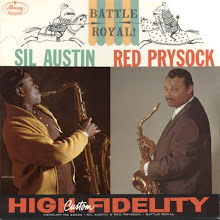
As for the music, as you would expect there’s jump, boogie, honkin’ saxes and blues bawlin’ aplenty, but there’s also a dash of jazz and an outstanding tenor sax ballad performance. This being Be Bop Wino, the tenor sax predominates. Hal Singer, Gene Ammons, Big Jay McNeely and James Von Streeter are the credited saxmen, but let us also pause and give a thought to the tenor players on some of the other tracks: Maxwell Davis appears on the Pete Johnson and Amos Milburn tracks, Red Prysock squares off against the guitar of Tiny Grimes, the Lucky Millinder line-up includes Ike Quebec and Paul Quinichette in the horn section which blows mightily on a familiar riff, the late great Johnny Griffin is on the stomping Joe Morris instrumental “The Applejack”, Johnny Fontenette is the sax blaster in Roy Brown’s Mighty, Mighty Men and Ben Webster turns in a marvellous interpretation of “Stardust” in the Johnny Otis Orchestra’s Mercury recording.

All tracks ripped from vinyl at 320 kbps.

Download from here:

http://www68.zippyshare.com/v/FdWmlDjc/file.html

Tracks:

1. Midnight Jump - Hal Singer – Savoy (unreleased), February 1949

2. Rockin' - Bobby Nunn & The Robins – Modern 807, 1951

3. Rocket Boogie "88" Part 1 - Pete Johnson & His Orchestra – Downbeat / SwingTime 169, April 1949

4. Skid Row Boogie - Pete Johnson & His Orchestra – Downbeat / SwingTime 168, April 1949

5. Bye Bye Boogie - Amos Milburn – Aladdin 206, October 1947

6. Blue Roller - Gene Ammons – Prestige 911, February 1955

7. Cadillac Baby - Roy Brown – DeLuxe 3308, April 1950

8. What's Mine Is Mine - The Ray-O-Vacs – Decca 48234, January 1950

9. Stardust - Johnny Otis & His Orchestra – Mercury 8263, December 1951

10. Hot In Harlem - Tiny Grimes – Atlantic 869, May 1948

11. Careless Love - Big Joe Turner –National (unreleased), November 1947

12. The Applejack - Joe Morris – Atlantic 866, September 1948

13. Mumblin' Blues - Jack McVea & His All Stars – Exclusive 270, December 1947

14. Slow Blues - James Von Streeter – Savoy (unreleased), July 1949

15. D'Natural Blues - Lucky Millinder & His Orchestra – Victor 20-3351, January 1949

16. Deceivin' Blues - Johnny Otis & His Orchestra (vocal - Little Esther & Mel Walker) – Savoy 759, June 1950

17. Two Guitar Boogie - Rene Hall – Victor 20/47-5407, March 1953

18. Wild Wig - Big Jay McNeely – Savoy 682, November 1948

Friday, 6 February 2009

Jack McVea & His All Stars - New Deal


We continue our occasional look at the jump blues bands of the 1940s with this Mr R&B LP of tenor sax man and bandleader Jack McVea.

The sleeve notes by Jim Dawson provide an excellent overview of Jack’s career and the background to the tracks on this compilation, which includes the first ever track recorded by the band, backing the sultry Betty Roché on “Rainy Day Blues” in 1944. The tracks are the standard mix of ballads, novelties, blues and boogies, in other words the staple fare of the 1940s jump blues scene. Along with Roy Milton and Joe Liggins, Jack McVea was a pioneer of West Coast jump blues. Like so many of the musicians in these bands he was a veteran of the big band scene, particularly with the Lionel Hampton band between 1940 and 1943. In the interview with Jim Dawson, Jack maintains that it wasn’t just economics that caused the demise of the big bands, it was also down to the more spontaneous nature of the music generated by the small groups who were developing R&B. This collection is a fine insight into a period of rapid change in swing, jazz and R&B.

There is a fair amount of surface noise present on most of the tracks.

Ripped from vinyl at 320kbps.

Download from here:

New Deal (Mega)

1. My Business Is C.O.D. (v – Estelle Edson)
2. Play It Over
3. Rainy Day Blues (v- Betty Roché)
4. F Minor Boogie
5. It Never Should Have Been This Way (v- Rabon Tarrant)
6. Jack's Boogie
7. Baby Make Up Your Mind (v – Estelle Edson)
8. Butch (v – Arthur Duncan)
9. Two Timin' Baby Boogie
10. Evening (v – Arthur Duncan)
11. Fish For Supper (v – Rabon Tarrant)
12. New Deal
13. Naggin' Woman Blues (v – Rabon Tarrant)
14. You Can Come Back Home (v – Gene Phillips)
15. Tatoe Pie
16. Carlos (v – Rabon Tarrant and Sammy Yates)