Be Bop Wino Pages

Joan Selects - the complete Joan Selects Collection

Big Ten Inchers - 78rpm rips by El Enmascarado


Attention Mac Users!

Mac users have been experiencing problems in unpacking the WinRAR archives used on this blog. Two solutions have been suggested.

1. Use The Unarchiver - www.theunarchiver.com - see comments on Little Esther Bad Baad Girl post for details.

2. Use Keka - http://www.kekaosx.com/en/ - see comments on Johnny Otis Presents post.

Showing posts with label bebop. Show all posts

Tuesday, 27 March 2018

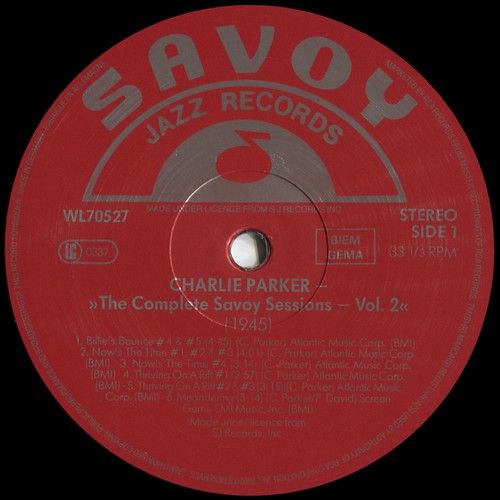
Charlie Parker - The Complete Savoy Sessions Volume 2 (1945)


Side 1:
01. Billie's Bounce (takes 4 and 5) - Charlie Parker's Reboppers
02. Now's The Time (takes 1, 2 and 3) - Charlie Parker's Reboppers
03. Now's The Time (take 4) - Charlie Parker's Reboppers
04. Thriving On A Riff (take 1) - Charlie Parker's Reboppers
05. Thriving On A Riff (takes 2 and 3) - Charlie Parker's Reboppers
06. Meandering - Charlie Parker's Reboppers

Side 2:
01. Koko (takes 1 and 2) - Charlie Parker's Reboppers
02. Dizzy Boogie (take 1) - Slim Gaillard And His Orchestra
03. Dizzy Boogie (take 2) - Slim Gaillard And His Orchestra
04. Flat Foot Floogie (take 1) - Slim Gaillard And His Orchestra
05. Flat Foot Floogie (take 2) - Slim Gaillard And His Orchestra
06. Popity Pop (take 2) - Slim Gaillard And His Orchestra
07. Slim's Jam - Slim Gaillard And His Orchestra


"The Complete Savoy Sessions Volume 2" continues with the rest of the NYC session from the 26th November 1945 which brought Volume 1 to a close. This was the session which gave us "Ko Ko" and "Now's The Time." The latter track would be the unacknowledged basis for the huge R&B hit "The Hucklebuck."

At the end of 1945 Dizzy Gillespie and Charlie Parker took a band to California for an engagement at Billy Berg's nightclub in Hollywood. On December 29th 1945 Bird and Diz joined the resident band at Berg's, the Slim Gaillard Trio, along with Dodo Marmarosa and Jack McVea for a light hearted recording session for the small Bel-Tone label. There were two reworkings of the Gaillard warhorse "Flat Foot Floogie" and an equally mad "Popity Pop (Goes The Motorsickle)." The final track from the session, "Slim's Jam," is a wonderfully relaxed piece of nonsense in which everyone is obviously enjoying themselves.

Alas, for Charlie Parker dark clouds were gathering as his heroin addiction spiraled out of control. "Lowlights" of his stay in California included signing away half of all his royalties to a heroin dealer, selling his return ticket to NYC for money to buy more heroin and thus ending up stranded, and wandering naked through his hotel lobby before setting his room on fire. In August 1946 he was committed to Camarillo State Hospital. But let us return to that "Now's The Time" session ...

So here we are in the WOR Studios, NYC, on the 26th of November 1945 where under the supervision of Teddy Reig, Charlie Parker is recording his first session as leader. With him are 3 members of his regular group - 19 year old Miles Davis on trumpet, Curly Russell on bass and Max Roach on drums. He had also asked Thelonius Monk and then Bud Powell to play piano on the session but neither could make it, so Sadik Hakim was the pianist. Also along was Dizzy Gillespie with whom Charlie had an acrimonious split back in July. That split was the end of the first great bebop group, the Gillespie - Parker combo. Diz formed a short lived big band for a tour of the southern states while Charlie kept a small combo going with Miles Davis coming in on trumpet.

Miles had arrived in New York from St Louis in September 1944, ostensibly to study music at Juilliard, but mainly to contact Bird and Diz with whom he had become acquainted during his brief spell filling in on trumpet with the Billy Eckstine band in St Louis in August 1944. Every night after classes at Juilliard Miles would head for the 52nd Street clubs or else uptown to Minton's in search of the elusive duo, eventually hooking up with them after a few weeks. Soon the young Miles was being invited to join the Minton's jam sessions by Parker and Gillespie. In May 1945 he had his first recording session (with Herbie Fields) and around the same time had a regular nightclub gig on 52nd Street with a group led by Eddie "Lockjaw" Davis.

When Bird was looking for a new trumpet player following the departure of Dizzy in July 1945, he naturally thought of Miles and the new band started playing at the Three Deuces in August. Dizzy returned for the Savoy session on 26th November, prepared to play both piano and trumpet if necessary. It may be that the pair got together again for the session as they had an upcoming gig at Billy Berg's club in Hollywood, Berg having stipulated that the offer was only open to a group which included both Parker and Gillespie.

Miles was aware of his own limitations at this time and felt unable to perform on "Ko Ko", a Parker composition based on "Cherokee" which he always had trouble playing, so Dizzy played trumpet on that track. Here's a summary of who played what on the tracks -

Charlie Parker (alto sax), Curly Russell (bass) and Max Roach (drums) on all tracks. Miles Davis trumpet on "Billie's Bounce," "Now's The Time" and "Thriving On A Riff." Dizzy Gillespie trumpet and piano on "Ko Ko," piano on "Warming Up A Riff," "Billie's Bounce," "Now's The Time" and "Meandering." Argonne Thornton (Sadik Hakim) piano on "Thriving On A Riff."

Single release of tracks:

"Billie's Bounce" / "Now's The Time" on Savoy 573 in February 1946. ("Billie's Bounce" take 5 and "Now's The Time" take 4)

"Ko Ko" was released as the B-Side of "How High The Moon" by the Don Byas Quintette on Savoy 597 in April 1946. ("Ko Ko" take 2)

"Thriving From A Riff" (note title change) was credited to "The Be Bop Boys" and released as the B-Side of "Opus De Bop" by "The Be Bop Boys featuring Stan Getz, tenor sax." ("Thriving On A Riff" take 3)

"Warming Up A Riff" / "Thriving On A Riff" released on Savoy 945. "Warming Up A Riff" credited to "Charlie Parker and the Be Bop Boys." "Thriving On A Riff" credited to "The Be Bop Boys." ("Warming Up A Riff" only take; "Thriving On A Riff" take 3).

"Meandering" first released on LP Savoy MG 12079, "The Charlie Parker Story," in 1956.

The following group, under the leadership of Dizzy Gillespie, headed west to Dreamland to fulfill a near two month engagement at Billy Berg's club in Hollywood: Dizzy Gillespie (trumpet), Charlie Parker (alto sax), Milt Jackson (vibes); Al Haig (piano); Ray Brown (bass) and Stan Levey (drums). They opened on Monday 10th December. On Saturday 29th December the band had a live recording for the AFRS "Jubilee" show scheduled, but earlier in the day Diz and Bird dropped in on a session being held by the resident band at Billy Berg's, the Slim Gaillard Trio. The sides were recorded for a small and short lived Hollywood label called Bel-Tone Records.

Above: Slim, Zutty and Bam at Billy Berg's, 1945

The regular trio of Slim Gaillard (guitar and vocals), Bam Brown (bass) and Zutty Singleton (drums) were joined by Dodo Marmarosa (piano), Jack McVouty (tenor sax and shout of "open up the door, Richard!"), Charlie Yardbird Orooney (alto sax) and Daz McSkivens Vouts Orooney (trumpet).

Original releases:

"Dizzy Boogie" / "Popity Pop" by the Slim Gaillard Orchestra released on Bel-Tone 753 ("Dizzy Boogie" take 2).

"Flat Foot Floogie" / "School Kids Hop" by The Slim Gaillard Orchestra released on Bel-Tone 758 ("Flat Foot Floogie" take 2)

"Slim's Jam" / "Santa Monica Jump" by The Slim Gaillard Orchestra released on Bel-Tone 761.

"Santa Monica Jump" and "School Kids Hop" were from a January 1946 session on which the Slim Gaillard Trio were joined by Howard McGhee, Marshall Royal, Lucky Thompson and Dodo Marmarosa.

Above: Bird at Berg's, 1945

Above: Berg's - Bird strung out, Diz not happy. Camarillo beckons

Recommended reading:

"Bird's Diary - The Life of Charlie Parker 1945 - 1955" by Ken Vail. Castle Communications, 1996.

"Miles - The Autobiography" by Miles Davis with Quincy Troupe.Picador, 2012.

"Bird Lives! - The High Life and Hard Times of Charlie 'Yardbird' Parker" by Ross Russell, Quartet Books, 1976.

Sunday, 18 March 2018

Charlie Parker - The Complete Savoy Sessions Volume 1 (1944-1945)


Side 1:
01. Tiny's Tempo (take 1) - Tiny Grimes Quintette
02. Tiny's Tempo (take 2) - Tiny Grimes Quintette
03. Tiny's Tempo (take 3) - Tiny Grimes Quintette
04. I'll Always Love You Just The Same (take 1) - Tiny Grimes Quintette
05. I'll Always Love You Just The Same (take 2) - Tiny Grimes Quintette
06. Romance Without Finance (take 1) - Tiny Grimes Quintette
07. Romance Without Finance (takes 2 and 3) - Tiny Grimes Quintette

Side 2:
01. Romance Without Finance (takes 4 and 5) - Tiny Grimes Quintette
02. Red Cross (take 1) - Tiny Grimes Quintette
03. Red Cross (take 2) - Tiny Grimes Quintette
04. Billie's Bounce (take 1) - Charlie Parker's Reboppers
05. Billie's Bounce (takes 2 and 3) - Charlie Parker's Reboppers
06. Warming Up A Riff (take 1) - Charlie Parker's Reboppers


Be Bop starts here (sort of)! I posted the first two volumes of  "Charlie Parker - The Complete Savoy Sessions" back in the earliest days of the blog, and here they are again, with new cover and label scans. First up is Volume 1 which covers Charlie's first official small group session - with swing guitarist Tiny Grimes, plus the start of Charlie's second Savoy session featuring his own band which included a young Miles Davis on trumpet and a guest / support appearance by Dizzy Gillespie on piano and trumpet.
The LPs feature the complete sessions including multiple takes and occasionally aborted takes. The post includes information on which of the takes were released as singles. The Grimes session includes two vocal efforts by Tiny, the dreadfully square "I'll Always Love You Just The Same" and the half-heartedly hip "Romance Without Finance." The main interest in this session centres on the swinging instro "Tiny's Tempo" and the Parker composition "Red Cross."

Background to the Savoy Sessions

In 1944 Savoy Records started recording sides by the jazz musicians who jammed in the clubs of Harlem and 52nd Street. Ben Webster, The Count Basie Band (under Earl Warren's name), Lester Young, Hot Lips Page, Pete Brown, Don Byas, Miss Rhapsody and Cozy Cole were among the artists who were recorded. The Hot Lips Page band which recorded a session on September 12th included Earl Bostic, Ike Quebec and guitarist Lloyd "Tiny" Grimes in its lineup. Three days later Tiny Grimes was back leading a small group which had Clyde Hart on piano, Jimmy Butts on bass, Doc West on drums and on alto sax one Charles Parker Esq, late of Kansas City whence he had arrived in the Big Apple with the Jay McShann Orchestra back in January 1942.

When the McShann outfit headed back to K.C. in the summer of '42, Charlie Parker elected to remain in N.Y.C. and play the clubs. At the end of the year he was recruited into the Earl Hines Orchestra at the suggestion of Billy Eckstine and Benny Harris. Also in the band were Sarah Vaughan and Dizzy Gillespie.

In April 1944 Eckstine formed a new band which included Parker, Gillespie, Vaughan, Wardell Gray and Art Blakey. In August 1944 the Eckstine band played a 2 week residency in St Louis where an 18 year old Miles Davis sat in to replace an ill Buddy Anderson. The band then played a week long engagement at the Regal Theatre in Chicago. Charlie Parker quit when the band returned to NYC. Shortly afterwards he was at the Onyx Club in 52nd Street where he worked with Ben Webster. He then appeared at another 52nd Street club, the Three Deuces, in a band which had Howard McGhee on trumpet, Dizzy Gillespie having decided to stick with the Eckstine band.

Just a few doors down 52nd Street from the Three Deuces was the Downbeat Club, where Charlie would drop in to jam with the band led by guitarist Tiny Grimes. On the 14th September Savoy asked Tiny to record a session for them. The following day he turned up with a group which included Charlie Parker. The complete session is on this LP, taking up the whole of Side 1, plus the first three tracks on Side 2.

Five 78 rpm discs were generated from this session. The same takes of each track were used on all of these singles -

Tiny's Tempo (take 3) and I'll Always Love You Just The Same (take 2), were released on Savoy 526.

Romance Without Finance (take 5) and Red Cross (take 2) were released on Savoy 532.

Red Cross (take 2) and Tiny's Tempo (take 3) were released on Savoy 541 credited to Charlie Parker.

I'll Always Love You Just The Same (take 2) and Red Cross (take 2) were released on Savoy 563, credited respectively to Tiny Grimes and Charlie Parker.

Romance Without Finance (take 5) and I'll Always Love You Just The Same (take 2) were released on Savoy 613 credited to Tiny Grimes Quintette.

It would be more than a year before Charlie Parker recorded another Savoy session. This time it would be under his own name. The time between the sessions was a busy one with Charlie involved in recording sessions with inter alia "Clyde Hart's All Stars" (featuring Don Byas) for Continental, Red Norvo, Sarah Vaughan (for Continental) and Sir Charles Thompson's All Stars (including Dexter Gordon) for Apollo. His most important recordings and live appearances were as a member of the small group featuring himself and Dizzy Gillespie. In February 1945 they recorded "Groovin' High," "All The Things You Are" and "Dizzy Atmosphere" for Guild. In May 1945 they recorded "Salt Peanuts," "Shaw 'Nuff," " Hot House" and "Lover Man" (with Sarah Vaughan on vocal) also for Guild. The Gillespie - Parker combo had a residency at the Three Deuces on 52nd Street from March until July 1945.

When the Three Deuces residency finished Dizzy Gillespie formed a big band for a Southern tour. Charlie attended a few rehearsals then split to form his own combo which opened at the Three Deuces in early August. In October the combo was at The Spotlite, also on 52nd Street, with the line up pictured below - Charlie Parker (alto sax), Miles Davis (trumpet), Dexter Gordon (tenor sax), Sir Charles Thompson (piano), Leonard Gaskin (bass) and Stan Levey (drums).

On 26th November Charlie Parker arrived at WOR studios in NYC for his Savoy session where he was accompanied by Miles Davis (trumpet), Argonne Thornton aka Sadik Hakim (piano), Curly Russell (bass), Max Roach (drums) and Dizzy Gillespie (piano, trumpet).

The first 3 takes of "Billie's Bounce" are on this LP, but it would be take 5 (on Volume 2) which would be the released take. Before proceeding to takes 4 and 5 the group improvised on the harmonies of "Cherokee" with what was later named "Warming Up A Riff" which was eventually released on Savoy 945 b/w "Thriving On A Riff" from later in the same session. Volume 2 which will be posted soon has the remainder of this session, including more takes of "Billie's Bounce," "Now's The Time" and "Koko." Stick around for more bop!

Elsewhere on the blog:


Info on Tiny Grimes here:


In the next thrilling episode - "Now's The Time" and "Is This The Way To Camarillo?" Bird and Diz head out West and meet up with Slim Gaillard. Vout-o-roonie!

Wednesday, 6 July 2016

The Be-Bop Boys - Boppin' A Riff


Side 1:
01. Boppin' A Riff, Parts 1 and 2
02. Fat Boy, Parts 1 and 2

Side 2:
01. Everything's Cool, Parts 1 and 2
02. Webb City, Parts 1 and 2

Download from:


Recorded in New York, September 6th, 1946. Personnel: Kenny Dorham; Fats Navarro (trumpet); Sonny Stitt (alto sax); Morris Lane (tenor sax); Eddie DeVerteuil (baritone sax); Bud Powell (piano); Al Hall (bass); Kenny Clarke (drums); Gil Fuller (arranger)

The session was credited to Fats Navarro / Gil Fuller's Modernists / The Be-Bop Boys

Release details:

01. Boppin' A Riff, Parts 1 and 2 - Savoy 588
02. Fat Boy, Parts 1 and 2 - Savoy 587
03. Everything's Cool, Parts 1 and 2 - Savoy 586
04. Webb City, Parts 1 and 2 - Savoy 585

The above four 78 rpm singles were listed in Billboard's Advance Record Releases section of 12th October 1946 as being due for release as a 4 disc set called "Be Bop Jam Session Album" (Savoy S-506). "Webb City" was later reissued as Savoy 900 and "Fat Boy" was reissued as Savoy 901. "Everything's Cool" was reissued as Savoy 941, credited to Fats Navarro.

These tracks have been reissued many times on LP and EP but with changing credited artists. For example "Fat Boy" was on "New Sounds In Modern Music - Fats Navarro" (Savoy MG 9005) issued in 1951:


"Everything's Cool" was on the 1952 Sonny Stitt LP (MG 9006) in the same series:


This is one of those "knock off" posts where a few tracks are gathered together into a home made compilation on some pretext or other. I've cobbled together a set inspired by the previous post on Morris Lane. I referred to the fact that prior to his first recording for Savoy as named artist, Lane had recorded for that label as a member of "The Be-Bop Boys" alongside some of the biggest names in bop, including Fats Navarro, Sonny Stitt and Bud Powell. Here are the four singles which resulted from that session, presented in the order in which they were recorded. Each track was split in two to fit onto a 78 rpm single, which leads to some odd sounding fade outs and fade ins.

"The Be-Bop Boys" was a generic name used by Savoy for recordings by various lineups of boppers, including bands led by Charlie Parker, Stan Getz, Allen Eager and Sonny Stitt. Anyway I'm a sucker for bop, so I'm off to find my beret and bop shades, then I'm going to  dig these cool vibes! I might even grow a goatee too. Way out, daddy-o.

Monday, 18 April 2016

Casbah / Sid's Delight - Tadd Dameron and His Orchestra (Capitol 57-60006)


Personnel: Tadd Dameron (piano, arranger); Fats Navarro (trumpet); Kai Winding (trombone); Sahib Shihab (alto saxophone); Dexter Gordon (tenor sax); Cecil Payne (baritone sax); Curly Russell (bass); Kenny Clarke (drums); Diego Ibarra (bongos); Vidal Bolado (conga); Rae Pearl (vocal on "Casbah")

Recorded in New York City, January 18th, 1949.

Casbah:


Sid's Delight:


Here's something the like of which you don't hear every day. A bebop essay into wordless vocalised exotica, courtesy of El Enmascarado who has ripped us another vintage jazz 78 rpm disc.

Pianist / composer / arranger Tadd Dameron said at a 1953 recording session: "When I write something it's with beauty in mind. It has to swing, sure, but it has to be beautiful." Dameron's search for beauty expressed through music had its starting point when, as a medical student, he saw a body with an almost severed arm dangling from it. That was enough medicine for Tadd. "There's enough ugliness in the world," he decided. "I'm interested in beauty."

He soon acquired the standard big band swing experience which formed the musical background of the bop pioneers, working in the bands of Blanche Calloway, Zach White, Vido Musso, Harlan Leonard and Jimmie Lunceford. Tadd's move into a modern bop style came with his work for the bands of Billy Eckstine ("Cool Breeze") and Dizzy Gillespie ("Our Delight"). In 1947 he had his own small combo featuring brilliant trumpeter Fats Navarro, which recorded for Blue Note and Savoy.


(above: Tadd Dameron and Fats Navarro)

In 1948 his group became the house band at The Royal Roost, a Broadway chicken restaurant which had been running unsuccessful jazz nights until promoter Monte Kay and deejay Symphony Sid stepped in with a policy of promoting the new sounds in jazz combined with regular live radio broadcasts which proved to be fabulously successful.


Which brings us to 1949 where we find Tadd still in residence at The Royal Roost but now with an expanded lineup (sometimes known as "The Big Ten"), which in the eternal quest for beauty through music, combines bop with Latin rhythms. "Casbah" features the wordless singing of Rae Pearl. "Sid's Delight" (named after Symphony Sid) has the tenor sax of Dexter Gordon, who is uncredited on the record label, as you can see from El Enmascarado's scans.

This session for Capitol records was the last to be shared by Tadd Dameron and his collaborator in chief, trumpeter Fats Navarro whose requests for higher pay led to a split.

Many thanks to our collaborator El Enmascarado for the sounds 'n' scans.

Recommended purchase:


2 CD set, Blue Note 3373.

Information source:


"Jazz Masters Of The 40s" by Ira Gitler, Da Capo, 1984.

Thursday, 14 April 2016

Dexter Gordon - Master Takes / The Savoy Recordings (1945-1947)


Side 1:
01. Blow Mr Dexter
02. Dexter's Deck
03. Dexter's Cuttin' Out
04. Dexter's Minor Mad
05. Long Tall Dexter
06. Dexter Rides Again
07. I Can't Escape From You
08. Dexter Digs In

Side 2:
09. Settin' The Pace
10. So Easy
11. Dexter's Riff
12. Dexter's Mood
13. Dextrose
14. Index
15. Dextivity

Download from:


This LP was originally posted back in the very earliest days of the blog. That post was subsequently deleted. The re-up includes new front and back cover scans as well as added label scans.

Six feet five inches tall Dexter Gordon was the first tenor sax player to play in the be bop style. Like many of his fellow be bop pioneers he received his musical grounding in the big swing bands. His career started to take off in his native Los Angeles, where in 1940 at the age of 17 he was recruited into the newly formed Lionel Hampton Orchestra. He stayed with the band until 1943, returning to LA where he joined a group led by drummer Lee Young. In 1944 he had spells with Fletcher Henderson and Louis Armstrong. In the autumn of that year he joined the bop inclined band of Billy Eckstine whose reed section boasted players of the calibre of Gene Ammons, Budd Johnson, John Jackson, Sonny Stitt and Leo Parker.

Dexter left the Eckstine band in 1945 and headed for New York where he joined a sextet led by Charlie Parker which also featured Miles Davis on trumpet and a changeable rhythm section with either Stan Levey or Max Roach on drums, Curley Russell on bass and Bud Powell or Sir Charles Thompson on piano. The first recording session featured on this LP took place in October 1945 while Dexter was still with the Parker outfit. (tracks 1-4, side 1)


Above: Charlie Parker Combo at the Spotlite Club, 52nd Street, NYC, October 1945. Bird out front, Miles on trumpet, Dex in shades.

For his October Savoy session, Dexter was backed by a rhythm section consisting of Argonne Thornton (Sadik Hakim) (piano), Gene Ramey (bass) and Eddie Nicholson (drums). For the second Savoy session in January 1946, Dexter was backed by a big name bebop rhythm section of Bud Powell (piano), Curley Russell (bass) and Max Roach (drums), all of whom had played in the Charlie Parker Combo. Also along was trumpeter Leonard Hawkins. (tracks 5-8, side 1).

Dexter quit New York in summer 1946. His first stop was Honolulu where he spent two months in Cee Pee Johnson's band and then he headed back home to Los Angeles where he was soon immersed in the burgeoning West Coast be bop scene. His next recordings were for Ross Russell's Dial label in June 1947, including the famous sax battle with Wardell Gray titled "The Chase."


Above: Wardell and Dexter - "The Chase"

A few weeks later Ralph Bass recorded Wardell and Dexter in a jam session at the Elks Auditorium in the Central Avenue area of LA. Among the personnel were stalwarts such as Howard McGhee, Sonny Criss, Trummy Young, Barney Kessel and Red Callender. Four of the recorded sides eventually made it to a 2LP set on Savoy - "The Hunt." This set, which was donated to Be Bop Wino by Billy K in November 2007, is nothing short of sensational. Bebop in the raw with no running time restrictions and recorded live in front of a rowdy audience.


Side 1:
Disorder At The Border
Side 2:
Cherokee
Side 3:
Byas-A-Drink
Side 4:
The Hunt

Download from here:


On December 4th 1947 Dexter recorded another sax battle in LA for Dial, this time with Teddy Edwards - "The Duel, Parts 1 and 2." One week later Dexter was back in New York to record for Savoy (tracks 1-3, side 2), this time with Leo Parker on baritone sax and a rhythm section consisting of pianist / arranger Tadd Dameron, bassist Nelson Boyd and Art Blakey on drums. "Settin' The Pace" is yet another sax battle, with Dex and Leo facing off against each other. Dexter certainly had a penchant for reed-based combat as the aforementioned matches with Wardell Gray and Teddy Edwards show. In fact this went back to his Billy Eckstine days when he and Gene Ammons recorded their regular show-stopper "Blowing The Blues Away."

The final session on this LP was recorded on the 22nd December 1947 (tracks 4-7, side 2). The backing band once again featured pianist / arranger Tadd Dameron, this time along with a couple of members of his quintet which had recorded a few months earlier for Blue Note: Fats Navarro on trumpet and Nelson Boyd on bass. The lineup was completed with Art Mardigan on drums.

In January 1949 Dexter played in Tadd Dameron's Big Ten at the Royal Roost and recorded a couple of sides with this band for Capitol. Which brings us neatly to our next post and another 78 rip by El Enmascarado. In the meantime you can groove to these "Master Takes" and shout "Go! Go! Go!" while flipping your wig to "The Hunt."

Stay cool, boppers.

Sunday, 22 June 2014

"Hot Jazz" and "Race" Records

 
I originally meant to make this post solely about a Leo Parker December 1947 single release on Savoy - "Wild Leo" / "El Sino" but while browsing online through the Billboard issues of the period (available free via Google Books) I found myself reading up on the reviews of other releases. That's how this post "growed and growed" as I found myself wandering down the highways and byways of  late 1940s jazz and R&B.
 
So let's start with "Wild Leo" / "El Sino" (Savoy 912):


Recorded in Detroit, October 4th, 1947. Personnel: Howard McGhee (trumpet); Gene Ammons (tenor sax); Leo Parker (baritone sax); Junior Mance (piano); Gene Wright (bass); Chuck Williams (drums).

The disc was reviewed in the Billboard issue of December 13th, 1947. Of "Wild Leo" Billboard said: "Showcase for the bary horn of Leo Parker with boppish backgrounds." As for "El Sino": "Medium tempoed be-bop riffer with top notch Parker bary, Navarro trumpet solos." The trumpet player was in fact Howard McGhee, but Fats Navarro performs on a track further down this post.


The Leo Parker platter was reviewed in the "Hot Jazz" section. On the same page were reviews under the heading "Race" which was the term used by Billboard at the time for what would later (from June 1949 onwards) be called "Rhythm and Blues" in the trade journal. The platter in this section which caught my eye was the Bull Moose Jackson release on King 4181, "I Love You, Yes I Do" / "Sneaky Pete":


Recorded in New York City, August 1947. Personnel, largely unknown, except Bull Moose Jackson (vocals, tenor sax). This disc went on to become the fourth largest rhythm seller of 1948, behind "Tomorrow Night" by Lonnie Johnson, "King Size Papa" by Julia Lee and "Long Gone, parts 1 and 2" by Sonny Thompson. Bull Moose was the top selling rhythm artist of 1948, easily outselling Louis Jordan thanks to big hits like "I Love You, Yes I Do", "All My Love Belongs To You", "I Can't Go On Without You" and "Love Me Tonight".

Many Bull Moose discs featured a ballad on one side and a jump tune on the other side. Collections of his material which were released from the 1980s onwards tended to feature the latter, often featuring "lee-rics" such as "Big Ten Inch" and "I Want A Bow Legged Woman." His ballads were generally consigned to the dustbin of musical history. However, I managed to resurrect "I Love You, Yes I Do" from a 1979 "Old King Gold" LP, hence the dodgy sound quality despite some TLC on my conversion software.

Continuing my Billboard search on Leo Parker, I came across this Savoy advert in the issue of 20th November, 1948:

 
What Billboard rather condescendingly labelled "race" records are advertised by Savoy under "Tops in Pops" and "Tops in Bop" is used for jazz releases, which is preferable to the rather archaic sounding "hot jazz." In the late 1940s, Savoy was a big backer of both be-bop and sax-driven r&b. The biggest seller of the discs advertised above was Hal Singer's storming "Corn Bread" which was the 9th biggest selling rhythm platter of 1948 and the second biggest selling  rhythm instrumental on the charts, behind Sonny Thompson's "Long Gone" (Miracle 126) which featured Eddie Chamblee on tenor sax.


Baritone sax man Paul Williams' "Waxie Maxie" was also a good seller, although his "Thirty-Five Thirty" was an even bigger success. Other sax instros on Savoy that year included "September Song" by Don Byas and two from Wild Bill Moore: "Bubbles" and "We're Gonna Rock." Other labels were in on the sax action too - King / Gotham with "Temptation" by Earl Bostic, and Atlantic with "Blue Harlem" and "Midnight Special" by the Tiny Grimes band featuring Red Prysock.

Enough from me, it's time to rock and bop to four of the tracks from the above advert: "Waxie Maxie" by Paul Williams; "Spinal" by Eddie "Lockjaw" Davis and his Be-Boppers (with Fats Navarro); "Cornbread" by Hal Singer; and "Barbados" by Charlie Parker.

Monday, 10 December 2012

Suede Jacket / Lion’s Roar – Russell Jacquet And His All Stars (King 4242)


Personnel: Russell Jacquet (trumpet); J.J. Johnson (trombone); Sonny Stitt (alto sax); Leo Parker (baritone sax); Sir Charles Thompson (piano); Al Lucas (bass); Shadow Wilson (drums)

Both sides were recorded at United Sound Studios, Detroit, in May or June, 1948.

The recordings were made for the Sensation label which was owned by Bernard Besman. The Billboard issue of June 19th 1948 carried an article on the purchase of 64 Sensation masters by King Records. The purchase included sides by Todd Rhodes, “Lord Nelson”, Milt Jackson and Russell Jacquet. “Suede Jacquet” / “Lion’s Roar” was released on King 4242 at the end of July or beginning of August 1948. The same record was also released on Sensation 8.


Russell Jacquet was the elder brother of tenor sax giant Illinois Jacquet, in whose band he played trumpet and contributed vocals from 1945 until 1953. During this period he also recorded occasionally as a band leader in his own right, beginning in Los Angeles in 1945 with a group which included Calvin Boze in its line-up.
The session which produced “Suede Jacket” and Lion’s Roar” wasn’t the first time Russell had recorded in Detroit. In 1947 he recorded with Sonny Stitt and Sir Charles Thompson in a group led by Milt Jackson. In May / June 1948 three sessions featuring various line-ups were held by Sensation in Detroit. The first session was credited to “Lord Nelson and His Boppers”, in reality a group led by Sonny Stitt and Milt Jackson. The second session was by The Sonny Stitt Sextet which included Stitt, Milt Jackson, Russell Jacquet and Sir Charles Thompson.

The third session was credited to “Russell Jacquet and His All-Stars.” This was actually the Illinois Jacquet band minus Illinois, but with Sonny Stitt added. Two discs resulted from this session – “Suede Jacket” / “Lion’s Roar” and “Scamparoo” / “Relaxin’ With Randel” (King 4259 and Sensation 12).

“Suede Jacket” is a nice bop workout with solo space given to Stitt, Johnson, Parker, Jacquet and, very briefly, Thompson. “Lion’s Roar” is a rousing showcase for the big bad baritone sax of Leo Parker. This session was a reunion for half of the Unholy Four sax section of the bop-leaning Billy Eckstine big band, Sonny Stitt and Leo Parker both being former members, along with Dexter Gordon and John Jackson.
Many thanks to El Enmascarado for putting the BeBop into the Wino with this 78 disc!

Sources - Bruyninckx  Discography. Sleevenotes by Joop Visser to 4CD set on Proper, "Sonny Stitt - Sax O' Bebop." The May / June 1948 Sensation sessions are included in the set.

Saturday, 10 November 2012

Odd-En-Dow / Dues In Blues - Gene Ammons And His Orchestra (Mercury 8080)


"Odd-En-Dow" was recorded on December 1st, 1947 and "Dues In Blues" was recorded on December 10th, 1947. Both sides were recorded in Chicago.

Personnel: Gail Brockman (trumpet); John "Raps" Dungee (alto and baritone sax); Gene Ammons (tenor sax); Junior Mance (piano); Gene Wright (bass); Ellis Bartree (drums)

Mercury 8080 was released in May 1948.


Billboard reviewed the disc in its Race Records section on May 8th, 1948. "Odd-En-Dow" was a "light bop riffer, with string of fair solo rides" while "Dues In Blues" received the slightly off hand comment: "instrumental with more bop touches."

Gene Ammons was the son of renowned boogie woogie piano man Albert Ammons. He played tenor sax in his school band, and got his first professional gig with the King Kolax band. His subsequent spell with Billy Eckstine's bop-leaning big band shot him to fame, most memorably on the searing tenor sax battle with Dexter Gordon, "Blowing The Blues Away." In 1947 he left the Eckstine outfit to start a solo recording career on Mercury. He had a hit with "Red Top" (Mercury 8048) and recorded a series of fiery bop sides for the label in 1947 and 1949 before signing for Chess for whom he had another big chart hit in 1950 with "My Foolish Heart." He had brief spells with Woody Herman and Count Basie before forming the legendary Gene Ammons - Sonny Stitt combo. But that may be another story for another post.

With many thanks to El Enmascarado  for ripping these sides from an original 78 rpm disc and for the label scans.

Monday, 14 May 2012

Flying Home Parts 1 and 2 – Tiny Grimes’ Swingtet (Blue Note 524)


Recorded at WOR Studios, NYC on August 14th, 1946. Personnel: Trummy Young (tb); John Hardee (ts); Marlowe Morris (p); Tiny Grimes (g); Jimmy Butts (b); Eddie Nicholson (d)


With thanks to El Enmascarado for his rips and scans from this Blue Note 78 rpm disc.

Before guitarist Lloyd “Tiny” Grimes was issuing those great jump blues singles on the Atlantic label and before he had renamed his group “The Rocking Highlanders”, dressing them in kilts and Tam O’Shanters, and yea, well before he was recording even more jump blues and backing the likes of J.B. Summers, Haji Baba and Screamin’ Jay Hawkins on Gotham, our hero was one cool dude on the New York jazz scene.

He was a late starter on the four string guitar, having commenced his musical career on the piano and as a tap dancer. In 1940, not long after taking up the guitar, he joined the already successful jive group The Cats & The Fiddle. From there he joined the illustrious pianist Art Tatum and bass player Slam Stewart to form the Art Tatum Trio. Inevitably his guitar playing improved greatly in such company and in 1944 Tiny formed his own group. While with the trio he had become a fixture on the New York jazz club scene and he was soon picking up recording work with Ike Quebec, Coleman Hawkins and Hot Lips Page.

Tiny’s first session as a leader (for Savoy in September 1944) has gone down in jazz history as Charlie Parker (who had been jamming with Tiny’s band at the Downbeat Club) was on alto sax. To round off the session the group recorded Parker’s “Red Cross”, an instrumental based on the chords of “I Got Rhythm” which is considered an important step in the development of be-bop.

After the Parker session, Tiny was on sessions on various labels with Ike Quebec, Coleman Hawkins, Hot Lips Page, Cozy Cole, Billie Holiday, Earl Bostic, John Hardee and Buck Clayton. In August 1946, Tiny finally got another session as a band leader with jazz label Blue Note. Two singles resulted from the session – the two-parter “Flying Home” and “’C’ Jam Blues” / “Tiny’s Boogie Woogie.”

Tiny Grimes circa 1948 - William Gottlieb collection
Tiny’s move towards R&B started 2 months later when his group backed blues shouter Gatemouth Moore on National, and the trend continued the following year when Tiny’s band backed Walter Brown on a cover of “Open The Door, Richard” on Signature. At the very end of 1947 Tiny’s group started recording for the new Atlantic label, but we shall leave that part of the story for another post!

Listen to “Red Cross” featuring Charlie Parker and “Nobody Knows The Way I Feel This Morning” by Gatemouth Moore with the Tiny Grimes Swingtet -


Red Cross (Savoy 532). Recorded NYC, September 15th, 1944. Personnel: Tiny Grimes (g); Charlie Parker (as); Clyde Hart (p); Jimmy Butts (b); Doc West (d)

Nobody Knows The Way I Feel This Morning (National 4015). Recorded NYC, October 25th, 1946. Personnel: Gatemouth Moore (vcl); Russell Royster (tpt); Herman Flintall (as); John Hardee (ts); Sam Benskin (p); Tiny Grimes (g); Al Raglin (b); Eddie Nicholson (d)

Tiny's tenor sax man - John Hardee c 1947 William Gottlieb collection
Sources:

Dan Kochakian & Dave Penny - Tiny Grimes Discography Part 1, Blues & Rhythm Magazine, No. 228, April 2008

Dan Morgenstern - sleeve notes to “The Changing Face of Harlem: The Savoy Sessions” Savoy Jazz 2LP set, SJL 2208, 1976

Claude Carrière - sleeve notes to “Charlie Parker: The Complete Savoy Sessions Volume 1” Savoy LP, WL70520, 1984

Dapper Tiny - NYC c 1948 William Gottlieb collection 

Sunday, 31 July 2011

Swingin' Saxophones


Side One
1. Cotton Tail - Duke Ellington & His Orchestra
2. Flying Home No 2 - Lionel Hampton & His Orchestra
3. Honeysuckle Rose - Ben Webster
4. Blowing The Blues Away - Billy Eckstine & His Orchestra
5. Lunatic - John Hardee
6. IQ Blues - Ike Quebec

Side Two
1. Riffin' At 24th Street - Illinois Jacquet
2. I'm Confessin' - Lester Young
3. The Spider - Joe Morris
4. Long Tall Dexter - Dexter Gordon
5. Hot In Harlem - Tiny Grimes
6. Cole Slaw - Frank Culley

My thanks to the anonymous donor who sent in this comp. It’s a good collection of 1940s tenor sax sides, beginning with some big band swing, and ending with some jazzy R&B combos via detours into boppish small group jazz. However you want to label it, it makes for some mighty fine listening. In fact never mind the label thing, just call it good music.

The sleeve notes are pretty uninformative as you would expect from a bootleg. I’ve looked up the recording details of all the tracks on the LP and listed them at the end of the post. Ben Webster is the soloist on “Cottontail,” Arnett Cobb is on “Flying Home No. 2” and Dexter Gordon and Gene Ammons serve up an early example of a tenor sax “chase” on “Blowing The Blues Away.”

On Side Two, Johnny Griffin delivers the most frantic performance of the set on “The Spider” while Red Prysock is the tenor man on “Hot in Harlem.” Ike Quebec’s “I.Q. Blues” on Savoy is really just another version of “Blue Harlem” which he had previously recorded for Blue Note in July 1944. I think I actually prefer the Savoy version for its gorgeous piano break by Johnny Guarnieri. The Blue Note original does have some nice guitar from Tiny Grimes, though.

As for the origins of this comp – there is no label number on the front or back cover, although the back cover does bear the legend “Bop u Rhythm Schallplatten, Saarland.” The sleeve notes are written pseudonymously and claim to date from 1952. I think this is probably a bootleg of a bootleg, or a reissue of an album which originally appeared in the mid to late 1950s on the legendary Bop-Rhythm label. I’m sure that the original release would have had a different front cover from the one which was sent to me. It doesn’t look like a 1950s style cover at all.

Bop-Rhythm was a strictly “underground” label whose issues of jazz, R&B and even some early rock and roll were much coveted by hopheads and beatniks around Europe. Their operation was based in the Saarland which for much of the 1950s was detached from the German Federal Republic and thus provided a haven for a motley group of jazz fanatics and dope fiends who were zealous spreaders of the gospel of groove. They took advantage of the Saarland’s unique status of being beyond the reach of German civil law and set up a record pressing plant from which they distributed all kinds of bopmungous vinyl goodies to adjacent countries. The music was sourced from records provided by American service personnel based in West Germany.

When the Saarland was incorporated into West Germany in 1957, Bop-Rhythm Records was doomed, although they managed to keep going until 1960 when their pressing plant (situated in the basement of a house of ill repute in Fraulautern, Saarlouis) was raided by an Interpol organised task force of police from three different countries – France, Germany and Belgium – plus a contingent of US Military Police. I hope that at the last, the stoned jazzers of Bop-Rhythm went down swinging as the forces of law and order stormed into their HQ.

Ripped from vinyl at 320 kbps.

Download from here:

http://www29.zippyshare.com/v/7xovktql/file.html

Recording Details:

1. Cotton Tail - Duke Ellington & His Famous Orchestra

Recorded in Hollywood CA, 4th May, 1940. Released on Victor 26610
Personnel: Rex Stewart (cnt) Cootie Williams, Wallace Jones (tp) Joe Nanton, Juan Tizol, Lawrence Brown (tb) Barney Bigard (cl,ts) Johnny Hodges (as,sop) Otto Hardwick (as, bassax) Ben Webster (ts) Harry Carney (bar,as,cl) Duke Ellington (p) Fred Guy (g) Jimmy Blanton (b) Sonny Greer (d )

2. Flying Home No 2 - Lionel Hampton & His Orchestra

Recorded in New York City, 2nd March, 1944. Released on Decca.
Personnel: Cat Anderson, Lamar Wright Jr., Roy McCoy (tp) Joe Morris (tp,arr) Al Hayse, Michael "Booty" Wood, Fred Beckett (tb) Earl Bostic, Gus Evans (as) Al Sears, Arnett Cobb (ts) Charlie Fowlkes (bar) Lionel Hampton (vib,p) Milt Buckner (p) Eric Miller (g) Vernon King (b) Fred Radcliffe (d)

3. Honeysuckle Rose – The Ben Webster Quartet

Recorded in New York City, 17th April, 1944. Released on Savoy 506.
Personnel: Ben Webster (ts) Johnny Guarnieri (p) Oscar Pettiford (b) David Booth (d)

4. Blowing The Blues Away - Billy Eckstine & His Orchestra

Recorded in New York City, 5th September, 1944. Released on Audiolab.
Personnel: Dizzy Gillespie, Shorty McConnell, Gail Brockman, Boonie Hazel (tp) Gerald Valentine, Taswell Baird, Howard Scott, Chips Outcalt (tb) John Jackson, Bill Frazier (as) Dexter Gordon, Gene Ammons (ts) Leo Parker (bar) John Malachi (p) Connie Wainwright (g) Tommy Potter (b) Art Blakey (d) Billy Eckstine (vcl)

5. Lunatic – The John Hardee Quintet

Recorded in New York City, November, 1947. Released on Savoy 703.
Personnel: Joe Jordan (tp) John Hardee (ts) Billy Kyle (p) John Simmons (b) Cozy Cole (d)

6. I.Q. Blues – The Ike Quebec All Stars

Recorded in New York City, 7th August, 1945. Released on Savoy 570.
Personnel: Ike Quebec (ts) Johnny Guarnieri (p) Bill De Arango (g) Milt Hinton (b) J.C. Heard (d)

7. Riffin' At 24th Street - Illinois Jacquet & His Orchestra

Recorded in New York City, 18th December, 1947. Released on Victor 20-2702.
Personnel: Joe Newman (tp) Russell Jacquet (tp) Jay Jay Johnson (tb) Illinois Jacquet (ts) Leo Parker (bar) Sir Charles Thompson (p) John Collins (g) Al Lucas (b) Shadow Wilson (d)

8. I'm Confessin' - Lester Young & His Band

Recorded in New York City, 2nd April, 1947. Released on Aladdin 212.
Personnel: Shorty McConnell (tp-1) Lester Young (ts) Argonne Thornton (p) Nasir Barakaat (g) Rodney Richardson (b) Lyndell Marshall (d)

9. The Spider - Joe Morris & His Orchestra

Recorded in New York City, 23rd December, 1947. Released on Atlantic 859.
Personnel: Joe Morris (tp) Johnny Griffin (ts) Bill McLemore (bar) Wilmus Reeves (p) George Freeman (g) Emmett Dailey (b) Leroy Jackson (d)

10. Long Tall Dexter – The Dexter Gordon Quintet

Recorded in New York City, 29th January, 1946. Released on Savoy 603.
Personnel: Leonard Hawkins (tp) Dexter Gordon (ts) Bud Powell (p) Curly Russell (b) Max Roach (d)

11. Hot In Harlem – The Tiny Grimes Quintet

Recorded in Cleveland, 1st May, 1948. Released on Atlantic 869.
Personnel: Red Prysock (ts) Jimmy Saunders (p) Tiny Grimes (g) Ike Isaacs (b) Jerry Potter (d)

12. Cole Slaw - Frank “Floorshow” Culley

Recorded in New York City, 17th January, 1949. Released on Atlantic 874.
Personnel: Frank Culley (ts) Harry Van Walls (p) Tiny Grimes (g) unknown b and d.

Saturday, 27 September 2008

Dizzy Gillespie - Dee Gee Days (2LP Set)

Finding himself without a recording contract in early 1951, Dizzy Gillespie (with the help of businessman and jazz fan Dave Usher) started his own label, Dee Gee, and released a series of 78rpm discs recorded at five sessions between March 1951 and July 1952.

It’s obvious that these sides were released with commercial success in mind as many of the tracks come under the category of hep/jive/novelty/ with Joe “Bebop” Carroll or Dizzy himself on hepcat vocals, plus there’s a couple of Billy Eckstine type ballads with Melvin Moore taking over on vocal duties. It’s all good stuff though, with small group backing which includes John Coltrane, Kenny Burrell, Budd Johnson, Percy Heath, Milt Jackson, and somewhat surprisingly, swing era violinist Stuff Smith.

UK downloaders may be rather disorientated by the inclusion of “Umbrella Man” in the band’s repertoire as this song (under the title “Any Umbrellas”) is invariably associated with music hall act Flanagan and Allen.

Ripped from vinyl at 320 kbps. Password = greaseyspoon

Download from here:

http://rapidshare.com/files/148657988/Dee_Gee_Days.rar

Or here:

http://www.megaupload.com/?d=XZ3XMKVB

Disc 1

1. Tin Tin Deo
2. Birk's Works
3. We Love To Boogie
4. Lady Be Good
5. Love Me Pretty Baby
6. The Champ
7. I'm In A Mess
8. School Days
9. Swing Low Sweet Cadillac
10. Bopsie's Blues (unreleased)
11. Bopsie's Blues
12. I Couldn't Beat The Rap

Disc 2

1. Caravan (unissued)
2. Caravan
3. Nobody Knows
4. The Bluest Blues
5. On The Sunny Side Of The Street
6. Stardust
7. Time On My Hands
8. Blue Skies
9. Umbrella Man
10. Pops' Confessin'
11. Ooh-Shoo-Be-Doo-Bee
12. They Can't Take That Away From Me

Sunday, 25 November 2007

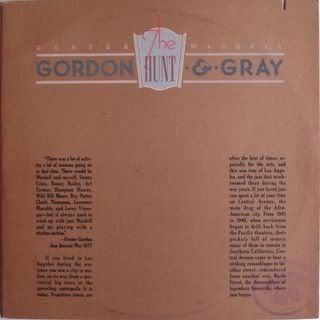
Dexter Gordon & Wardell Gray - The Hunt

Many thanks to Billy K for sending this Savoy Jazz double LP to post here.

Each of the four tracks occupied one side of the original album. They are jam sessions, principally tenor sax battles between Dexter Gordon and Wardell Gray, recorded live in front of an audience at the Brown Bomber, Los Angeles, in July 1947. Other musicians on the sessions include Howard McGhee, Trummy Young, Sonny Criss, Barney Kessel and Hampton Hawes.

Billy K has included scans of the album art, featuring an essay by Ross Russell which wonderfully evokes the Central Avenue scene in Los Angeles and the arrival of bebop on the West Coast.

The original rip from vinyl is in m4a format (160 kbps) and can be downloaded from Billy K's link here:

link deleted by mediafire

I used the freeware program Any Audio Converter to produce an mp3 version (192 kbps ) which you can download from here:

http://www17.zippyshare.com/v/27721171/file.html

1. Disorder At The Border
2. Cherokee
3. Byas-a-Drink
4. The Hunt