Be Bop Wino Pages

Joan Selects - the complete Joan Selects Collection

Big Ten Inchers - 78rpm rips by El Enmascarado


Attention Mac Users!

Mac users have been experiencing problems in unpacking the WinRAR archives used on this blog. Two solutions have been suggested.

1. Use The Unarchiver - www.theunarchiver.com - see comments on Little Esther Bad Baad Girl post for details.

2. Use Keka - http://www.kekaosx.com/en/ - see comments on Johnny Otis Presents post.

Showing posts with label Jumpin' On 78. Show all posts

Wednesday, 12 November 2014

Tiny Bradshaw LPs and those mighty 78s


It seems fitting to post the new links to 2 Tiny Bradshaw LPs as three of our recently featured tenor sax men had spells in his band - Red Prysock, Sil Austin and Noble Watts.

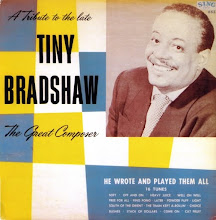
The main post on Tiny is about the King LP "A Tribute To The Late Tiny Bradshaw, The Great Composer." This magnificent post which is guaranteed to treble your brainpower, increase your vocabulary tenfold and transform you into the hippest character in your neighbourhood (if you aren't already) can be found here:

http://bebopwinorip.blogspot.co.uk/2009/01/tribute-to-late-tiny-bradshaw-great_03.html

Not only do you get a fantastic LP to download, you also get biographical details and a pile of scans of labels and EP covers from Joan.

For those of you with a short attention span or who are already at the top of the hipness scale, the new download link for "The Great Composer" is:

Tiny Bradshaw The Great Composer (Mega)

The Krazy Kat LP "Stomping Room Only" can be found at:

http://bebopwinorip.blogspot.co.uk/2009/10/tiny-bradshaw-stomping-room-only.html

There is some duplication of tracks with "The Great Composer" but there are enough dynamite extras such as "T-99" and "Walk That Mess" to make it well worth your while downloading both albums.

The new download link for "Stomping Room Only" is:


Tiny Bradshaw Stomping Room Only (Mega)


We mustn't forget 3 superb 78s that El Emascarado ripped and sent in. These posts are well worth investigating for the streaming audio, label shots, and insights of El Enmascarado ( a real musician as well as failed Mexican wrestler). These posts can be found at:

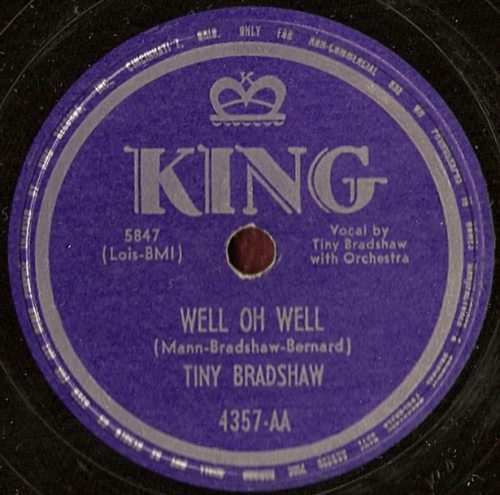
Well Oh Well / I Hate You


http://bebopwinorip.blogspot.co.uk/2011/03/well-oh-well-tiny-bradshaw.html

South of the Orient / Later


http://bebopwinorip.blogspot.co.uk/2012/10/south-of-orient-later-tiny-bradshaw-his.html

Walkin' The Chalk Line / Bradshaw Boogie


http://bebopwinorip.blogspot.co.uk/2012/11/walkin-chalk-line-bradshaw-boogie-tiny.html

These tracks were featured in the downloadable series "Jump & Jive On 78".

Friday, 10 May 2013

Cocktails For Two / Walkin' Home - Arnett Cobb (Okeh 6823)


Personnel: Willie Moore (trumpet); Dickie Harris (trombone); Arnett Cobb (tenor sax); Johnny Griffin (baritone sax); George Rhodes (piano); Walter Buchanan (bass); Al Walker (drums).
Recorded in New York, August 7th, 1951. Released in early October 1951.

Listen to "Cocktails For Two"

Listen to "Walkin' Home"

Billboard review from 6th October, 1951:

"Walkin' Home" - "Cobb's sharp combo drives fluidly through an easy riffer akin to "Smooth Sailing." The leader blows up a mess of tenor. There's as much jazz appeal here as there is danceability for juke players."

"Cocktails For Two" - "Group opens and closes with a pulsing Latin beat and swings out in between with Cobb's tenor pulsing all the way. A fine disking, well recorded, which could stimulate action."

Arnett Cobb belongs to the legion of legendary Texas tenormen. Born in Houston in 1918, Cobb started out in the local bands of Frank Davis and Chester Boone from where he was recruited in 1936 by Milt Larkin who led an aggregation which soon achieved a formidable reputation throughout the Southwest territory and beyond. Larkin's reed section featured Cobb and Tom Archia on tenor sax and Illinois Jacquet and Eddie "Cleanhead" Vinson on alto. Jacquet left in 1939, moving to California where he eventually joined the new Lionel Hampton big band on tenor sax. Vinson left at the turn of 1941/42 to join the Cootie Williams Orchestra after Cootie had attempted to lure Arnett Cobb away from Larkin.

Count Basie also tried to sign Cobb who remained with the Larkin outfit until 1942 when he replaced Illinois Jacquet (who had joined the Cab Calloway Orchestra) in Lionel Hampton's band. Cobb's big, big toned tenor was heard to brilliant effect in Hamp's 1944 version of "Flying Home", known as "Flying Home No. 2." Other showcases for Cobb included "Cobb's Idea" and "Adam Blew His Hat."

In early 1947 Arnett Cobb left the Hampton orchestra, formed his own small combo and signed for Apollo Records. His best selling disc for that label was a two part version of "When I Grow Too Old To Dream," the first part being an affecting instrumental while the second part featured exaggeratedly hep vocals. Arnett's career came to a temporary halt in early 1948 due to a failed spinal operation. He didn't start recording again until September 1950 when he began a two year stint with Columbia and its Okeh subsidiary. His most successful release at this time was "Smooth Sailing" from his first Columbia session. In 1953 he moved to Mercury Records, in 1954 - 55 he had three releases on Atlantic and in early 1956 he cut "No Dues" / "Slats" for Vee-Jay.

Swingin' Cobb - William Gottlieb collection
His name misspelled in lights - William Gottlieb collection
Misfortune intervened again, this time in the shape of a crash while driving the band bus. Arnett's injuries kept him from recording for three years and forced him to use crutches for the rest of his life. However in 1959 he resumed his recording career with jazz label Prestige,  recording a series of albums (1959 - 60) which included a powerhouse set with Lockjaw Davis. He continued to record until the year before his death in 1988.

With thanks as ever to El Enmascarado for his sterling work in reviving this 78 rpm disc.

Recommended listening for Arnett's early small group sides - "A Proper Introduction To Arnett Cobb - The Wild Man From Texas" (Proper Intro CD 2070).

Monday, 4 March 2013

Jump & Jive On 78 - Volume 3


It's time to gather together the latest selection of El Enmascarado's 78 rpm rips in downloadable form. We proudly present Volume 3 of our series of "Jump & Jive On 78" virtual LPs. If you dig your R&B on the jazzy side, then this is the collection for you.

Click on the artist names in the labels section to find out more about these tracks. The download includes a folder of label scans.

Download from here:

http://www24.zippyshare.com/v/28763255/file.html

No password

Track list:

1 Calvin Boze - Slippin' and Slidin'
2 Big John Greer - Hey Bruz
3 Gene Ammons - Dues In Blues
4 Tiny Bradshaw - Walking The Chalk Line
5 Red Saunders - Blow Mr Low Blow
6 Russell Jacquet - Lion's Roar
7 Sonny Thompson - Backyard Affair
8 Joe Liggins - How Come
9 Calvin Boze - Baby You're Tops With Me
10 Gene Ammons - Odd-En-Ow
11 Tiny Bradshaw - Bradshaw Boogie
12 Russell Jacquet - Suede Jacket
13 Big John Greer - Tonight's The Night
14 Tiny Grimes - Flying Home Part 1
15 Tiny Grimes - Flying Home Part 2
16 Red Saunders - Lyin' Girl Blues
17 Joe Liggins - Worried
18 Sonny Thompson - Dreaming Again


Collect 'em all!


With thanks, as ever, to El Enmascarado.

Friday, 1 March 2013

Worried / How Come - Joe Liggins And His Honeydrippers (Exclusive 262)


Recorded in Los Angeles, probably at the end of 1947. Personnel: Little Willie Jackson (alto and baritone saxes); James Jackson (tenor sax); Joe Liggins (piano and vocal); Frank Pasley (guitar); Red Callender (bass); Peppy Prince (drums).


Exclusive 262 was released in March 1948 and reviewed in Billboard on the 13th of that month. Of "Worried" Billboard said, "Relaxed instrumental for more sophisticated race locations. Jackson Brothers on sax with Pasley's guitar provide smooth blend."

Billboard gave "How Come" higher ratings than "Worried." The review ran thus: "Band jumps with Leon Rene tune. Liggins handles vocal chore capably. Sax work excellent."

I agree with the Billboard review. "How Come" is an infectiously catchy jump tune with a tight arrangement and good sax breaks, especially by tenor man James Jackson. I really like it. "Worried" just doesn't do it for me, but judge for yourselves. This record didn't get into the race music chart. The biggest hit for Joe in 1948 was "Darktown Strutters' Ball." Although Billboard refers to the "Jackson Brothers", Little Willie Jackson and James Jackson were in fact unrelated.

Thanks to El Enmascarado for yet another slice of shellac!

Sunday, 24 February 2013

Blow "Mr. Low-Blow" / Lyin' Girl Blues - Red Saunders and his Orchestra (Columbia 30218)


Recorded in Chicago, June 15th, 1950. Personnel: Hot Lips Page, Sonny Cohn (trumpets); Harlan Floyd, John Avant (trombones); Porter Kilbert (alto sax); Leon Washington (tenor sax); McKinley Easton (baritone sax); Earl Washington (piano); Jimmy Richardson (bass); Jumpin' Joe Williams (vocal); Sonny Blount (arranger).


Once more we thank El Enmascarado for the rips and label shots from this deejay special issue of a fine 78 rpm disc by Red Saunders, featuring some great blues shouting by Joe Williams. Band leader and drummer Red Saunders was a prominent performer and recording artist on the Chicago jazz and R&B scene from the late 1930s until the late 1960s. He backed T-Bone Walker on his early recordings for Rhumboogie and Mercury and also played on some of Big Joe Turner's sessions for National. As named artist, Red recorded for Savoy in 1945, Sultan in 1946, Score in 1947 and Supreme in 1948.

In June 1950, Red started recording for Columbia, this disc being the only one he released on that label, the rest of his Columbia recordings being released on their Okeh subsidiary with whom he stayed until 1953. His only hit came in 1952 - "Hambone" released on Okeh 6862, credited to Red Saunders and his Orchestra with Dolores Hawkins and the Hambone Kids. Joe Williams performed live with the Red Saunders band in Chicago, particularly at the Club DeLisa which was the home base for Red for many years. He also featured on many of Red's recordings for Columbia and Okeh. In 1954 he joined the Count Basie band with whom he achieved stardom.

The above is the briefest of outlines of part of Red Saunders' career. There is much, much more to be found at the incredible Red Saunders Research Foundation website which explores the Chicago R&B scene in tremendous depth. The article on Red Saunders can be found here.

At the Club Delisa, 1942.

Photograph: Jack Delano. One of a series of 10 now at the Library of Congress website:

 http://www.loc.gov/pictures/search/?q=delisa&sg=true

Monday, 10 December 2012

Suede Jacket / Lion’s Roar – Russell Jacquet And His All Stars (King 4242)


Personnel: Russell Jacquet (trumpet); J.J. Johnson (trombone); Sonny Stitt (alto sax); Leo Parker (baritone sax); Sir Charles Thompson (piano); Al Lucas (bass); Shadow Wilson (drums)

Both sides were recorded at United Sound Studios, Detroit, in May or June, 1948.

The recordings were made for the Sensation label which was owned by Bernard Besman. The Billboard issue of June 19th 1948 carried an article on the purchase of 64 Sensation masters by King Records. The purchase included sides by Todd Rhodes, “Lord Nelson”, Milt Jackson and Russell Jacquet. “Suede Jacquet” / “Lion’s Roar” was released on King 4242 at the end of July or beginning of August 1948. The same record was also released on Sensation 8.


Russell Jacquet was the elder brother of tenor sax giant Illinois Jacquet, in whose band he played trumpet and contributed vocals from 1945 until 1953. During this period he also recorded occasionally as a band leader in his own right, beginning in Los Angeles in 1945 with a group which included Calvin Boze in its line-up.
The session which produced “Suede Jacket” and Lion’s Roar” wasn’t the first time Russell had recorded in Detroit. In 1947 he recorded with Sonny Stitt and Sir Charles Thompson in a group led by Milt Jackson. In May / June 1948 three sessions featuring various line-ups were held by Sensation in Detroit. The first session was credited to “Lord Nelson and His Boppers”, in reality a group led by Sonny Stitt and Milt Jackson. The second session was by The Sonny Stitt Sextet which included Stitt, Milt Jackson, Russell Jacquet and Sir Charles Thompson.

The third session was credited to “Russell Jacquet and His All-Stars.” This was actually the Illinois Jacquet band minus Illinois, but with Sonny Stitt added. Two discs resulted from this session – “Suede Jacket” / “Lion’s Roar” and “Scamparoo” / “Relaxin’ With Randel” (King 4259 and Sensation 12).

“Suede Jacket” is a nice bop workout with solo space given to Stitt, Johnson, Parker, Jacquet and, very briefly, Thompson. “Lion’s Roar” is a rousing showcase for the big bad baritone sax of Leo Parker. This session was a reunion for half of the Unholy Four sax section of the bop-leaning Billy Eckstine big band, Sonny Stitt and Leo Parker both being former members, along with Dexter Gordon and John Jackson.
Many thanks to El Enmascarado for putting the BeBop into the Wino with this 78 disc!

Sources - Bruyninckx  Discography. Sleevenotes by Joop Visser to 4CD set on Proper, "Sonny Stitt - Sax O' Bebop." The May / June 1948 Sensation sessions are included in the set.

Saturday, 1 December 2012

Baby, You’re Tops With Me / Slippin’ And Slidin’ – Calvin Boze and His All-Stars (Aladdin 3086)


“Baby, You’re Tops With Me” was recorded in Los Angeles on January 13th, 1950. Probable personnel: Calvin Boze (vocal); Floyd Turnham (alto sax); Don Wilkerson (tenor sax); Chuck Walker (baritone sax); Willard McDaniel (piano); Ulysses Livingstone (guitar); Bill Cooper (bass); Walter Murden (drums)

“Slippin’ And Slidin’” was recorded in Los Angeles on January 15th, 1951. Personnel: Calvin Boze (trumpet and vocal) with possibly Marshall Royal (alto sax); Maxwell Davis (tenor sax) plus unknown baritone sax, piano, guitar, bass and drums. Possibly Scatman Crothers with vocal ensemble.


Aladdin 3086 was released at the beginning of May 1951. It was reviewed in Billboard on May 5th. The verdict on “Baby You’re Tops with Me” was – “Shuffle boogie novelty drives, with Boze doing a Louis Jordan on the lyrics, of which he sings a couple of choruses.” The B-Side, “Slippin’ And Slidin’” was given a higher rating and more positive review – “Boze projects an engaging set of novelty lyrics infectiously, while combo puts down a swingy, medium shuffle. Could click.”

Both these sides are obviously heavily influenced by Louis Jordan. I find myself in agreement with Billboard – “Slippin’ And Slidin’” is a funny (and gloriously politically incorrect) account of the joys of dancing (?) with big boned women.  Somehow one night Calvin finds himself in a shabby joint on the wrong side of town - “… A big fat chick walked up and said ‘come on baby, and dance with me.’” Who could possibly resist such an invitation? “That big fat chick knew all the tricks, she’s got me in a spin …” In fact there’s nothing for it but to go back again the following night for another close encounter with the energetic large dame.
“Baby You’re Tops With Me” is another good jump blues but it doesn’t quite hit the spot the way “Slippin’ And Slidin’” does. The two sides were recorded almost exactly a year apart with different personnel, but they both feature fantastically tight arrangements and playing. Despite this, the record didn’t chart. Dominating the Billboard Rhythm And Blues chart in May 1951 were “Black Night” by Charles Brown, “Lost Love” by Percy Mayfield, “Teardrops From My Eyes” by Ruth Brown and “Rockin’ Blues” by Johnny Otis, featuring Mel Walker.

For much more on Calvin Boze, please read the post “Choo Choo’s Bringing My Baby Home.”

A big thank you to El Enmascarado for providing the rips and scans from a 60 year old 78 rpm shellac disc. Once again the sound quality is remarkably clear and a testament to the work put in on these artefacts from the great years of R&B.

Sunday, 25 November 2012

Walkin’ The Chalk Line / Bradshaw Boogie – Tiny Bradshaw (King 4457)


“Walkin’ The Chalk Line” was recorded in Cincinnati on February 8th, 1950. Personnel : Tiny Bradshaw (lead vocal); Jimmy Robinson piano); Clarence Mack (bass); Calvin Shields (drums). Also present at the session, but sitting this track out, were Leslie Ayres (trumpet); Orrington Hall (alto and baritone sax); Rufus Gore (tenor sax) and Leroy Harris (guitar).
“Bradshaw Boogie” was recorded in New York on January 16th, 1951. Personnel: Tiny Bradshaw (vocal); Leslie Ayres (trumpet); Andrew Penn (trombone); Orrington Hall (alto and baritone sax); Red Prysock (tenor sax); Jimmy Robinson (organ); Willie Gaddy (guitar); Eddie Smith (bass); Calvin Shields (drums).


King 4457 was released in mid-June 1951. The disc was reviewed in Billboard on June 30th. Of “Walkin’ The Chalk Line” Billboard said – “Bradshaw and male trio, backed by rhythm section only here, register with a hard-hitting little jingle with a recurring refrain.” And on “Bradshaw Boogie” the comment was: “Tiny and the boys come thru with one of their typical hard driving boogie blues novelties.”

“Walkin’ The Chalk Line” wasn’t a big seller despite being featured in the King / Federal / DeLuxe adverts in Billboard during July and August alongside Lucky Millinder’s “I’m Waiting Just For You,” “Sleep” by Earl Bostic, “Bloodshot Eyes” by Wynonie Harris, “Sixty Minute Man” and “Do Something For Me” by The Dominoes and Roy Brown’s “Wrong Woman Blues.”

Enough platters were sold to make King 4457 the 90th best-selling R&B record of 1951. The really big hits around the middle of the year included the aforementioned “I’m Waiting Just For You,” “Sixty Minute Man” and “Do Something For Me” plus “Don’t You Know I Love You” by The Clovers, “Chains Of Love” by Big Joe Turner, “Rocket 88” by Jackie Brenston and “Too Young” by Nat King Cole.

The “Bradshaw Boogie” session marked Red Prysock’s recording debut with the band and his fiery, rabble rousing tenor sax solo really brings what could have been a formulaic side to life.


As always we have El Enmascarado to thank for yet another slice of R&B history from his growing stash of 78 rpm discs. The sound quality on these two rips is remarkable, considering that they originate from shellac that is over sixty years old. I’ve been listening to these sides on my new laptop (a necessary buy after my 11 year old Pentium 4 PC took its final, fatal crash) which I’ve hooked up to my hifi and they pack quite a wallop. Thank you, o masked one!

Saturday, 10 November 2012

Odd-En-Dow / Dues In Blues - Gene Ammons And His Orchestra (Mercury 8080)


"Odd-En-Dow" was recorded on December 1st, 1947 and "Dues In Blues" was recorded on December 10th, 1947. Both sides were recorded in Chicago.

Personnel: Gail Brockman (trumpet); John "Raps" Dungee (alto and baritone sax); Gene Ammons (tenor sax); Junior Mance (piano); Gene Wright (bass); Ellis Bartree (drums)

Mercury 8080 was released in May 1948.


Billboard reviewed the disc in its Race Records section on May 8th, 1948. "Odd-En-Dow" was a "light bop riffer, with string of fair solo rides" while "Dues In Blues" received the slightly off hand comment: "instrumental with more bop touches."

Gene Ammons was the son of renowned boogie woogie piano man Albert Ammons. He played tenor sax in his school band, and got his first professional gig with the King Kolax band. His subsequent spell with Billy Eckstine's bop-leaning big band shot him to fame, most memorably on the searing tenor sax battle with Dexter Gordon, "Blowing The Blues Away." In 1947 he left the Eckstine outfit to start a solo recording career on Mercury. He had a hit with "Red Top" (Mercury 8048) and recorded a series of fiery bop sides for the label in 1947 and 1949 before signing for Chess for whom he had another big chart hit in 1950 with "My Foolish Heart." He had brief spells with Woody Herman and Count Basie before forming the legendary Gene Ammons - Sonny Stitt combo. But that may be another story for another post.

With many thanks to El Enmascarado  for ripping these sides from an original 78 rpm disc and for the label scans.

Sunday, 28 October 2012

Jump & Jive On 78 - Volume 2


Side 1
1 Headhunter – Johnny Otis
2 Later – Tiny Bradshaw
3 Sing Rebop – Doles Dickens
4 Miss Betty’s Blues – Joe Liggins
5 The Honeydripper Pt 1 – Sammy Franklin
6 The Honeydripper Pt 2 – Sammy Franklin
7 Big Fat Mama – Mystery Artist
8 The Blues – Joe Liggins
9 The Mojo – Sax Mallard

Side 2
1 Blow Mr Jackson – Joe Liggins
2 Cool And Easy – Johnny Otis
3 South of the Orient – Tiny Bradshaw
4 Lover’s Lament – Joe Liggins
5 P.S. I Love You – Mystery Artist
6 Cotton Ball Pt 1 – Sonny Thompson
7 Cotton Ball Pt 2 – Sonny Thompson
8 Let’s Love Again – Sax Mallard
9 Don’t Move a Vip Till I Say Vop – Doles Dickens

We proudly present the second round up of  El Enmascarado’s rips from original R&B 78 rpm discs. The mood is more relaxed and cooler than on the somewhat more heated Volume One of the series, with the exception of the opening blaster, “Headhunter” by Johnny Otis. There’s plenty swingin’ and jivin’ for you cool cats which you can download from here:


A folder of label scans is included in the download.

Ripped from shellac at 128 kbps.

All the info on all the tracks is available on the original posts on Be Bop Wino. Here are the links to unfathomable depths of arcane knowledge:


With many, many thanks to El Enmascarado for his work in rescuing these original ten inchers, many of which are in very poor condition. Volume Three is already shaping up, with a few of its tracks already posted and more in the pipeline. Stay cool, you swing, jump and jive fans!

Sunday, 7 October 2012

South of the Orient / Later – Tiny Bradshaw, His Piano and Band (King 4664 Dee Jay Special)


Both sides were recorded in Cincinnati on July 29th, 1953. Personnel: Bill Hardman (tp); Andrew Penn (tb); Sil Austin, Rufus Gore (ts); Jimmy Robinson (p); Sam Jones (b); Philip Paul (d)

The record was released in October, 1953. Sil Austin made his recording debut for the Bradshaw band at this session, having replaced Red Prysock who left earlier in the year to start a successful solo career. Thanks are due to El Enmascarado for unearthing this 78 rpm disc.


El Enmascarado comments: “South Of The Orient/Later by Tiny Bradshaw is on a white label promo/DJ copy. Although it looked pristine and pretty much unplayed, it had more surface grit than I expected. That might possibly have something to do with the disc seeming to be made out of vinyl rather than shellac.

South Of The Orient is kind of Afro/Exotica with a mambo beat. It's mostly piano bass and drums, although the horns play quietly in a few spots.

Later is a more straight ahead jump number. The drummer plays brushes rather than sticks, which tend to give it a lighter feel.”

This disc was released after Tiny Bradshaw had enjoyed two substantial instrumental R&B chart hits in 1953 – “Soft” and “Heavy Juice.” Unfortunately “South Of The Orient” failed to live up to the success of the two preceding Bradshaw releases. It may be that “South Of The Orient” was a little too exotic and “jazzy” for the R&B crowd.

Billboard Magazine reviewed “South Of The Orient” thus: “This Oriental flavoured effort bears a close kinship to some of the work being turned out by the bopsters today, but the pulsating tempo and the bright drum work make it a listenable hunk of wax. Good for jazz jocks.”

As for “Later” Billboard commented: “The Tiny Bradshaw ork has a happy time with this riff instrumental that is more jazz than r&b. It swings and it should please a lot of the cats.”

Here’s your chance to hear the two numbers that made it big for Tiny Bradshaw in 1953. “Soft” was released in late 1952 and peaked at number 3 in the R&B charts, spending most of spring 1953 on the best selling list. “Heavy Juice” was a smaller hit, reaching number 9 in August 1953.


Sunday, 9 September 2012

Tonight’s The Night / Hey Bruz – Big John Greer and his Quartet (Sittin’ In With 518)


Both sides recorded in New York City in the second half of 1948. Exact recording date, personnel and date of release are unknown.

This one-off session for Bobby Shad’s Sittin’ In With label marked the recording debut of Big John Greer. Two singles resulted from the session – “Rockin’ With Big John” / “Wine-ola” (Sittin’ In With 510) plus the featured platter on this post which we can all enjoy thanks to El Enmascarado’s work in ripping these sides from the original 78 rpm shellac disc.

The Sittin’ In With date was something of a moonlight session for tenor sax player and vocalist Big John Greer who had arrived in New York City to join Lucky Millinder’s Orchestra as a replacement for Bull Moose Jackson who had embarked on a solo career. The Millinder outfit was under contract to RCA Victor and Greer’s first recording session with the band took place in January 1949. He sang on “Little Girl Don’t Cry” which was a number fifteen R&B hit, although it was heavily outsold by the Bull Moose Jackson version which reached number two in the charts.

Greer’s career followed a parallel path to that of his fellow saxophonist / vocalist Bull Moose Jackson when he started recording as leader of a small group called The Rhythm Rockers, which consisted of Millinder band members, in April 1949 for RCA Victor. When the Millinder band moved to King in 1950, Greer continued to record for Victor and subsequently its R&B subsidiary Groove until the mid 1950s. He recorded as a sideman for King, being on the Lucky Millinder / Wynonie Harris session which produced a storming version of Louis Prima’s “Oh Babe!” He was also on Bull Moose Jackson’s epic double entendre rocker “Nosey Joe” and recorded several sessions with fellow former Millinder vocalist Annisteen Allen.

We’ll be taking a look at Big John Greer’s output for Victor and Groove in an upcoming updated post of the “R&B In New York City” LP.

Thanks again to El Enmascarado for these rips which are in remarkably good sound quality.

Friday, 8 June 2012

Cotton Ball Parts 1 and 2 – Sonny Thompson (King 4729)


Recorded on May 21st, 1954 in Cincinnati. Personnel: Fred Clark (as); David Brooks (ts); Tommy Purkson (bar); Sonny Thompson (p); Clarence Kenner (g); James Royal (b); Robert Boswell (d). Released July, 1954.


Thanks to El Enmascarado for these rips from the original 78 rpm disc of this two part late night smoocher from Sonny Thompson. You can imagine these cool jazzy sounds coming out of a tavern juke box shortly before closing time. Perhaps the clientele have been listening to Big Joe Turner, Ruth Brown, The Midnighters, Fats Domino and Ray Charles. But the evening wears on and only a few hardened drinkers remain to hear this moody late night instrumental. That’s it, folks. We’re closing. Ain’t you got homes to go to?

Billboard Magazine reviewed “Cotton Ball” on July 17th, 1954: “Here’s a neat slow-blues instrumental item which is particularly danceable yet retains a retentive melody line. The strongly repetitious bass figure and drum backing spark the various solo efforts for a slick hunk of wax. For the jazz and r.&b. markets."

Sonny Thompson had several hits with slow instrumentals such as “Long Gone”, “Late Freight” and “Mellow Blues.” “Cotton Ball” wasn’t a big seller but as you can hear, it’s a fine atmospheric recording. For an overview of Sonny’s career (plus an LP to download) see this post:

  
You can listen to “Late Freight” ripped from El Enmascarado’s 78 rpm disc at this post:


Monday, 7 May 2012

Head Hunter / Cool And Easy – Johnny Otis Orchestra (Regent 1028)


“Head Hunter” was recorded in Los Angeles on the 23rd December, 1949. Probable personnel: Lee Graves, Don Johnson (trumpets); George Washington (trombone); Big Jay McNeely, Lorenzo Holden (tenor saxes); Walter Henry (baritone sax); Johnny Otis (vibes); Devonia Williams (piano); Pete Lewis (guitar); Mario Delagarde (bass); Leard Bell (drums)

“Cool And Easy” was recorded in Los Angeles on the 27th February, 1950. Personnel are as above except James Von Streeter replaces Big Jay McNeely on tenor sax and Redd Lyte is added on vocals.


Many thanks to El Enmascarado for this 78 rpm disc which was released in January 1951. Billboard reviewed “Head Hunter” favourably: “Walkin’ and honkin’ medium blues refers to ‘Pinetop’s BW’ for backdrop riffs. Striding tenor sax and heavy bottom, rocking beat set this lung buster up for at least moderate coin collection.”

The B side was reviewed thus: “Redd Lyte warbles a southern style blues chant with a strong ork backdrop. Fine beat helps throughout.”

Billboard, January 1951
Released initially on Herman Lubinsky’s secondary label Regent, rather than his Savoy label, “Head Hunter” failed to chart, possibly because the Otis band was still riding high in the charts with “Rockin’ Blues.” In 1950 the Johnny Otis Orchestra was the nation’s top selling R&B act mainly thanks to a series of hits featuring the vocal pairing of Little Esther and Mel Walker. “Cupid’s Boogie,” “Mistrustin’ Blues,” “Deceivin’ Blues,” and “Wedding Blues” were all big hits for the duo in 1950, along with “Dreamin’ Blues” and “Rockin’ Blues” (both featuring Mel Walker) and the biggest seller for the band, “Double Crossing Blues” (Little Esther and The Robins).

The band failed to maintain the same level of success in 1951, however, mainly due to disagreements with Herman Lubinsky, the notoriously tight-fisted honcho of Savoy and Regent. In late 1950, Ralph Bass, the Savoy A&R man on the West Coast was lured away by Syd Nathan of King Records who set him up with his own subsidiary label, Federal. One of the first signings made by Bass for the new label was Little Esther who began recording for Federal in late January 1951. Backing for her recordings through 1951 and 1952 was provided by a moonlighting Johnny Otis Orchestra which made their last recordings for Savoy in March 1951 and later signed for Mercury towards the end of the year.

Given such a background it was no surprise that the Johnny Otis Orchestra failed to reach the levels of success it had achieved in 1950. There were only three chart entries for the group in 1951: “Rockin’ Blues” (released in late 1950), “Gee Baby” / “Mambo Boogie” and “All Nite Long.”


“Head Hunter” (a tribute to deejay Hunter Hancock) may have failed to chart but as you can hear, it’s a tremendous instrumental featuring great guitar work from Pete Lewis followed by screeching sax by Big Jay McNeely and all underpinned by driving horns and brass. There is some doubt as to the personnel performing on the number. Both Bruyninckx and the jazzdisco.org website list the band as consisting of only one horn player, Big Jay McNeely, plus vibes, piano, guitar, bass and drums. As you can hear on this post, however, it’s pretty obvious that there is more than one sax plus brass present on the track.

Our benefactor, El Enmascarado, says: “There's certainly more than one saxophone playing on Head Hunter- in the opening seconds, the huge saxophone "power chord" couldn't be less than two, and could easily be three. The lower note of the "power chord" is below the range of the tenor, and is a baritone sax.”

For “probable personnel” on the track, I’ve stuck with the complete band which was present at this session according to jazzdisco.org and ignored their suggestion that only Big Jay plus rhythm played on “Head Hunter.” Of course there is always the possibility that it isn’t Big Jay but James Von Streeter or Lorenzo Holden on lead tenor sax here.

Big Jay McNeely
Big Jay had started his recording career with the Johnny Otis Orchestra on Excelsior in 1948 before going solo on Savoy in late 1948 and then Exclusive in the first half of 1949. However in late 1949 and early 1950 Big Jay is credited on sitting in with the Otis band on several sessions, perhaps because regular Otis honker Von Streeter was becoming unreliable due to “lifestyle issues.” Moreover at the time of this session Big Jay was “between” recording commitments as Exclusive was about to go out of business and he was about a month away from signing with Aladdin. So let’s stick with Big Jay. Judge for yourselves!

Redd Lyte
The B-side “Cool And Easy” is another excellent track with fine blues guitar from Pete Lewis and a fine vocal from shouter Redd Lyte. Both Lewis and Lyte had graduated to the Otis band via the talent show at The Barrelhouse Club where Otis had a long standing residency. All in all this is a first class record with two strong sides. Thanks again to El Enmascarado for his rips from shellac (in very good sound quality) and label scans.

We’re not quite finished yet! Here’s a little bonus streaming audio playlist of Big Jay McNeely’s other tribute to Hunter Hancock – “Hoppin’ With Hunter” recorded for Exclusive in April 1949. Also present is a track recorded by James Von Streeter & His Wig Poppers for the small Scoop label in August 1949. The similarity to Big Jay’s style is remarkable. Keep on honkin’ and bluesin’, Be Bop Winos!


Thursday, 3 May 2012

Blow Mr. Jackson / The Blues - Joe Liggins & His Honeydrippers (Exclusive 244)


Recorded in Los Angeles in the second half of 1946. Released in June 1947. Personnel: Joe Darensbourg (clarinet); Little Willie Jackson (alto sax, baritone sax); James Jackson (tenor sax); Joe Liggins (piano, vocal); Frank Pasley (guitar); Red Callender (bass); Peppy Prince (drums)

Thanks to El Enmascarado and his ever growing mountain of shellac, we can enjoy listening to this 78 rpm disc by Joe Liggins.


“Blow Mr Jackson” was Joe’s big hit of 1947, following in the wake of “The Honeydripper” in 1945 and “I’ve Got A Right To Cry” and “Tanya” in 1946. Exclusive Records was the top selling R&B independent label in 1947 thanks in part to Joe’s record sales but mainly thanks to Johnny Moore’s Three Blazers who had two bigger hits with “New Orleans Blues” and “Merry Christmas Baby.”

Billboard, 16th August 1947
Exclusive was the 5th biggest R&B selling label of 1947, with the top four places being taken by major labels Decca, Capitol, Mercury and RCA Victor. Decca’s domination was largely due to the enormous popularity of Louis Jordan whose “Ain’t Nobody Here But Us Chickens” / “Let The Good Times Roll” was the year’s top selling R&B record. Other big sellers for Louis in 1947 were “Boogie Woogie Blue Plate,” “Jack, You’re Dead,” “Texas And Pacific,” “Open The Door, Richard!” and “Early In The Mornin’”. Lionel Hampton and The Mills Brothers were also successful for Decca.

Capitol’s big selling artists were Julia Lee, Nellie Lutcher and Nat “King” Cole. Mercury’s R&B success was mostly due to Eddie “Cleanhead” Vinson’s “Old Maid Boogie” / “Kidney Stew Blues” while RCA Victor had the Count Basie version of “Open The Door, Richard!” and “Hawk’s Boogie” by Erskine Hawkins to thank for their position as 4th top selling R&B label.

Major label dominance of R&B sales would come to an end in 1948 when King became the top selling label thanks to big sales for Bull Moose Jackson, Lonnie Johnson and Wynonie Harris.

Thanks once more to El Enmascarado for providing the opportunity to post this snapshot from the rapidly developing R&B scene of the late 1940s.

Thursday, 5 April 2012

The Honeydripper, parts 1 & 2 - Sammy Franklin and His Atomics (Black & White 101)


Recorded in Los Angeles and released in late August 1945. Personnel - Sammy Franklin (trumpet); Len Talley (vocal); remainder unknown.


This disc was one of a number of cover versions of Joe Liggins' huge hit "The Honeydripper." There were more successful covers by Jimmie Lunceford, Roosevelt Sykes and Cab Calloway but what makes this version especially interesting is Sammy Franklin's connection with Joe Liggins and with the genesis of  "The Honeydripper."

At the beginning of the 1940s Joe was a member of Sammy Franklin's band, The California Rhythm Rascals. Joe wrote "The Honeydripper" and started performing it with Sammy's band. He offered Sammy co-composer rights if he would front up $500 to cover the cost of recording the song but Sammy turned him down. Joe left and formed his own small jump band, The Honeydrippers, recorded his song for Leon Rene's Exclusive Records and the rest is, as they say, history.

"The Honeydripper" by Joe Liggins and His Honeydrippers was released towards the end of April 1945 and became one of the biggest R&B hits of all time. Five months later we find Sammy releasing a version with a small jump group with the then topical name "The Atomics." But it was too late for Sammy. The Honeydripper juggernaut had long disappeared over the horizon and was now well out of reach. There's a lesson there for us all.

With thanks to El Enmascarado for this rare 78 rpm disc. More jumpin' and jivin' on 78!

Billboard, 15th September 1945