Be Bop Wino Pages

Joan Selects - the complete Joan Selects Collection

Big Ten Inchers - 78rpm rips by El Enmascarado


Attention Mac Users!

Mac users have been experiencing problems in unpacking the WinRAR archives used on this blog. Two solutions have been suggested.

1. Use The Unarchiver - www.theunarchiver.com - see comments on Little Esther Bad Baad Girl post for details.

2. Use Keka - http://www.kekaosx.com/en/ - see comments on Johnny Otis Presents post.

Showing posts with label Kansas City. Show all posts

Saturday, 16 May 2020

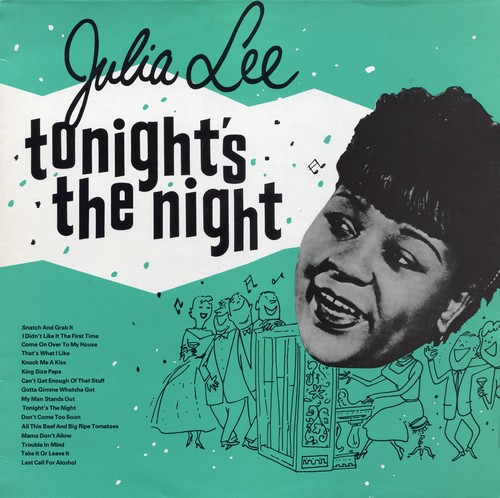
Julia Lee - Tonight's The Night


Side 1:
01) Snatch And Grab It
02) I Didn't Like It The First Time
03) Come On Over To My House
04) That's What I Like
05) Knock Me A Kiss
06) King Size Papa - Julia Lee
07) Can't Get Enough Of That Stuff
08) Gotta Gimme Whatcha Got

Side 2:
01) My Man Stands Out
02) Tonight's The Night
03) Don't Come Too Soon
04) All This Beef And Big Ripe Tomatoes
05) Mama Don't Allow
06) Trouble In Mind
07) Take It Or Leave It
08) Last Call For Alcohol


As promised - more Julia Lee. This 1980s Charly collection includes 3 tracks which were hitherto unreleased - a cover of Louis Jordan's "Knock Me A Kiss" and 2 rather more salacious tracks, "Can't Get Enough Of That Stuff" and "All This Beef And Big Ripe Tomatoes".

The latter two tracks are good listens but perhaps the jukebox operators were heeding the warning that accompanied the Billboard review of "My Man Stands Out" / "Don't Come Too Soon" (see below) and Capitol decided to hold back on the double entendre stuff.

In a way it's a shame that Julia came to be associated almost exclusively with such material as she was a fine performer not only in the classic Kansas City blues vein, but could also put ballads and pop material across. See her performance of "Trouble In Mind" for proof of her blues credentials.

Anyway, that's all I've got of Julia on vinyl, so download and enjoy before we move on to fresh fields.

Original Release Info (tracks listed in recording order):

Come On Over To My House / Trouble In Mind - Capitol 10030, part of Capitol Album "The History Of Jazz (Volume II) - The Golden Era" - Capitol CE-17 - Released in October 1945.

Gotta Gimme Watcha Got / Lies - Capitol 308 - Released in September 1946 - #3 Most-Played Juke Box Race Records, November 30th, 1946.

(Opportunity Knocks But Once) Snatch And Grab It / I Was Wrong - Capitol 40028 - Released in August 1947 - #1 Most-Played Juke Box Race Records, December 6th, 1947.

Mama Don't Allow It / Breeze (Blow My Baby Back To Me) - Capitol 1589 - Released in July 1951.

Knock Me a Kiss - first released on this LP.

The Glory Of Love / Take It Or Leave It - Capitol 57- 70006 - Released in May 1949.

King Size Papa / When You're Smiling (The Whole World Smiles With You) - Capitol 40082 - Released in January 1948. #1 Most-Played Juke Box Race Records in April 1948.

That's What I Like / Crazy World - Capitol 15060 - Released in April 1948.  #6 Most-Played Juke Box Race Records in May 1948.

I Didn't Like It The First Time (The Spinach Song) / Sit Down And Drink It Over - Capitol 15367 - Released in February 1949. #4 Most-Played Juke Box Race Records April 9th, 1949.

Tonight's The Night / After Hours Waltz - Capitol 57-70013 - Released in July 1949.

My Man Stands Out / Don't Come Too Soon - Capitol 1111 - Released in July 1950.

Billboard, July 29th, 1950
Can't Get Enough Of That Stuff - first released on this LP.

All This Beef And Big Ripe Tomatoes - first released on this LP.

Goin' To Chicago Blues / Last Call (For Alcohol) - Capitol 2203 - Released in August 1952.

Release information from Billboard, 45worlds.com and Discogs.com. More thrushes and bloozy chantoozies in the next post.

Thursday, 14 May 2020

Julia Lee - Party Time (Capitol LP T-228)


Side 1:
01) King Size Papa
02) Snatch and Grab It
03) You Ain't Got It No More
04) Tell Me Daddy
05) Last Call For Alcohol
06) I Was Wrong

Side 2:
01) Tonight's The Night
02) I Didn't Like It The First Time
03) Ain't It A Crime
04) Don't Save It Too Long
05) After Hours Waltz
06) My Man Stands Out


Many thanks to Marv for sending in this reconstituted 1955 Julia Lee Capitol LP. "Party Time" was first issued as a 10 inch LP (Capitol H228) in 1950. The 1980s brought a Pathe Marconi reissue of "Party Time" plus two more compilations of Julia's Capitol sides on Charly: "Tonight's The Night" and "Of Lions And Lambs" so no R&B revival party was complete without a few "naughty" tracks by Miss Lee and of course the hipper pubs would signal last orders with "Last Call For Alcohol."

It was quite the comeback for Julia Lee, but unfortunately she was not around to enjoy it, having died of a heart attack in Kansas City in 1958. Her career was remarkably long lived, starting during the roaring days of KC jazz. Her first recordings were made as pianist / vocalist with her brother George Lee's band back in the late 1920s. Stardom came late to Julia, when she hit the R&B charts with a series of suggestive songs in the late 1940s on the Capitol label.

Her first big success was in 1947 with "(Opportunity Knocks But Once) Snatch And Grab It" which was followed by "King Size Papa" in early 1948. What was noteworthy was that due to the salacious content of these discs, success was achieved without the support of radio play, but was rather due to jukebox plays and word of mouth. Of course to the pure all things are pure and the classic format of Miss Lee's discs included a brief intro which would set the song in a pefectly innocent context so that whatever followed was all in the mind of the listener.

There'll be more Julia Lee in the next post but in the meantime welcome to the world of king size papas and men who stand out! Thanks to Marv!

Naughty Original Issues:

All discs by "Julia Lee And Her Boyfriends"

(Opportunity Knocks But Once) Snatch And Grab It / I Was Wrong - Capitol 40028 - August 1947

King Size Papa / When You're Smiling (The Whole World Smiles With You) - Capitol 40082 - January 1948

Tell Me, Daddy / (It Will Have To Do) Until The Real Thing Comes Along - Capitol 15144 - July 1948

I Didn't Like It The First Time (The Spinach Song) / Sit Down And Drink It Over - Capitol 15367 - February 1949

Tonight's The Night / After Hours Waltz - Capitol 57-70013 - July 1949

Oh, Chuck It (In A Bucket) / You Ain't Got It No More - Capitol 57-70031 - September 1949

Don't Save It Too Long (The Money Song) / Ain't It A Crime? - Capitol 838 - February 1950

My Man Stands Out / Don't Come Too Soon - Capitol 1111 - July 1950

Goin' To Chicago Blues / Last Call (For Alcohol) - Capitol 2203 - August 1952

Issue information from 45worlds.com. Artwork from various sales sites and Discogs.com. Sounds from Marv.

Sunday, 5 June 2016

Jesse Price - Jump It With A Shuffle


Side A:
01. Jump It With A Shuffle
02. You Satisfy
03. Froggy Bottom
04. Kansas City Mama
05. You Can't Take It With You
06. I Ain't Mad At You
07. The Whirligig
08. Just Another Day Wasted Away

Side B:
01. Frettin' For Some Pettin'
02. Nagasaki
03. I'm The Drummer Man
04. That's The Way She Feels
05. Big Town Blues
06. My Baby Done Left Me
07. Tippin' Out (Creepin' And Peepin')
08. Blue Book Boogie
09. Baby, Let's Be Friends

Download from:


Session dates and personnel are listed on the LP cover. The Capitol sides were recorded in Los Angeles between July 1946 and November 1947. The Miltone side was recorded in 1948.

Additional discographical information:

01. Jump It With A Shuffle - Capitol 40047
02. You Satisfy - Capitol 295
03. Froggy Bottom - Capitol 40093
04. Kansas City Mama - Capitol 295
05. You Can't Take It With You - Capitol 391
06. I Ain't Mad At You - Capitol 348
07. The Whirligig - Capitol 15370
08. Just Another Day Wasted Away - Capitol 15370
09. Frettin' For Some Pettin' - Capitol 40093
10. Nagasaki - Capitol 40047
11. I'm The Drummer Man - Capitol 348
12. That's The Way She Feels - Capitol 40014
13. Big Town Blues - Capitol 391
14. My Baby Done Left Me - Capitol 15138
15. Tippin' Out (Creepin' And Peepin') - Miltone 5250
16. Blue Book Boogie - Capitol 40014
17. Baby, Let's Be Friends - Capitol 15138

Release dates:

Capitol 295: Kansas City Mama / You Satisfy - September 1946

Capitol 348: I Ain't Mad At You / I'm The Drummer Man - January 1947

Capitol 391: You Can't Take It With You / Big Town Blues - April 1947

Capitol 40014: That's The Way She Feels / Blue Book Boogie - July 1947

Capitol 40047: Jump It With A Shuffle / Nagasaki - October 1947

Capitol 40093: Frettin' For Some Pettin' / Froggy Bottom - March 1948

Capitol 15138: Baby Let's Be Friends / My Baby Done Left Me - July 1948

Capitol 15370: The Whirligig / Just Another Day Wasted Away - February 1949

Miltone 5250: Creepin' And Peepin' / (Just Before Sunrise by Buddy Floyd) - June 1949

Miltone 5250 was in the Billboard Advance Race Record Releases on June 18th 1949. The Jesse Price title was listed as "Tippin' In." Label shots of the actual release show the title as "Creepin' & Peepin'." The B Side, "Just Before Sunrise", was by Buddy Floyd.

See (and hear) this post for more on the Jesse Price / Buddy Floyd Miltone single:


We continue our West Coast jump theme with this 1987 Jukebox Lil LP featuring sides by singer / drummer Jesse Price. Or for "West Coast" in this case, read from Memphis to Kansas City and then on to California, thus picking up all the jazz and blues influences that such a musical journey brings. The sleevenotes by Dave Penny tell the fascinating story of Jesse Price's life, beginning in Memphis in 1909 and taking in spells playing with W.C. Handy, working on riverboat bands, backing Ma Rainey, Bessie Smith and Ida Cox and all that before Kansas City has been reached!

And as for K.C. well, just read the notes! Walter Page, Basie, Jay McShann, Harlan Leonard, oh, and the little matter of a small band featuring a 17 year old Charlie Parker. Then there's a spell with the late Chick Webb's band under the leadership of Ella Fitzgerald which brought Jesse to Los Angeles. Followers of this blog will be in hog heaven reading about the life and times of Jesse Price.

The sides on this collection show the K.C. jazz and blues influence and the musicians in these small group lineups are top notch, including Billy Hadnott, Buddy Tate, Snooky Young, Gene Porter, Dave Cavanaugh and Paul Quinichette. The band on the final Capitol session (Baby Let's Be Friends / My Baby Done Left Me) has Dexter Gordon, Jimmy Guiffre, Red Callender and Barney Kessel, a jazz combo which sounds a bit uneasy on "My Baby Done Left Me" but which does very nicely on "Baby Let's Be Friends" thanks to ace solos by Dexter Gordon and Barney Kessel.

Saturday, 14 August 2010

Jay McShann and his Orchestra - Hootie's K.C. Blues


Side 1:
1. Hootie Blues
2. Red River Blues
3. Confessin' The Blues
4. Vine Street Boogie
5. 'Fore Day Rider
6. Sepian Bounce
7. Hold 'Em Hootie
8. Swingmatism

Side 2:
1. The Jumpin' Blues
2. One Woman's Blues
3. Get Me On Your Mind
4. Dexter Blues
5. Hootie's Ignorant Oil
6. (New) Confessin' The Blues
7. Lonely Boy Blues
8. So You Won't Jump

In some of the upcoming posts I’ll be looking at the big band roots of R&B. Some of the LPs that were on the original Be Bop Wino blog will be re-posted and I’ll also be adding some new albums – and here’s the first of the new ones – the band that jumps the blues – The Jay McShann Orchestra out of Kansas City.

In the years 1926 to 1939, thanks to the corrupt rule of city boss Tom Pendergast, Kansas City remained relatively untroubled by technicalities like prohibition and city laws limiting bar opening hours. A multiplicity of clubs, bars, dance halls and bawdy houses provided just the right raucous environment for the growth of a flourishing jazz scene. Musicians from all over the Southwest and beyond were attracted to the bright lights and low down dives of this latter day Gomorrah (okay, I’m getting carried away here, but indulge me.)

There was Piney Brown’s Sunset Club where barman Big Joe Turner shouted the blues to the accompaniment of Pete Johnson’s boogie woogie piano. The Count Basie band squeezed itself on to the cramped stage of the Reno Club while a young Charlie Parker watched from the shadows as Basie and Walter Page and Walter’s half brother “Hot Lips” Page, and Herschel Evans and most of all Lester Young swung like crazy. And there were the jam sessions when visiting musicians with reputations to maintain would come up against locally based musicians all too determined to make their own mark. In 1934 Coleman Hawkins, then the acknowledged king of the tenor sax, took on the K.C. triumverate of Ben Webster, Herschel Evans and Lester Young in a mammoth session at the Cherry Blossom. Hawkins had to concede defeat with Young generally considered to be the winner.

Although a round-the-clock live music scene flourished in this Godless city of sin (carried away again, sorry), no parallel recording industry was established and artists who wished to record and become nationally known had to move North. In 1936 the record company talent scouts swooped and the exodus of talent began. From a scene which was dominated early on by Walter Pages’ Oklahoma Blue Devils and Bennie Moten’s Kansas City Orchestra, there issued forth Count Basie (whose band developed out of the Page and Moten outfits), Andy Kirk and His Twelve Clouds of Joy (with brilliant pianist and arranger Mary Lou Williams and sax giant Ben Webster), the duo of boogie pianist Pete Johnson and blues shouter Big Joe Turner, Hot Lips Page, Harlan Leonard’s Rockets (they picked up drummer Johnny Otis on their travels as they headed ever westwards after failing to make it in NYC) and one of the last to leave – the Jay McShann Orchestra.

Pianist Jay McShann was born in Muskogee, Oklahoma in 1909. The early part of his career was spent touring the Southwest and Midwest in various territory bands, but in 1937 he settled into the Kansas City scene, forming a small band which included Gene Ramey on bass and Gus Johnson on drums.

In 1939 the law finally caught up with Boss Pendergast and his cohorts who were carted off to prison on tax evasion and corruption charges, and as K.C. prepared to make the transformation from Godless to God fearing, the night time neon glare dimmed as many clubs and bars closed down, throwing a host of musicians out of work. Every cloud has a silver lining and Jay McShann, who had managed to raise the necessary financial backing, set about augmenting his septet and transforming it into a twelve piece big band. A rock steady Basie style rhythm section consisting of McShann (piano), Gus Johnson (drums), Gene Ramey (bass) and Lucky Enois (guitar) provided the basis for a powerful riff, boogie and blues based outfit.

Heading up the reeds section was young alto sax prodigy Charlie Parker. The band embarked on several gruelling tours of the South and Midwest and had its first recording session for Decca in Dallas in April 1941 (tracks 8, 1, 12, 4 and 3.)

The last addition to the band personnel before the session was blues shouter Walter Brown, for Decca producer Dave Kapp wanted the band to record the blues rather than show their jazz side. Indeed three of the sides (“Vine Street Boogie”, “Hold ‘Em Hootie” and “Confessin’ The Blues”) featured the rhythm section only, with a vocal contribution from Brown on “Hold ‘Em” and “Confessin’”. Parker was heard on “Swingmatism” and also on “Hootie Blues” which he co-wrote with McShann.

Of course it was “Confessin’ The Blues” which captured the record buying public’s imagination and it has become a blues standard, being subsequently revived by Chuck Berry, Little Walter and later by The Rolling Stones. The success of “Confessin’” led to Walter Brown’s vocals dominating the even more blues-drenched second session for Decca held in Chicago in November 1941 (tracks 2, 5, 10, 13, 14, 16.) Of the eight tracks recorded, all were Walter Brown vehicles with the exception of “So You Won’t Jump.”

The band was an extremely popular live act and proved itself to be a formidable opponent in band battles. In 1940 – 41 Earl Hines, Milt Larkin and Nat Towles were vanquished, but the McShann band had to give second best to Duke Ellington. When the band made its New York debut in early 1942 in a battle of the bands at The Savoy Ballroom against Lucky Millinder, the result was a resounding victory for Kansas City, possibly provoked by a pre-battle telegram sent by Millinder: “We’re gonna chase you hicks right back to the sticks.”


At the Savoy in early 1942.

During 1942 Jimmy Coe (baritone sax) was added to the personnel and on tenor sax Jimmy Forrest had a stint with the band, although he wasn’t on the July 1942 Decca recording session. That session did mark the recording debut of band ballad singer Al Hibbler on “Get Me On Your Mind” which turned out to be the only track he recorded with McShann. “Lonely Boy Blues” and “The Jumpin’ Blues” were Walter Brown vocal performances and “Sepian Bounce” was an all too rare opportunity for the whole band to show its jazz chops, with two solos from Charlie Parker. “The Jumpin’ Blues” is my favourite track on the album – a superb riffer with great piano intro from McShann, a solo from Parker and solid blues shouting from Brown.

After the recording session the band was scheduled to return to Kansas City, but Parker elected to remain in New York where he immersed himself in the jam session scene at Monroe’s Uptown House and Minton’s Playhouse. Towards the end of the year he joined the Earl Hines Orchestra along with two other refugees from the McShann band – John Jackson and Bernard Anderson. The time remaining to the Jay McShann Orchestra was marked by an increasingly high turnover in personnel, with many of the original KC musicians giving way to musicians from New York and Chicago.

The final Decca session took place in December 1943 with neither Gus Johnson nor Lucky Enois in the line up, although Paul Quinichette had been recruited on tenor sax. McShann was drafted in May 1944 and the band broke up. In early 1945 McShann briefly reformed the band but later in the year he moved to Los Angeles where he remained for the rest of the 1940s, achieving considerable success with small groups fronted by blues shouters Crown Prince Waterford and Jimmy Witherspoon.

Charlie Parker and Walter Brown represented the two opposing poles of the music that would develop from big band swing. One was the bebop genius who would become one of the greatest figures in twentieth century jazz, the other was the blues shouter who enjoyed early success which he never quite recaptured after the Jay McShann Orchestra split up. However, they shared a fondness for booze and heroin, an unfortunate enthusiasm which brought about their premature deaths – Parker in March 1955 and Brown in June 1956.


Ripped from vinyl at 320 kbps.

Download from here:


1. Hootie Blues (De 8559)*
2. Red River Blues (De 8595)
3. Confessin' The Blues (De 8559)*
4. Vine Street Boogie (De 8570)
5. 'Fore Day Rider (De 8635)*
6. Sepian Bounce (De 4387)
7. Hold 'Em Hootie (De 8583)
8. Swingmatism (De 8570)
9. The Jumpin' Blues (De 4418)*
10. One Woman's Blues (De 8607)*
11. Get Me On Your Mind (De 4418)**
12. Dexter Blues (De 8583)
13. Hootie's Ignorant Oil (De 8635)*
14. (New) Confessin' The Blues (De 8595)*
15. Lonely Boy Blues (De 4387)*
16. So You Won't Jump (De 8607)

* vocal = Walter Brown
** vocal = Al Hibbler

Recommended purchase:

From the Jazz Greats series – number 34 “Jazz City – Kansas City” magazine and CD now available as a download from Jazz Greats Online. 21 tracks including Walter Page’s Blue Devils, Benny Moten, Julia Lee, Big Joe Turner, Andy Kirk, Count Basie, Jay McShann, Harlan Leonard, Charlie Parker and others.


Recommended reading:

Bird Lives! by Ross Russell.
Big Band Jazz by Albert McCarthy