Side 1
1. Echoes Of Harlem
2. Things Ain't What They Used To Be (vocal – Eddie “Cleanhead” Vinson)
3. Tess' Torch Song (vocal – Pearl Bailey)
4. You Talk A Little Trash
5. Sweet Lorraine
6. Cherry Red Blues (vocal – Eddie “Cleanhead” Vinson)
7. 'Round Midnight
8. Is You Is Or Is You Ain't My Baby? (vocal – Eddie “Cleanhead” Vinson)
Side 2
1. Blue Garden Blues
2. Floogie Boo (vocal – Eddie “Cleanhead” Vinson)
3. I Don't Know
4. Gotta Do Some War Work (vocal – Cootie Williams)
5. My Old Flame
6. Now I Know (vocal – Pearl Bailey)
7. Somebody's Gotta Go (vocal – Eddie “Cleanhead” Vinson)
8. Honeysuckle Rose
Continuing our look at the big band roots of rhythm and blues, we come to the Cootie Williams Orchestra. This 1986 Affinity LP offers a fascinating mix of influences and trends with former Duke Ellington “growl” trumpet player Cootie Williams leading a band which included pioneer bop pianist Bud Powell, alto sax player and blues shouter Eddie “Cleanhead” Vinson, powerful tenor sax men Eddie “Lockjaw” Davis and Sam “The Man” Taylor, and future R&B bandleader Leroy Kirkland on guitar. And there’s the additional ingredient of the vocal presence of star of stage, screen and radio Pearl Bailey on what are among her earliest recordings.
Cootie Williams was born with the rather more mundane moniker of Charles Melvin Williams in Mobile, Alabama in 1910. The nickname “Cootie” originated in early childhood when his father got into the habit of calling “Cootie, Cootie” when young Charles was learning to walk.
Cootie began playing the trumpet in his early teens and at the age of 14 he spent summer touring with the Young family band. That’s Young as in young Lester Young who made his debut with his family group. Cootie turned pro in 1926, having spells with territory bands like that of Eagle “Eye” Shields and the Alonzo Ross Deluxe Syncopators. After a couple of years at this level Cootie moved to New York where he had brief spells with Chick Webb and Fletcher Henderson. In 1929 Cootie began an eleven year association with Duke Ellington during which he came to be regarded as the foremost trumpeter of his generation.
At the end of 1940 the world of jazz was rocked by Cootie’s sensational move from the Ellington band to Benny Goodman’s orchestra where he recorded with the full band and small groups featuring Lionel Hampton and Charlie Christian. Before 1941 was out however, Cootie was looking to lead his own big band. He took a trip down to Texas intent on enticing Arnett Cobb away from the territory band of Milt Larkin but instead it was Larkin's alto sax player Eddie Vinson who made the journey to New York to join the new band. Williams’ outfit was very much a blues-based dance band which suited Vinson who quickly became the star of the band’s appearances at the Savoy Ballroom and the Apollo Theatre.
The band’s first recordings were for Columbia / Okeh in April 1942 and included a version of Thelonius Monk’s “Epistrophy”, retitled “Fly Right.” Eddie Vinson was given a vocal outing on “When My Baby Left Me.”
The first AFM recording ban led to a delay before the next recording sessions were held on January 4th and 6th 1944 for the Hit/Majestic diskery. By now Eddie “Lockjaw” Davis and Bud Powell had joined the band. The sessions were split between small group and full band line ups and account for 12 of the 16 tracks on this LP. The remaining 4 tracks are from a full band session recorded for Hit/Majestic in August 1944, by which time Eddie “Lockjaw” Davis had been replaced by Sam “The Man” Taylor and Leroy Kirkland had joined the band.
The tracks include Ellingtonian swing (a revival of “Echoes of Harlem”), early bop (the first ever recording of Thelonius Monks’ “’Round Midnight”) and proto - R&B (Vinson’s “Cherry Red Blues” and a cover of Louis Jordan’s “Is You Is or Is You Ain’t?”)
In early 1945 Charlie Parker was brought in to replace Eddie Vinson who had been drafted but by the time the next recording session (for Capitol) came round at the end of May, 1945, Vinson was back for a rousing “Juice Head Baby.” Before the end of 1945 Vinson left to form his own big band and it has to be said that the Cootie Williams band was never quite the same again. And at this point the curtain falls on our humble post but you can follow the further fortunes of Cootie Williams and Eddie “Cleanhead” Vinson on subsequent posts. Stay tuned, you crazy swingsters!
Ripped from vinyl at 320 kbps.
Download from here:
http://www120.zippyshare.com/v/QH3DNNhx/file.html
Recorded in New York City for Hit/Majestic in January and August 1944.
1. Echoes Of Harlem (January 6, 1944)
2. Things Ain't What They Used To Be (January 6, 1944)
3. Tess' Torch Song (January 6, 1944)
4. You Talk A Little Trash (January 4, 1944)
5. Sweet Lorraine (January 6, 1944)
6. Cherry Red Blues (January 6, 1944)
7. 'Round Midnight (August 22, 1944)
8. Is You Is Or Is You Ain't? (August 22, 1944)
9. Blue Garden Blues (August 22, 1944)
10. Floogie Boo (January 4, 1944)
11. I Don't Know (January 4, 1944)
12. Gotta Do Some War Work (January 4, 1944)
13. My Old Flame (January 6, 1944)
14. Now I Know (January 6, 1944)
15. Somebody's Gotta Go (August 22, 1944)
16. Honeysuckle Rose (January 6, 1944)


 His replacement came from within the ranks of the band – tenor sax man Benjamin “Bull Moose” Jackson stepping forward to take up vocal duties. Unfortunately his singing doesn’t feature on this collection. He fronted a series of recordings on the Queen and King labels which were really Millinder band performances issued under a different name to get round the Decca contract. See the Be Bop Wino post

 “Jukebox Hits 1942-1951” on the Acrobat label (has it been revived?) is available both as a CD and mp3 collection on Amazon. It has 20 tracks including 2 under Bull Moose Jackson’s name. Recordings from Decca, RCA and King, including many not on the LP posted here. Go git it! The world needs to swing more.


 In October 1956 the album presented in this post was issued as a 12 inch LP with 13 tracks (Aladdin LP-801). Volume 2 (Aladdin LP-802) which also had 13 tracks was released at the same time. See below for cover scans:

 Tracks from the above two LPs were also issued on 3 EPs – Aladdin EPs 502, 503 and 513. See below for Joan’s EP 503 scan:
 In 1957 the two LPs were reissued with different titles and covers on Aladdin’s jazz/pop subsidiary Intro. Volume 1 became “Swinging Lester Young” (LP-602) and Volume 2 became “The Great Lester Young” (LP-603). In 1958 they were reissued on the Aladdin budget subsidiary Score (as SLP-4028 and SLP-4029) with the same covers and titles as the Intro issues. See below for Score cover scans:

 Subsequent releases of Lester Young Aladdin material on Imperial in the early 1960s were on two LPs (as two volumes of “The Great Lester Young”) with different tracks and covers.

 Blue Note CDP 7243 8 32787 2 5:


 Now that I’ve reacquainted myself with the album as I plough my way through the conversion of the Boogie Woody vinyl vault to a digital format, I find myself appreciating the sheer genius of the music contained in the unjustly neglected grooves. The Ray-O-Vacs’ sound is rooted in that of the jive groups of the late 1930s and the 1940s and is similar to that of other self contained vocal / instrumental outfits like The Red Caps or The Four Blazes.
 Of the Decca releases, only “Besame Mucho” (covered some years later by The Coasters and then by The Beatles) achieved noteworthy sales. The Ray-O-Vacs’ sound was rapidly becoming old fashioned as rockin' gospel-influenced vocal groups began to dominate the R&B market. The Dominoes and The “5” Royales especially were a world away from the comparatively staid Ray-O-Vacs who seemed to belong more to the world of The Charioteers or The Delta Rhythm Boys.

 Now I have to confess that I have no idea when Flap joined the Ray-O-Vacs or how long he stayed with them. Perhaps someone out there can fill in the blanks?

 Joan K has supplied a couple of label scans from Kaiser plus an issue on Sharp of “I’ll Always Be In Love With You”, which was the first Ray-O-Vacs’ recording to be issued, originally as a 78 rpm disc on Coleman in 1949. And as a final little treat from Joan there’s two m4a rips (plus mp3 conversions) from 78 rpm discs of “What’s Mine Is Mine” / “I Still Love You Baby”, originally released on Decca in 1950.
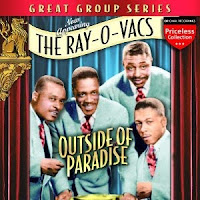 In the US two 22 track CDs were released on the Coleman label – “Besame Mucho” (Coleman 100) and “It’s Party Time with the Ray-O-Vacs” (Coleman 105). They’re probably just about impossible to find now.

 A jive group who managed to get a hit in 1952 were The Four Blazes, with “Mary Jo” on the United label. Their sound was similar to that of The Ray-O-Vacs, with tasteful sax fills supplied by Eddie Chamblee. A 24 track Delmark CD, “Mary Jo” (DE-704) is highly recommended by your boogster pal. Oh, and by the way, I haven’t a clue who is playing sax on The Ray-O-Vacs’ sides. Can anyone help?